

The Fuel Costs You Control but Rarely Think About
Most drivers focus on the obvious: gas prices, mpg ratings, and how far they drive. But a surprising share of what you spend at the pump is determined by small, repeatable decisions you make before you even leave the driveway. Whether the AC is on, what's strapped to the roof, or how long you let the car idle while answering a text — these choices compound over thousands of miles into real money.
This isn't about extreme hypermiling or sacrificing comfort. It's about understanding the actual cost of habits you might not have questioned. The U.S. Department of Energy and AAA have both published research quantifying these effects — and the numbers are worth knowing. For a broader look at how driving behavior connects to what you actually pay, see our guide to fuel economy and real-world running costs.
Running the Air Conditioning
Air conditioning is the most significant comfort-related fuel drain in a typical vehicle. The U.S. Department of Energy estimates that AC use can reduce fuel economy by 5–25%, with the largest impact felt during short trips, stop-and-go traffic, and in smaller vehicles where the engine is working harder relative to its displacement.
The compressor draws power directly from the engine. In a city driving scenario with frequent stops, that constant draw adds up fast. On the highway, the calculus shifts: above roughly 45–50 mph, closing the windows and running AC is generally more efficient than open windows, which create aerodynamic drag at speed. Below that threshold, windows down is usually the more fuel-efficient call on mild days.
Practical middle ground: use the recirculation setting when AC is on — it cools interior air rather than constantly pulling in hot outside air, reducing the compressor's workload.
AC use can cut fuel economy by up to 25% in stop-and-go traffic conditions.
Leaving a Roof Rack or Cargo Carrier Mounted
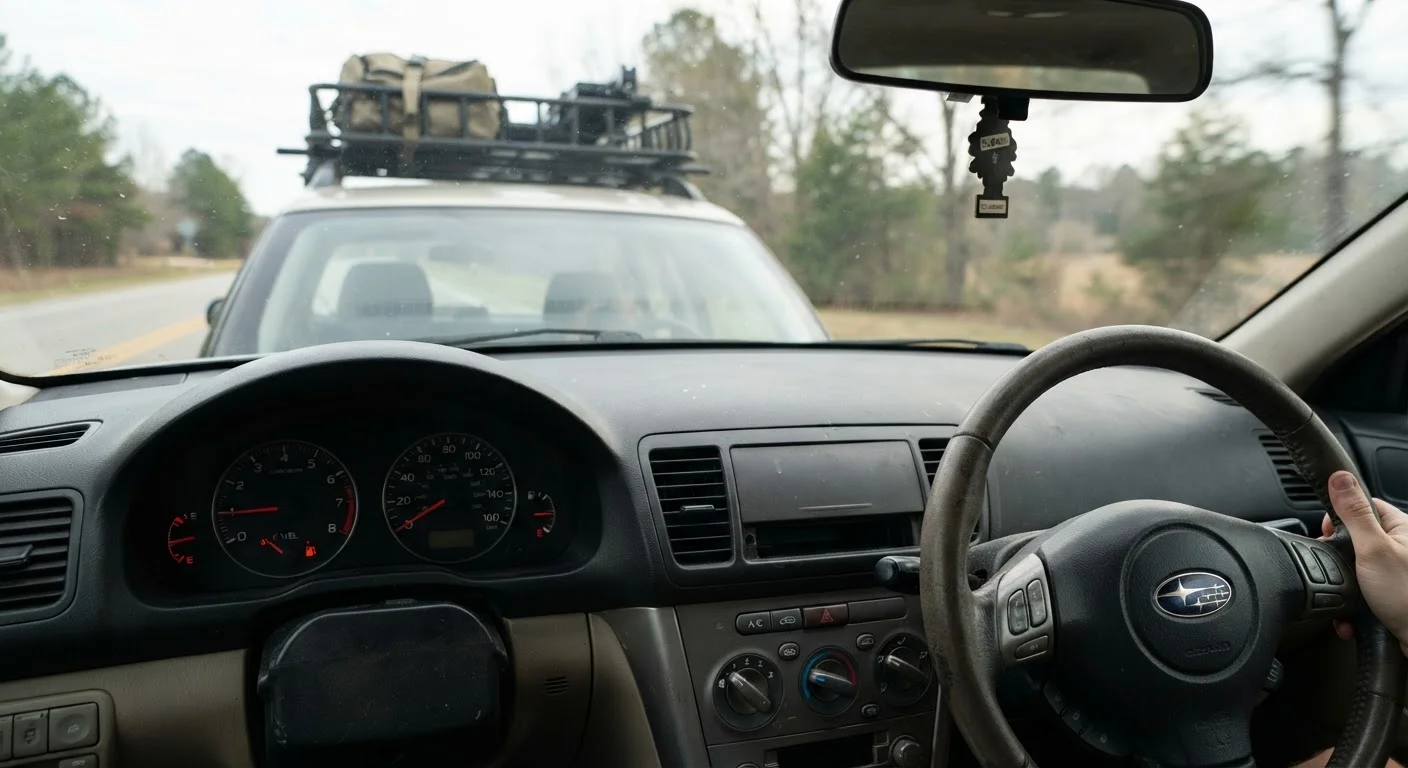
Roof racks are useful for road trips, but many drivers leave them installed year-round out of convenience. That convenience has a cost. A roof rack — even an empty one — increases aerodynamic drag by disrupting the vehicle's airflow profile. The DOE notes that cargo boxes can reduce fuel economy by 2–8% in city driving and 6–17% on the highway depending on size and shape.
The highway figure matters most, because that's where aerodynamic drag has its greatest effect. At 70 mph, drag forces are roughly four times what they are at 35 mph. A loaded cargo box compounds both the drag and the added weight penalty.
If you use a roof rack only a few times a year, removing it between trips is one of the easiest free fuel savings available. Our comparison of highway vs. city fuel costs explains more about how driving environment amplifies these effects.
An empty cargo box can reduce highway fuel economy by up to 17% due to aerodynamic drag.
Extended Idling
Idling burns fuel and produces zero miles in return. The DOE estimates that idling consumes roughly 0.1 to 0.5 gallons of fuel per hour depending on engine size and whether AC is running. In a modern fuel-injected engine, restarting uses less fuel than idling for more than about 60 seconds — a threshold that's relevant every time you're parked waiting, sitting in a long drive-through, or warming up on a cold morning.
The old advice to warm up a carbureted engine for several minutes before driving doesn't apply to modern vehicles. Most manufacturers recommend driving gently for the first minute or two rather than stationary warming — it brings the engine to operating temperature faster and doesn't waste fuel.
If you're stopped for more than a minute and it's safe to do so, shutting off the engine is the practical call. Many newer vehicles automate this with stop-start systems for exactly this reason.
Idling for more than 60 seconds typically burns more fuel than simply restarting the engine.
Carrying Unnecessary Weight
Every extra 100 pounds in a vehicle reduces fuel economy by roughly 1%, according to DOE estimates. For most passenger cars, that's a relatively small absolute number — but it adds up if you're routinely hauling sports equipment, tools, or other cargo that isn't needed for a given trip.
The effect is proportionally larger in smaller, lighter vehicles where the added weight represents a higher percentage of the total. It also compounds with other factors: a heavier vehicle needs more engine effort to accelerate, which matters especially in city driving with frequent stop-and-go cycles.
A reasonable habit: periodically check what's living in your trunk. Items that were temporarily loaded and forgotten are easy to remove and cost nothing to leave at home.
An extra 100 pounds reduces fuel economy by roughly 1% — small per trip, significant over a year.
Underinflated Tires
Tires that are even a few PSI below the recommended pressure create more rolling resistance — meaning the engine works harder to maintain speed. The DOE estimates that fuel economy improves by about 0.5–3% when tires are properly inflated. Underinflation also accelerates tire wear and can affect handling and braking, making this a safety concern alongside a cost one.
Tire pressure fluctuates with temperature: tires typically lose about 1 PSI for every 10-degree Fahrenheit drop in ambient temperature. This means a tire that was correctly inflated in summer may be noticeably low by winter without any visible leak or damage.
Checking tire pressure takes about two minutes at most gas stations and is worth building into a monthly habit. Use the pressure listed on the driver's door jamb sticker, not the maximum pressure listed on the tire sidewall — those are different numbers. For a full picture of how maintenance decisions affect running costs, see our car maintenance savings hub.
Tires lose roughly 1 PSI per 10°F temperature drop — easy to miss, easy to fix.
Aggressive Acceleration and Hard Braking
Driving style has one of the largest individual impacts on fuel consumption of any factor on this list. The DOE estimates that aggressive driving — rapid acceleration and hard braking — can lower fuel economy by 15–30% on the highway and up to 40% in city conditions compared with smooth, anticipatory driving.
The physics are straightforward: kinetic energy that's built up through acceleration and then scrubbed off through braking is energy that came from burning fuel and produced nothing useful. Maintaining more consistent speeds and anticipating stops — coasting to a red light rather than accelerating up to it — recovers some of that energy as distance traveled.
This is also the factor that contributes most to the gap between EPA-rated fuel economy and what drivers actually experience. For more on that disconnect, our fuel economy and real-world running costs article covers the full picture. Smoother driving also reduces brake wear, which connects directly to the maintenance costs that quietly accumulate over time.
Aggressive driving can cut highway fuel economy by 15–30% compared to smooth, anticipatory driving.
Putting It Together: Small Adjustments, Real Savings
None of the items on this list require a mechanic visit or a new piece of gear. They require a shift in awareness. Taken individually, each habit might save a few dollars a month. Taken together — and held consistently — they can meaningfully reduce what you spend on fuel across a year of normal driving.
If you want to go further, our annual car ownership audit walks through every line of your running costs, not just fuel. And if maintenance costs are also on your radar, this look at overlooked maintenance expenses covers the items most drivers quietly let slip.
Track Your Own Baseline First
Before changing habits, fill your tank completely, reset your trip odometer, and note your miles per gallon over the next two to three fill-ups. This gives you a personal baseline to measure against — more useful than comparing to EPA ratings, which reflect controlled test conditions. Apps like GasBuddy or a simple spreadsheet work fine for this. Even rough tracking over a month reveals where your fuel costs are actually going.
This article provides general educational information about vehicle fuel consumption. It is not personalized financial or mechanical advice. Fuel savings will vary depending on your vehicle, driving conditions, and habits. Consult a qualified mechanic for vehicle-specific guidance.
The content provided on our blog site traverses numerous categories, offering readers valuable and practical information. Readers can use the editorial team’s research and data to gain more insights into their topics of interest. However, they are requested not to treat the articles as conclusive. The website team cannot be held responsible for differences in data or inaccuracies found across other platforms. Please also note that the site might also miss out on various schemes and offers available that the readers may find more beneficial than the ones we cover.