

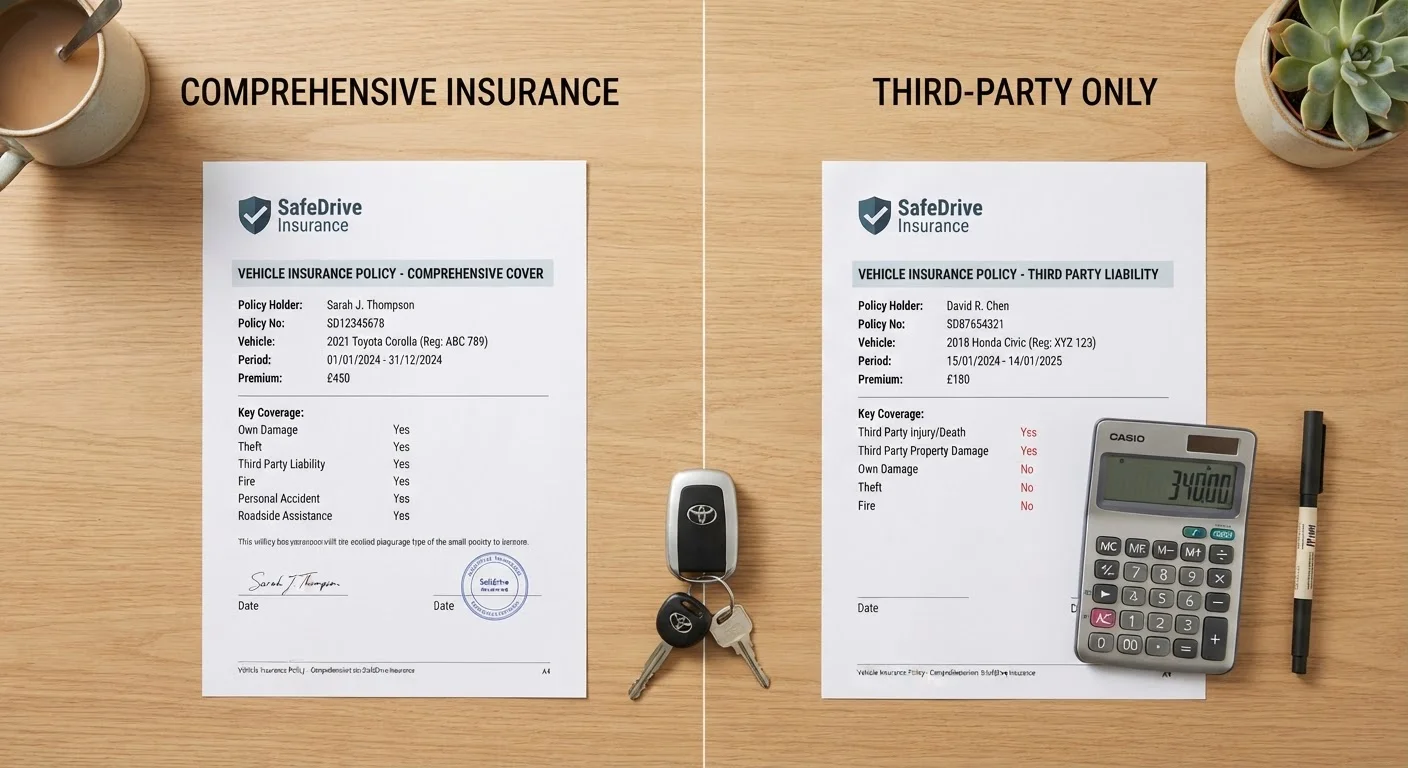
Option A
Comprehensive Car Insurance
The broadest protection available for your vehicle and others.
Best for: Drivers with newer, higher-value cars who want full protection against damage, theft, and third-party claims.
Option B
Third-Party Car Insurance
The legal minimum — covers others, not your own vehicle.
Best for: Drivers of older, low-value vehicles who primarily need to meet legal requirements at the lowest possible cost.
What Each Policy Actually Covers
Third-party insurance is the legal minimum required to drive on public roads in the U.S. and in most countries. At its core, it pays out when you are responsible for injuring another person or damaging their property — their car, a fence, a storefront. What it does not do is pay anything toward repairing or replacing your own vehicle, regardless of who caused the accident.
Comprehensive insurance includes everything third-party covers, then adds a layer of protection for your own car. That typically includes accidental damage (even if you caused it), theft, fire, vandalism, weather events such as hail or flooding, and in some policies, windshield repair. Think of it as third-party cover with a safety net underneath your own vehicle as well.
It's worth noting that U.S. policies bundle this differently than in some other countries. In the U.S., "comprehensive" specifically covers non-collision incidents (theft, weather, animals), while collision damage to your own car is usually a separate add-on called collision coverage. Many drivers carry both together. For simplicity, when people say "comprehensive" in everyday conversation, they generally mean both combined — and that's the sense used here.
| Criterion | Comprehensive | Third-Party Only |
|---|---|---|
| Damage to other people's property | Yes | Yes |
| Injury to other people | Yes | Yes |
| Damage to your own car (collision) | Yes (with collision add-on) | No |
| Theft of your vehicle | Yes | No |
| Fire or weather damage | Yes | No |
| Vandalism | Yes | No |
| Mechanical breakdown | No | No |
| Typical relative cost | Higher premium | Lower premium |
The Financial Logic Behind Choosing a Level
The instinct to go with the cheaper third-party option is understandable when money is tight. But the math doesn't always support it. Consider this: if your car is worth $8,000, a comprehensive policy might add $600–$900 per year to your premium. One at-fault collision that writes off your vehicle leaves you with nothing under third-party. Under comprehensive, you recover the car's actual cash value (minus your deductible).
The calculation flips when your car is worth very little — say, under $3,000. If a comprehensive upgrade costs $700 annually and the car is worth $2,500, you'd pay more in extra premiums over two or three years than you'd ever collect on a total-loss claim. In that scenario, third-party may genuinely be the more rational financial choice.
A useful rule of thumb: if your car's market value is less than ten times the annual cost of adding comprehensive cover, the upgrade often stops making financial sense. That's a general guide, not a guarantee — your actual situation depends on your deductible, your savings cushion, and your risk tolerance. For a deeper look at what drives your premium in the first place, see what goes into your car insurance premium.
~$1,771
Average annual full-coverage premium (U.S.)
According to Bankrate's analysis of industry rate data, the national average for full-coverage car insurance in the U.S. was approximately $1,771 per year as of 2023.
~$635
Average annual minimum-coverage premium (U.S.)
Bankrate's 2023 rate data shows minimum liability-only coverage averages around $635 per year nationally, though this varies widely by state.
1 in 8
Uninsured drivers on U.S. roads
The Insurance Research Council has estimated that roughly one in eight drivers on U.S. roads is uninsured, underscoring why your own vehicle protection matters.
What Both Policies Leave Out
Neither cover type is a blank cheque. Common exclusions that catch drivers off guard include:
- Mechanical breakdown: Insurance is not a warranty. Engine failure, worn brakes, and transmission problems are not covered by either policy.
- Driving under the influence: A claim made while the driver was impaired will almost certainly be denied under any policy.
- Unlisted drivers: If someone not named on the policy causes an accident, the insurer may reject or limit the claim.
- Business use: Standard personal policies typically exclude accidents that occur while driving for hire or delivery work.
- Agreed vs. actual cash value: Comprehensive pays the market value of your car at the time of the loss — not what you paid for it, and not what it would cost to replace it with a newer model.
Reading the exclusions section of your policy document is non-negotiable. If that feels daunting, reading your insurance policy document in plain language walks you through exactly what to look for.
This article provides general information about car insurance cover types and is not personalised financial or insurance advice. Coverage terms, exclusions, and availability vary by provider, state, and individual circumstances. Consult a licensed insurance professional before making decisions about your own policy.
The content provided on our blog site traverses numerous categories, offering readers valuable and practical information. Readers can use the editorial team’s research and data to gain more insights into their topics of interest. However, they are requested not to treat the articles as conclusive. The website team cannot be held responsible for differences in data or inaccuracies found across other platforms. Please also note that the site might also miss out on various schemes and offers available that the readers may find more beneficial than the ones we cover.