

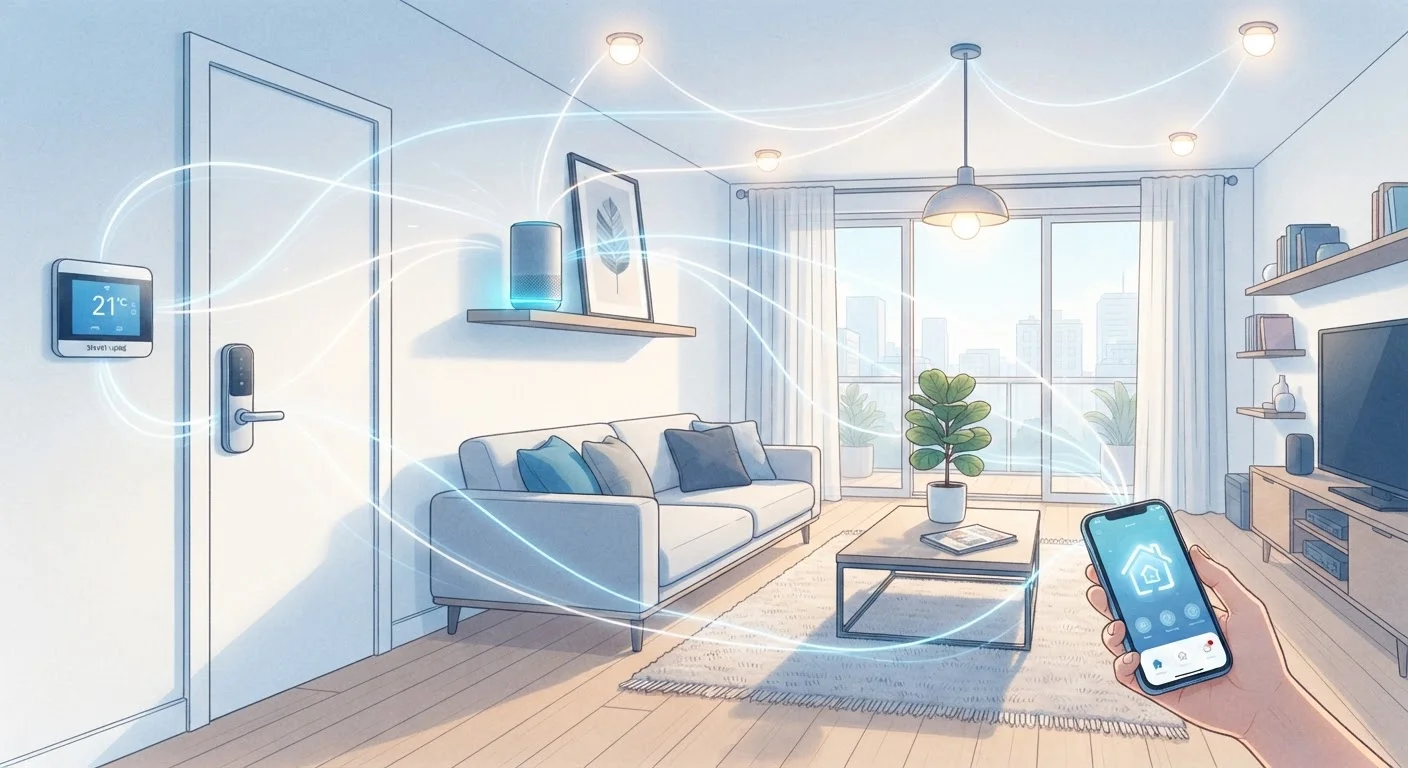
The Problem Matter Is Solving
If you've ever stood in a store, device in hand, wondering whether it will actually work with what you already own at home — that's the exact frustration Matter was designed to eliminate. For years, buying a smart home device meant committing to a specific brand's ecosystem. A bulb that worked with one voice assistant might be invisible to another. A sensor from one company might require a separate hub that conflicted with a hub you already owned.
This fragmentation wasn't accidental — it was the result of competing proprietary protocols and walled-garden business models. Consumers paid the price in wasted money, returned devices, and hours of troubleshooting. For a more grounded look at how these ecosystem dynamics develop, see what smart home ecosystems actually mean before you commit to any setup direction.
Matter's ambition is to make that wall disappear at the protocol level — so the question shifts from "will it work?" to "which features do I need?"
How Matter Actually Works
Matter isn't an app, a hub, or a subscription service. It's a specification — a shared technical rulebook that device manufacturers agree to follow. When a company builds a Matter-certified device, they're committing to a standardized way of communicating over your home network that any other Matter-compatible platform can understand.
At its core, Matter handles device discovery and control locally. When you add a Matter device to your home, it uses a QR code or numeric code to securely commission onto your network. After that, any Matter-compatible controller — whether it's an Amazon Echo hub, a Google Nest Hub, an Apple HomePod, or a Samsung SmartThings hub — can discover and control it without requiring you to link accounts or jump between apps.
600+
Matter-certified products available
As of mid-2024, the Connectivity Standards Alliance reported over 600 Matter-certified products in its public registry, with the number growing as more manufacturers complete certification.
4+
Major platforms supporting Matter
Amazon Alexa, Google Home, Apple Home, and Samsung SmartThings all announced Matter controller support, representing the majority of smart home platforms in active US household use.
2022
Year Matter 1.0 specification launched
The Connectivity Standards Alliance officially released the Matter 1.0 specification in October 2022, marking the start of broad commercial device certification under the standard.
Matter supports a growing list of device categories including lights, plugs, switches, thermostats, door locks, blinds, sensors, and televisions. The specification is versioned, meaning new device categories are added over time through official updates from the Connectivity Standards Alliance.
What 'Multi-Admin' Means for Real Users
One of Matter's more underappreciated features is multi-admin — the ability to add a single device to more than one platform simultaneously. In practice, this means a Matter-certified smart lock could appear in both your Google Home app and your Apple Home app at the same time, controlled by either without conflict.
For households with mixed device preferences (one person uses Siri, another uses Google Assistant), this is a genuine quality-of-life improvement. Previously, you'd either have to pick one platform as the household standard or accept that some devices would be invisible to one system.
That said, multi-admin has nuances. Each platform you add the device to may expose different features. Advanced automations, energy monitoring dashboards, or brand-specific notification settings often still live in the manufacturer's own app, regardless of Matter support.
Practical Limitations to Know Before You Shop
Matter is a meaningful improvement, but it isn't a silver bullet. A few honest caveats worth understanding:
- Not all devices are certified yet. Matter adoption is growing, but a large portion of devices currently on store shelves — especially at the lower price points — are not Matter-certified. Always check before buying.
- Retroactive updates vary. Some manufacturers have issued firmware updates to add Matter support to existing devices; others have not and may never do so. Don't assume an older device will gain Matter support.
- Thread requires a Thread border router. If a device uses Thread as its radio (common for battery-powered sensors), you'll also need a Thread border router on your network. Some smart speakers already include one — but not all.
- Advanced features may still be siloed. Matter standardizes core controls, not every feature a device offers. Proprietary cloud features, detailed energy data, and custom scenes may remain app-specific.
If you're building a setup from scratch, running through a structured compatibility check is a useful habit. The pre-purchase checklist for smart home devices covers the key questions in a practical format.
Putting Matter in Context for Budget Shoppers
For budget-conscious shoppers, Matter's biggest value isn't necessarily unlocking premium features — it's reducing the risk of buying the wrong thing. Devices that carry Matter certification are less likely to become incompatible dead-ends as your setup evolves. That matters when you're spending carefully and can't afford to replace a device six months after purchase because it doesn't work with the hub you added later.
It also gives you more flexibility to start small and expand gradually without locking yourself into a single manufacturer's product line. If you're just getting started, a plain-language overview of smart home technology is a useful foundation before diving into device decisions.
One final note: Matter is evolving. The specification will continue to add device categories and refine features. Staying broadly informed about which device types are currently covered helps you know when the standard is mature enough for your use case — and when you might be better off waiting.
Look for the Matter Logo on Packaging
Before buying any smart home device, scan the box or product listing for the Matter certification mark — a stylized 'M' shape. It's the fastest way to confirm a device meets the standard without reading through technical spec sheets. If the listing doesn't mention Matter explicitly, assume it isn't certified.
This article is for general informational purposes only. Device compatibility, firmware update eligibility, and feature availability can change. Always verify current certification status and compatibility with your specific setup before purchasing.
Frequently Asked Questions
Matter-certified devices should interoperate with any Matter-compatible platform or hub, which significantly reduces lock-in. However, some advanced brand-specific features may still only work within that brand's own app, so full feature parity across platforms isn't always guaranteed.
Not necessarily. Some existing devices have received or are eligible for over-the-air firmware updates that add Matter support. Check the manufacturer's support page for your specific device to see if an update is available.
Yes — local control is a foundational design goal of Matter. Most core functions (turning lights on, adjusting a thermostat) are intended to work on your local network even if your internet connection goes down, which is a meaningful reliability improvement.
Thread is a separate low-power mesh networking protocol that Matter uses for certain device types, particularly battery-powered sensors and locks. Matter defines how devices talk to each other; Thread defines one of the radio pathways they can use. They are complementary but distinct.
Look for the Matter logo on the product packaging or in the product specifications online. The Connectivity Standards Alliance maintains a public product registry at csa-iot.org where you can verify certification status.
No. Zigbee and Z-Wave are older wireless protocols that require dedicated hubs and have their own compatibility limitations. Matter is a newer, higher-level standard that can run over Wi-Fi, Ethernet, and Thread, and is designed to be platform-agnostic from the ground up.
The content provided on our blog site traverses numerous categories, offering readers valuable and practical information. Readers can use the editorial team’s research and data to gain more insights into their topics of interest. However, they are requested not to treat the articles as conclusive. The website team cannot be held responsible for differences in data or inaccuracies found across other platforms. Please also note that the site might also miss out on various schemes and offers available that the readers may find more beneficial than the ones we cover.