

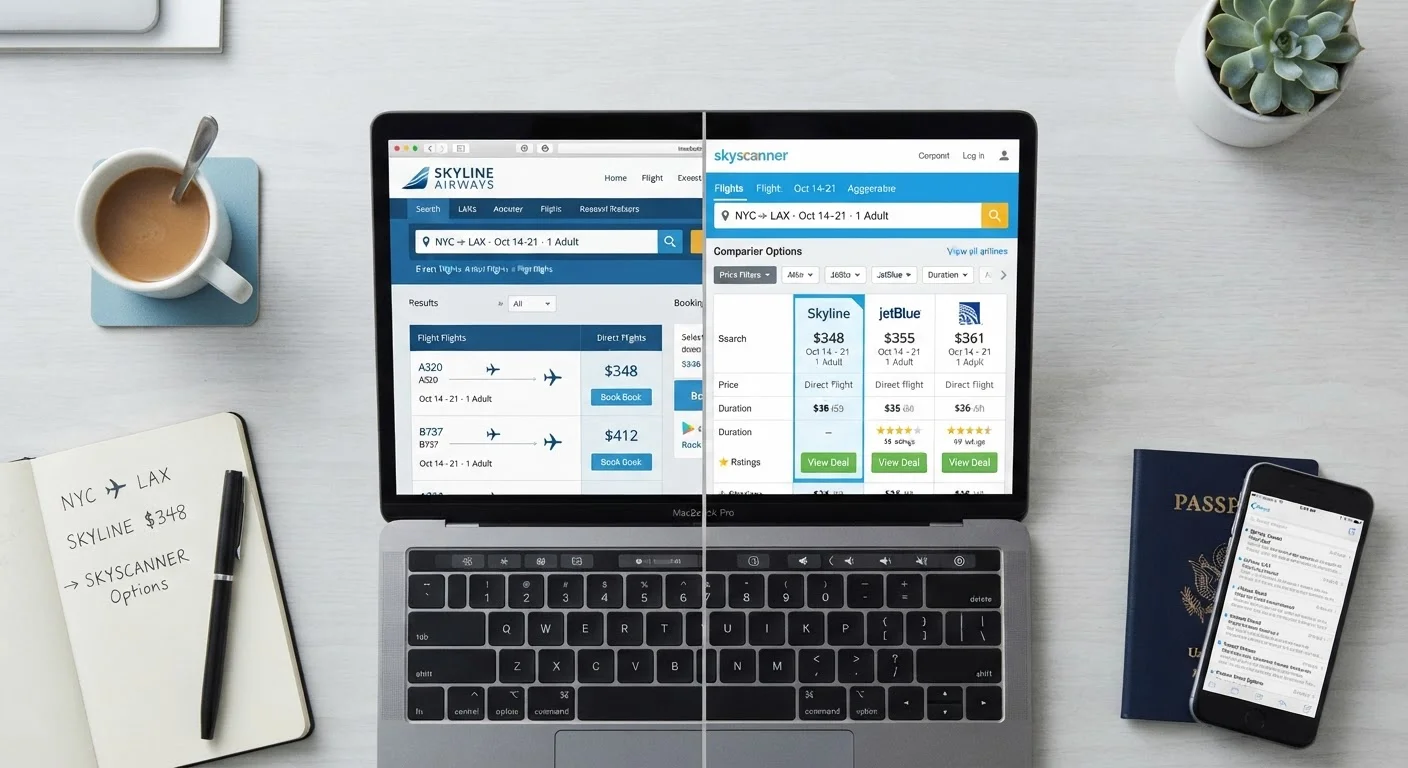
Option A
Booking Direct (Airline Website)
The source-of-truth channel with the fewest middlemen.
Best for: Travelers who prioritize flexibility, loyalty perks, and reliable customer support when things go wrong.
Option B
Third-Party Flight Sites
The broad-view search layer built for price comparison.
Best for: Travelers focused on quickly scanning multiple airlines and routes to identify the lowest headline fare.
What Each Channel Actually Does
Booking direct means purchasing your ticket through the airline's own website or app. The airline is the merchant of record, holds your reservation, and is your first point of contact for any issue. Third-party flight sites — including aggregators (sites that display fares but redirect you to book elsewhere) and OTAs (platforms where you complete the transaction on their site) — sit between you and the airline.
The distinction matters because it determines who controls your booking. With an OTA, the platform often holds the ticket under its own account with the airline, which can complicate changes, upgrades, or rebooking during irregular operations. Aggregators that redirect you to the airline's own checkout don't carry this risk — functionally, you end up booking direct even if you started the search elsewhere.
Before you even open a search tool, it's worth understanding your priorities. Our pre-flight booking checklist walks through the questions to answer before you start comparing prices.
Price: The Gap Is Smaller Than You Think
The most common reason travelers use third-party sites is to find lower fares. And while aggregators can surface deals that aren't immediately visible on a single airline's website, the actual price differential is often narrow — and sometimes disappears entirely once you account for the OTA's service fees.
Airlines increasingly price-match or publish their lowest fares directly on their own sites. In some cases, airlines offer exclusive discounts or web-only fares that don't appear on third-party platforms at all. Basic economy fares, in particular, are sometimes withheld from aggregator displays to avoid price comparisons on stripped-down products.
| Criterion | Booking Direct | Third-Party Sites |
|---|---|---|
| Price transparency | All fees visible upfront | OTA service fees may apply |
| Range of options | One airline only | Multiple carriers in one search |
| Disruption support | Airline handles directly | Platform may act as intermediary |
| Loyalty mile accrual | Typically full credit | Varies; verify post-booking |
| Seat selection access | Full seat map available | May be limited at booking |
| Change/cancel fees | Airline policy only | Airline + possible OTA fee |
| Exclusive fares | Web-only deals possible | Some fares withheld by airlines |
The practical move: use a broad aggregator to identify competitive fare ranges and route options, then verify the price on the airline's own site before completing the purchase. If the direct price matches or comes within a few dollars, booking direct is almost always the lower-risk choice. For more on search strategies that go beyond simple price tools, see lesser-known flight search tactics.
Flexibility and Changes: Where the Real Cost Difference Appears
Price at checkout is only part of the equation. The more meaningful cost gap often emerges when something changes — your plans shift, the airline reschedules, or a disruption forces a rebooking.
When you book direct, the airline can modify, rebook, or refund your ticket without a third party's involvement. During widespread disruptions, airlines typically prioritize direct customers in their queues and can waive change fees under their own policies. When an OTA holds your booking, you may be directed back to the platform to make any change, and the platform's support infrastructure varies widely in responsiveness.
Some OTAs also impose their own change and cancellation fees on top of any airline fees. This layering can make a nominally cheaper fare expensive in practice if your travel plans aren't ironclad. Understanding fare classes is essential context here — our guide to fare classes and ticket restrictions explains the rules attached to different booking codes.
Loyalty Programs, Seat Selection, and Ancillaries
Frequent flyer miles are generally credited based on fare class and ticket price rather than where you booked — but some airlines have historically limited mileage accrual on certain OTA-issued tickets or applied different earning rates. The safest approach for travelers who actively accumulate miles is to enter their loyalty number at the airline level and verify post-trip that miles posted correctly.
Seat selection, baggage add-ons, and upgrade eligibility are also cleaner when managed directly through the airline. OTA platforms sometimes don't surface the full seat map or ancillary options available on the airline's own site, meaning you may end up paying more for the same seat selection done after the fact.
Loyalty Number Verification Worth Doing
When booking through any third-party platform, always enter your frequent flyer number during checkout and confirm it appears on your itinerary confirmation. After travel, log into your airline account to verify miles posted at the expected rate. Discrepancies are easier to resolve with documentation in hand shortly after the flight than weeks later.
Timing also intersects with this decision. Whether you're locking in early or leaving things flexible, the channel you choose affects your options later. See how advance vs. last-minute booking plays out in terms of pricing patterns and risk.
When Third-Party Sites Have a Genuine Edge
Despite the friction they can introduce, third-party platforms serve real purposes. Their primary strength is breadth: searching across dozens of airlines simultaneously saves time on routes served by multiple carriers. For budget-conscious travelers without a preferred airline, aggregators are an efficient starting point.
Some OTAs also offer package deals — bundling flights with accommodations in ways that can reduce overall trip cost. If you're researching lodging alongside airfare, this can simplify comparison, though the Cheap Stays & Lodging hub covers accommodation strategy separately. Certain niche third-party platforms also specialize in finding error fares or unadvertised deals that airlines quietly publish and quickly correct — these are rare but real.
The informed approach isn't to pick one channel and ignore the other. It's to use aggregators for discovery and price orientation, then make a deliberate call about where to complete the purchase based on your specific trip's flexibility needs and risk tolerance.
This article is for general informational purposes only and does not constitute financial or travel advice tailored to your individual circumstances. Prices, policies, and platform features change frequently — always verify current terms directly with airlines and booking platforms before making a purchase.
The content provided on our blog site traverses numerous categories, offering readers valuable and practical information. Readers can use the editorial team’s research and data to gain more insights into their topics of interest. However, they are requested not to treat the articles as conclusive. The website team cannot be held responsible for differences in data or inaccuracies found across other platforms. Please also note that the site might also miss out on various schemes and offers available that the readers may find more beneficial than the ones we cover.