

Our Verdict
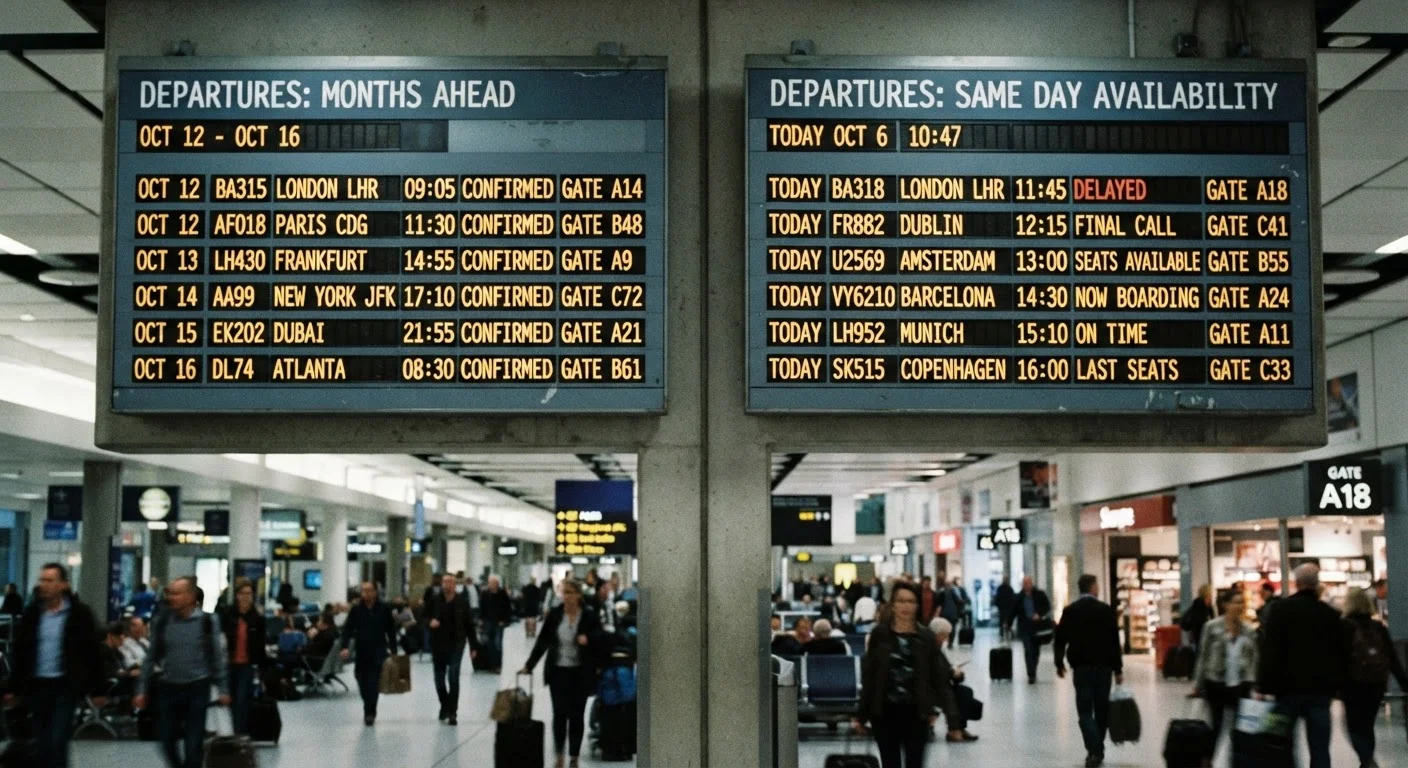
Neither approach is universally superior. Advance booking reduces risk and typically outperforms on high-demand routes, while last-minute strategies occasionally yield genuine savings on less-trafficked flights — but require genuine flexibility and a tolerance for uncertainty. Most budget travelers are better served by targeting the mid-range window and pairing it with date flexibility.
| Best for | Recommended |
|---|---|
| Travelers with fixed dates and specific destinations | Booking far in advance |
| Highly flexible travelers with no fixed destination or date | Last-minute booking |
| Domestic travelers with some schedule flexibility | Mid-range booking window (4–8 weeks out) |
| International or peak-season travel planners | Booking far in advance |
Why Booking Timing Is More Complicated Than the Rule Suggests
The conventional wisdom splits into two camps: book as early as possible to lock in low fares, or wait until the last minute when airlines dump unsold seats at a discount. Both pieces of advice have survived decades of repetition — and both are partially wrong.
Airline pricing is driven by dynamic revenue management systems, meaning fares respond in real time to demand signals, competitive routes, load factors, and historical booking patterns. There is no single price trajectory that applies to every flight. What works on a heavily trafficked domestic corridor in October may produce the opposite result on a thin international route in February.
Understanding the actual evidence — rather than folk wisdom — is the starting point. See how date flexibility intersects with this question in our look at flexible vs. fixed travel windows.
What Research and Pricing Data Actually Show
Studies of domestic US airfare pricing — including analyses by fare-tracking platforms and academic researchers — have consistently found that fares tend to rise as departure approaches on popular routes, but the pattern is not linear. Prices often dip modestly in the one-to-three-month window before departure, then climb steeply inside three weeks as remaining seats thin out.
For international flights, the dynamic shifts. Capacity is tighter, route competition is lower, and demand is less elastic — meaning fares on transatlantic or transpacific routes tend to hold higher later in the booking window. The conventional advice to book international flights three to six months ahead has more evidence behind it than the equivalent domestic rule.
Last-minute pricing is real but inconsistent. Airlines do sometimes reduce fares on unsold inventory in the final days before departure, particularly on routes with multiple daily flights where seat fill is a concern. However, this is not a strategy that can be planned around — it functions more like a lottery than a tactic.
47 days
Reported average domestic booking lead time for lower fares
Fare analysis studies have pointed to a general window of roughly four to seven weeks before departure as a zone where domestic US prices are often — though not always — more competitive.
3–6 months
Typical advance window cited for international fares
Multiple fare-tracking analyses suggest international routes show their more competitive pricing several months ahead of departure, with prices generally rising closer to travel dates.
For travelers who want to go deeper on search strategy beyond just timing, lesser-known flight search tactics are worth building into your regular routine.
The Real Trade-Offs: Risk, Flexibility, and What You're Giving Up
The booking-timing question is ultimately a risk management decision, not just a price optimization exercise.
| Advance Booking (2–6 months) | Mid-Range Window (4–8 weeks) | Last-Minute (Under 2 weeks) | |
|---|---|---|---|
| Price reliability | Generally stable, lower risk | Often competitive, route-dependent | Highly variable, unpredictable |
| Seat availability | Full selection available | Good on most routes | Limited, especially peak days |
| Flexibility required | Low — fixed dates work fine | Moderate — some flexibility helps | High — must accept what's left |
| Best route type | International, peak-season domestic | Off-peak domestic | Overserved domestic corridors only |
| Risk level | Low | Low to moderate | High |
| Works with fixed schedule? | Yes | Usually | Rarely |
Booking far ahead reduces uncertainty — you have a confirmed seat, a locked fare, and time to arrange logistics. The trade-off is opportunity cost: fares might drop after you purchase, and you're committed before you have full visibility on your schedule or personal circumstances.
Last-minute booking requires you to accept that your preferred flight may not be available, that prices may have risen rather than fallen, and that accommodation and logistics at the destination may be harder to arrange. For travelers with genuine schedule flexibility and no fixed destination, this calculus can occasionally pay off. For most millennials juggling work schedules and fixed time-off windows, it is a higher-stakes gamble than it appears.
One useful frame: think about what you're actually optimizing for. If the goal is certainty and peace of mind, advance booking wins. If the goal is the absolute lowest possible price and you can absorb the uncertainty, a flexible last-minute approach has some basis in evidence — but no guarantee. And regardless of when you book, the channel you use matters too: see the trade-offs between booking direct vs. third-party flight sites.
How to Apply This Practically
A few concrete principles hold up reasonably well across route types and seasons:
- Domestic, off-peak travel: Target the four-to-eight-week window before departure. Set a fare alert and move when the price is acceptable to you, rather than waiting for a mythical low that may not arrive.
- Domestic, peak-season travel (summer, holidays): Treat this more like international travel. Prices on Thanksgiving or July 4th routes can behave like international fares — book two to four months out.
- International travel: Three to six months ahead is a reasonable general range. The further the route and the fewer competitors, the earlier you should move.
- Truly last-minute: This is viable only if you have zero fixed destination, can leave within 48–72 hours, and are genuinely comfortable with whatever is available. It is not a reliable cost-cutting strategy for most travelers.
Lodging timing follows a similar logic — shoulder-season lodging pricing can shift dramatically based on when you book relative to peak demand periods.
This article provides general travel information and educational content. Airfare prices and availability vary by route, carrier, and market conditions. Nothing here constitutes a guarantee of specific fares or availability. Always verify current pricing through multiple sources before making travel decisions.
The content provided on our blog site traverses numerous categories, offering readers valuable and practical information. Readers can use the editorial team’s research and data to gain more insights into their topics of interest. However, they are requested not to treat the articles as conclusive. The website team cannot be held responsible for differences in data or inaccuracies found across other platforms. Please also note that the site might also miss out on various schemes and offers available that the readers may find more beneficial than the ones we cover.