

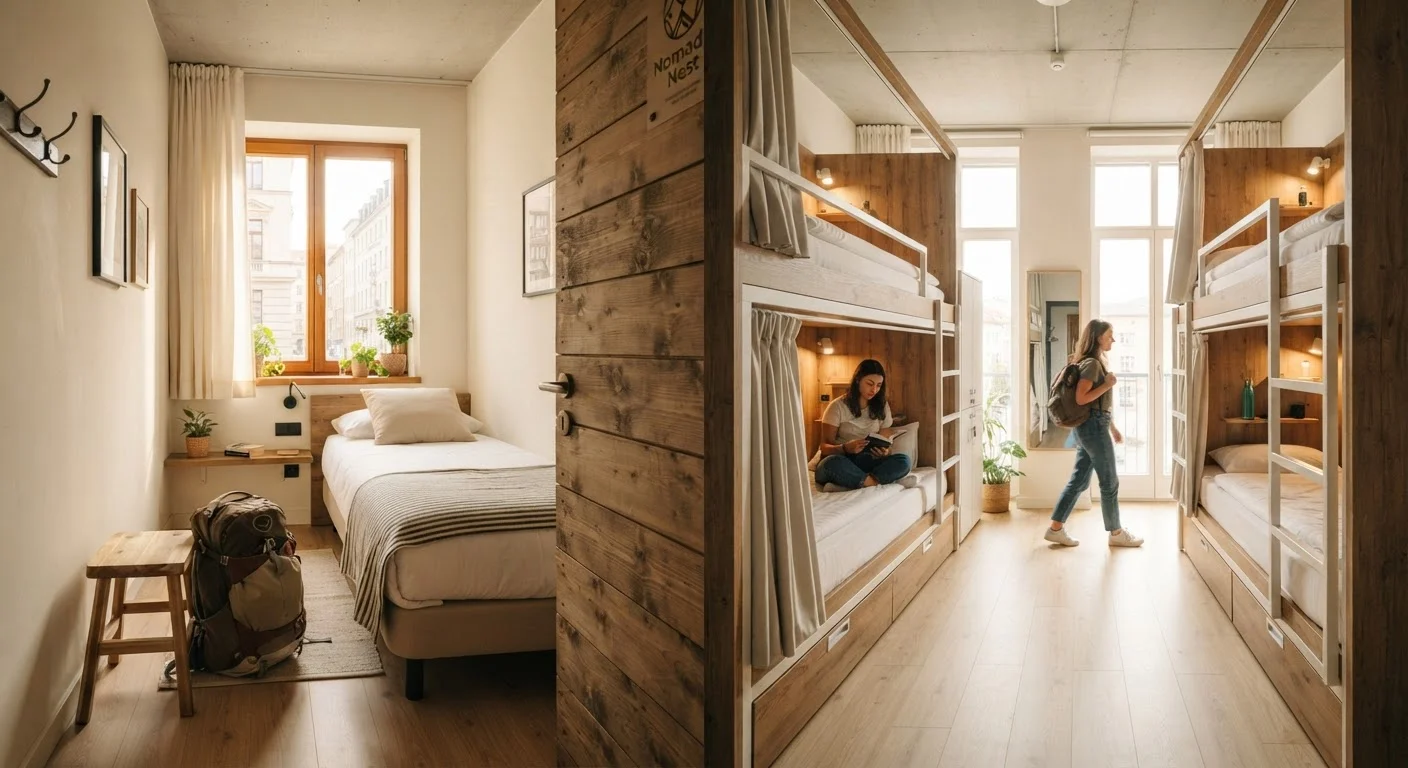
Option A
Private Room (Hostel or Guesthouse)
The solo-space option that still keeps costs well below hotels.
Best for: Travelers who value uninterrupted sleep, need reliable work conditions, or are traveling with one other person.
Option B
Shared Dorm Bed
The leanest lodging option for maximizing destination spending.
Best for: Solo travelers on tight daily budgets who can adapt to shared spaces and unpredictable sleep environments.
The Actual Price Gap (And When It Closes)
The nightly rate difference between a dorm bed and a private room in the same hostel typically runs between 40% and 70%, depending on destination and property. In Southeast Asia and Eastern Europe, dorm beds in well-reviewed hostels commonly fall in the $8–$15 range, while private rooms at the same property land between $25–$45. In Western Europe and major US cities, those figures shift upward — dorms at $20–$35, privates at $55–$90.
That gap sounds decisive until you factor in two variables: travel companions and trip duration. Two people splitting a private room immediately cuts the per-person cost in half, often landing it within a few dollars of a dorm bed. Over a week-long stay, many properties also offer weekly rates that reduce the private room premium further. Before defaulting to the dorm to save money, run the actual math for your specific trip — the savings differential may be smaller than the sticker prices suggest.
| Criterion | Private Room | Shared Dorm Bed |
|---|---|---|
| Typical nightly cost (solo) | $25–$90 depending on city | $8–$35 depending on city |
| Cost per person (2 travelers) | $13–$45 (split rate) | $8–$35 (each pays full rate) |
| Sleep disruption risk | Low | Moderate to high |
| Privacy | Full | Minimal |
| Social opportunity | Limited (common areas only) | High (built-in) |
| Storage security | Room-level security | Locker-dependent |
| Best trip length | 3+ nights | 1–3 nights |
For a fuller picture of how these options fit within the broader lodging landscape, see our breakdown of budget lodging types.
What You're Really Giving Up in Each Direction
Choosing a dorm isn't just about tolerating bunk beds — it's accepting a set of genuine trade-offs that compound over time. The most documented issue is sleep disruption: late arrivals, early departures, phone alarms, and snoring are structural features of shared rooms, not exceptions. For light sleepers or anyone with an early commitment, this isn't a minor inconvenience.
Privacy and storage security are the other real costs. Most reputable hostels provide lockers, but you're still managing access to your belongings throughout the day. Getting dressed, making calls, or simply decompressing after a long travel day all require more negotiation of shared space.
Private rooms eliminate those friction points but introduce their own limitation: reduced social exposure. Hostel common areas help, but the organic interaction that happens in a shared dorm — meeting people who become travel companions — is harder to replicate behind a closed door.
A balanced look at dorm trade-offs specifically can help you assess whether the social upside outweighs the sleep risk for your travel style. And if you're weighing other low-cost formats entirely, comparing hostels, guesthouses, and vacation rentals adds useful context.
Dorm Quality Varies Considerably by Property
A 6-bed dorm in a well-managed hostel with enforced quiet hours and individual reading lights is a materially different experience from a 16-bed room with no lockers and no noise policy. Dorm size, locker availability, bathroom ratios, and guest reviews all signal how disruptive a specific dorm is likely to be. Filtering by dorm size and reading recent reviews about noise levels is more useful than treating all dorms as equivalent.
The Decision Framework: Four Questions to Ask Before Booking
Rather than treating this as a fixed preference, think of it as a per-trip calculation driven by four factors:
- How many nights? Short stays favor dorms. Longer stays shift the value equation toward privates, especially if you negotiate extended rates.
- How many people? Solo travelers feel the price gap most acutely. Two or more travelers sharing a private room often reach parity with dorm pricing per person.
- What's your daily budget structure? If lodging is your largest daily expense, the dorm savings matter more. If activities and food dominate your spend, the lodging differential is less critical.
- What's your sleep sensitivity? Be honest. Dorm environments are genuinely unpredictable. If poor sleep would derail your trip, the private room premium is likely worth it.
These questions don't produce a universal answer — they produce the right answer for your specific trip. Common lodging misconceptions can also skew this calculation in ways that aren't grounded in reality; separating lodging myths from facts is a useful corrective before you book.
This article provides general travel information for educational purposes. Prices, availability, and property conditions vary widely and cannot be guaranteed. Always verify current rates and reviews directly with the property before booking.
The content provided on our blog site traverses numerous categories, offering readers valuable and practical information. Readers can use the editorial team’s research and data to gain more insights into their topics of interest. However, they are requested not to treat the articles as conclusive. The website team cannot be held responsible for differences in data or inaccuracies found across other platforms. Please also note that the site might also miss out on various schemes and offers available that the readers may find more beneficial than the ones we cover.