

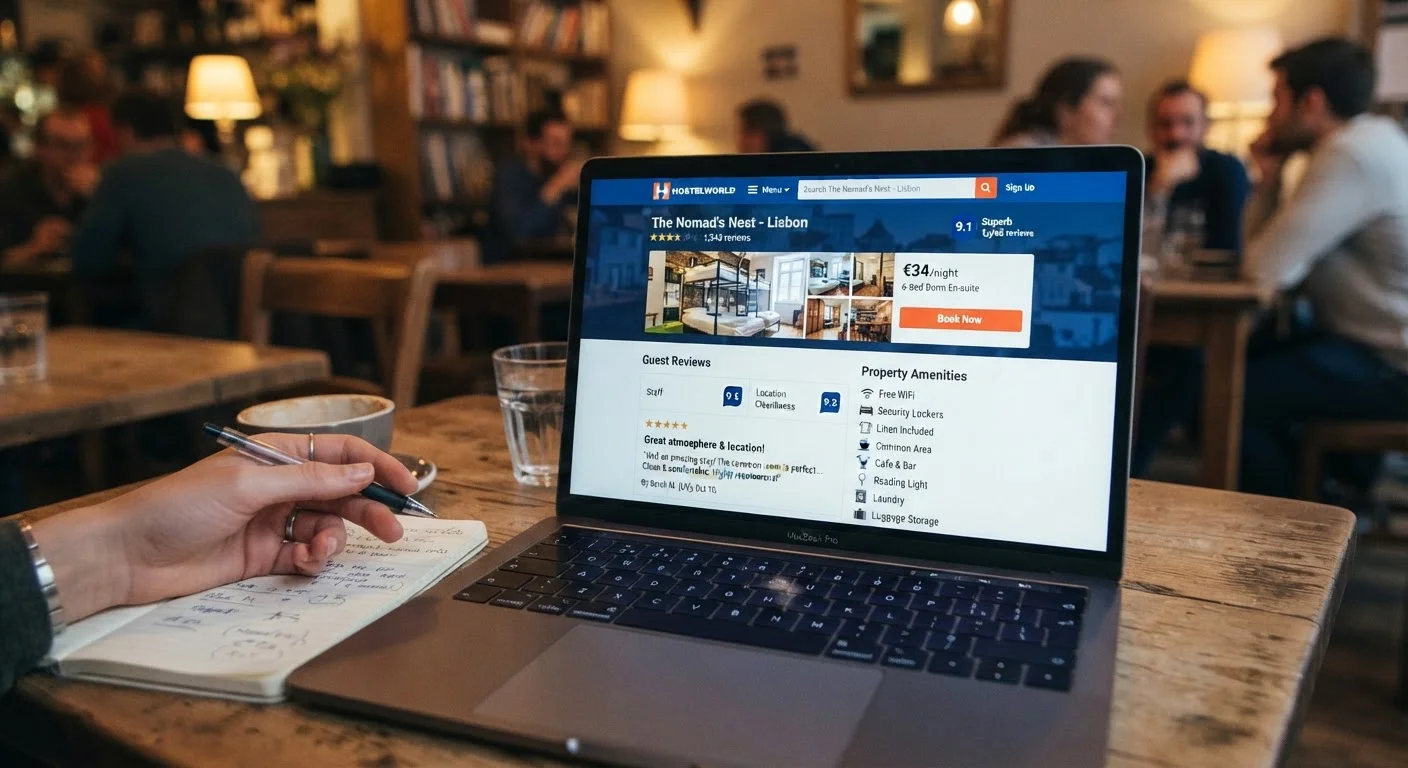
Why Hostel Listings Require a Critical Eye
Hostel listings are marketing documents first and information sources second. Every platform — whether a dedicated hostel-booking site or a general travel aggregator — incentivizes properties to present their best face. That's not inherently dishonest, but it means the gap between a listing's implied promise and your actual experience can be wide. Understanding that gap is a core travel skill.
If you're still weighing whether a hostel is the right lodging type for your trip at all, the guide to budget lodging types gives a clear breakdown of all your options. And if concerns about cleanliness or safety are holding you back, common lodging myths addresses those directly with current context.
The steps below train you to evaluate what a listing shows, what it avoids showing, and what questions to ask before you commit.
What you will need
How to Decode a Hostel Listing Step by Step
Start with the photos — in order and with skepticism
Listing photos are curated. Look at how many there are and what they show first. A hostel with 40 photos that are all of the common area and zero of the actual dorm rooms is telling you something. When dorm photos do appear, check for bed spacing, whether lockers are visible, and whether the images look staged versus lived-in. Wide-angle lenses can make a six-bed dorm look like a suite.
Parse the amenity list for what's actually included
Amenity lists are among the most misleading elements of any hostel listing. 'Free Wi-Fi' may mean one weak router for 80 guests. 'Breakfast included' often means a bread roll and instant coffee. 'Lockers available' frequently means lockers exist but you must pay a deposit or bring your own padlock. Read each amenity and mentally ask: at what cost, and with what conditions? If the listing doesn't specify, assume there's a catch worth clarifying.
Find the exact dorm configuration
The bed count per dorm room is the single most underreported figure in hostel listings, yet it determines your sleep quality, privacy level, and bathroom access more than almost anything else. A 4-bed dorm and a 16-bed dorm are categorically different experiences. Look for this number in the room description, not just the listing headline. If you can't find it, check the booking platform's room-type detail page or contact the hostel directly. Also note whether dorms are mixed-gender or same-gender — this is often filterable but not always prominently displayed.
Analyze the review score structure, not just the average
An 8.2 overall score can mask a 6.5 on cleanliness or a 6.0 on security — categories that matter far more to safety and comfort than 'staff friendliness.' On platforms that break scores into sub-categories, check each one individually. A high atmosphere score often reflects social programming (pub crawls, group dinners) that also correlates with noise. Decide whether that trade-off works for your travel style.
Read negative reviews for patterns, not isolated complaints
One complaint about a noisy neighbor is an outlier. Three complaints in the past month about thin walls or disruptive guests at 3 a.m. is a structural problem. Filter or search reviews for terms like 'noise,' 'smell,' 'security,' 'broken,' and 'dirty.' A single mention of bedbugs in recent reviews should be treated as a hard stop — this is not a risk worth taking. For first-time hostel guests, what to expect before you arrive covers how to spot and avoid common hostel hazards.
Verify the location claim independently
'Central location' and 'steps from the city center' are marketing phrases with no fixed meaning. Open a mapping application separately and drop a pin on the listed address. Check walking time to the transit options you'll actually use, not the landmark the listing chose to highlight. Also scan the immediate surroundings — a hostel adjacent to a nightlife district may be convenient but loud until dawn regardless of its own quiet hours policy.
Once you've worked through the listing systematically, compare what you found against alternatives. Our hostel vs. guesthouse vs. vacation rental comparison can help you decide whether you're getting real value or whether another accommodation type fits better at the same price point.
Cross-Reference Across Multiple Platforms
The same hostel can look quite different depending on which booking platform you use — photo sets, review pools, and even listed amenities sometimes vary. Pull up the property on two or three different platforms and compare. Discrepancies between what each platform shows are themselves informative and worth investigating before you book.
What Listings Won't Tell You — And How to Find It Anyway
Even a thorough listing read has limits. Structural noise (street traffic, a busy bar below, thin walls between dorms) rarely appears in official descriptions. Neither do enforcement gaps — a hostel might list a midnight quiet policy that staff don't actually enforce. These details live almost exclusively in reviews, and specifically in the most recent ones.
Sort reviews by date, not helpfulness. A hostel that was excellent two years ago may have changed ownership, let maintenance slip, or added a rooftop bar that runs until 2 a.m. Treat anything older than six months as background color, not a current signal.
When reviews are sparse — fewer than 20 for a property that's been operating over a year — treat that as a yellow flag. Either the hostel is genuinely new or it has a reputation-management problem worth investigating. For newer properties, direct contact is your best tool: email the hostel with a specific question (e.g., 'How many beds are in your mixed six-bed dorm, and is there a locker for each bed?'). How quickly and specifically they reply tells you a lot about operations.
If flexibility on destination matters to you, the low-cost destinations hub surfaces places where quality hostels are both plentiful and well-reviewed, which reduces the due-diligence burden considerably. And for travelers open to more unconventional arrangements, alternative lodging options covers arrangements where listings are often more transparent by necessity.
This article is for general informational purposes only. Prices, policies, availability, and conditions at any accommodation can change without notice. Always verify current details directly with the property and through official booking channels before making a reservation.
The content provided on our blog site traverses numerous categories, offering readers valuable and practical information. Readers can use the editorial team’s research and data to gain more insights into their topics of interest. However, they are requested not to treat the articles as conclusive. The website team cannot be held responsible for differences in data or inaccuracies found across other platforms. Please also note that the site might also miss out on various schemes and offers available that the readers may find more beneficial than the ones we cover.