

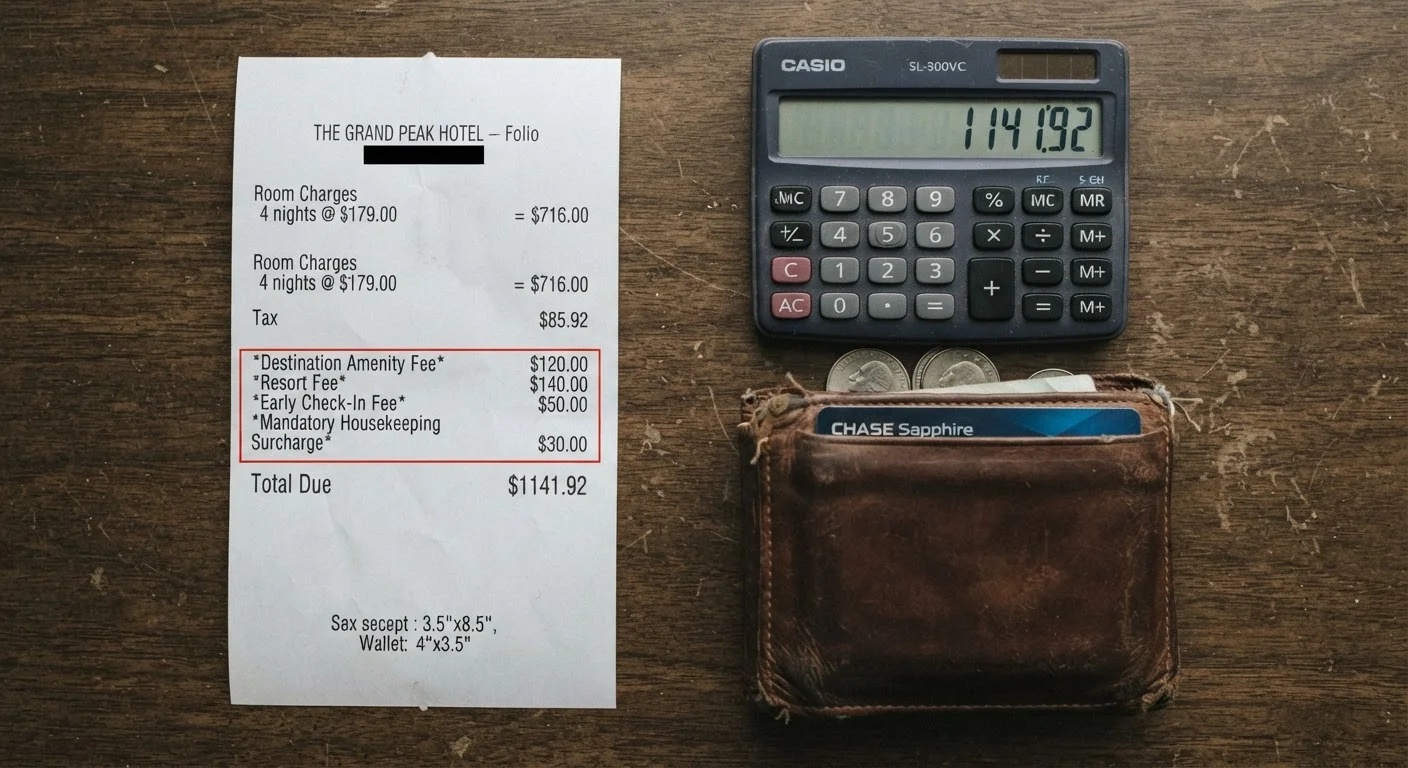
The Gap Between What You See and What You Pay
A hotel booking that looks like a deal at checkout rarely reflects what you'll actually spend. The gap between the advertised rate and the real out-of-pocket cost is where most budget accommodation mistakes live — and it's intentional by design. Platforms and properties alike benefit from leading with low headline numbers.
This pattern mirrors what happens with cheap flights, where the base fare is just the starting point. As explored in our breakdown of hidden flight costs, low headline prices consistently understate actual trip costs. Hotel booking operates the same way, with a few categories of creep that are especially reliable.
Understanding where the inflation happens — before you book — is the practical skill that separates travelers who genuinely save money from those who think they did. The glossary of accommodation fees and terms is a useful reference for decoding exactly what appears in a booking summary.
Comparing hotels by nightly rate instead of total cost including all mandatory fees.
Why it happens: Booking platforms prominently display the base nightly rate, and mandatory add-on fees like resort fees or destination fees are often buried in the checkout summary — or disclosed only at check-in.
Booking a cheap hotel far from your actual destination and underestimating daily transport costs.
Why it happens: Budget travelers naturally focus on accommodation cost and overlook how location affects transportation spending. A hotel 45 minutes from the city center may save $30/night but cost $25+ per day in rideshares or transit.
Paying mandatory resort or amenity fees for facilities you won't use.
Why it happens: Resort fees are framed as access to amenities (pool, gym, Wi-Fi), which sounds reasonable. What travelers miss is that these fees are mandatory regardless of whether you use a single amenity, effectively functioning as a hidden price increase.
Ignoring parking costs when booking a hotel for a road trip.
Why it happens: Parking fees are almost never included in advertised rates and often don't appear in booking platform summaries. Daily parking at urban hotels can run $25–$50, easily doubling the cost of a supposedly cheap room.
Booking a non-refundable rate to save a small amount without accounting for trip uncertainty.
Why it happens: The price difference between refundable and non-refundable rates looks like easy savings at booking time. Travelers underestimate how often plans change, particularly with budget travel involving low-cost airlines.
How to Actually Compare Accommodation Value
Once you account for mandatory fees, location-driven transport costs, and parking, two properties with a $40/night difference in advertised rate can be cost-equivalent — or even reversed. The calculation is straightforward but requires a few extra steps most travelers skip.
Always Check the Total Before Confirming
Booking platforms in the US are increasingly required to show total costs including fees, but enforcement and implementation remain inconsistent. Before entering payment details, always look for a full price breakdown that includes taxes, resort fees, and any mandatory charges. A room priced at $89/night can realistically cost $130+ per night once all fees are added. Never compare properties based on nightly rate alone.
Start by anchoring on total stay cost, not nightly rate. Add any mandatory fees disclosed at checkout. Then estimate realistic daily transport spend based on the hotel's actual distance from your itinerary. If you're driving, add parking. Only then can you make an accurate comparison between options.
This same logic applies across travel decisions — the patterns that cause budget travelers to overspend typically come down to optimizing visible costs while ignoring the invisible ones. And if you've ever wondered whether a destination is genuinely affordable for someone traveling from the US, what 'low-cost destination' actually means is worth reading before you plan.
The comparison framework is simple: total your accommodation cost, add your estimated local transport for the stay, and divide by nights. That number — not the nightly rate — is your real accommodation cost per day. Apply it consistently and you'll make materially better decisions. For a broader look at how these misconceptions form, lodging myths that keep budget travelers overspending addresses the assumptions that lead travelers to prioritize the wrong variables from the start.
This article is for general informational purposes only. Prices, fees, and policies vary by property, platform, and location. Always verify total costs directly with the property or platform before booking.
The content provided on our blog site traverses numerous categories, offering readers valuable and practical information. Readers can use the editorial team’s research and data to gain more insights into their topics of interest. However, they are requested not to treat the articles as conclusive. The website team cannot be held responsible for differences in data or inaccuracies found across other platforms. Please also note that the site might also miss out on various schemes and offers available that the readers may find more beneficial than the ones we cover.