

Why These Destinations Actually Work on $40 a Day
Most budget travel advice gravitates toward the same handful of countries — Thailand, Vietnam, Indonesia. Those are solid choices, but the crowding of mainstream backpacker routes has nudged prices upward in popular hubs. The countries on this list sit outside that circuit. They share a common profile: low accommodation costs, cheap and reliable local transit, and food cultures where eating well at street stalls or small restaurants costs a few dollars at most.
For context, $40 a day works out to roughly $1,200 a month — a figure that genuinely covers basics in these destinations without requiring extreme austerity. That said, costs vary by city, season, and travel style. For a broader picture of what daily budgets look like across regions, see the reference guide to average daily travel costs we've put together separately. The countries below were selected because $40 is not a floor — it's a workable mid-range that includes some comfort.
A quick note on safety and entry: conditions, visa rules, and travel advisories change. Verify current requirements through your government's official travel advisory site before booking anything.
Arrive with a Transport Plan
Airport transfers and first-night taxi rides are where new arrivals overpay most often. Before landing, research the local bus or shared taxi route from the airport and note the approximate local-currency fare. This single habit can save $20–40 on arrival day alone — a meaningful chunk of a $40 daily budget.
Countries Where $40 a Day Delivers Genuine Value
Georgia (the country)
Georgia sits at the crossroads of Eastern Europe and the Caucasus, and it remains one of the most underpriced destinations for what it delivers. Guesthouses in Tbilisi's old city run $15–25 a night for private rooms. A full meal — often including wine, for which Georgia is historically significant — costs $5–10 at a neighborhood restaurant. Public marshrutka minibuses connect cities for under $5.
The draw goes beyond the price: ancient cave monasteries, high Caucasus hiking trails, and a food culture built around slow-cooked stews and flatbread make Georgia substantively rewarding. English is increasingly spoken in Tbilisi, and the country has developed real traveler infrastructure without pricing itself out of the budget range.
A full meal with wine in Tbilisi commonly costs under $10 at a local restaurant.
Albania
Albania is the overlooked Mediterranean country that offers Adriatic beaches, Ottoman-era bazaars, and mountain hiking at prices well below its neighbors Greece and Montenegro. Budget accommodation in cities like Berat or Gjirokastër — both UNESCO-listed — runs $15–20 a night. Street food and small restaurant meals are $3–6.
The Albanian Riviera, which draws significant summer crowds, is still cheaper than comparable coastline in Croatia or Greece. Off-season travel (spring and autumn) further reduces prices while avoiding the heat. Local furgon minibuses are the primary intercity transport and cost very little.
Albania's coastline and UNESCO towns cost a fraction of neighboring Mediterranean destinations.
Uzbekistan
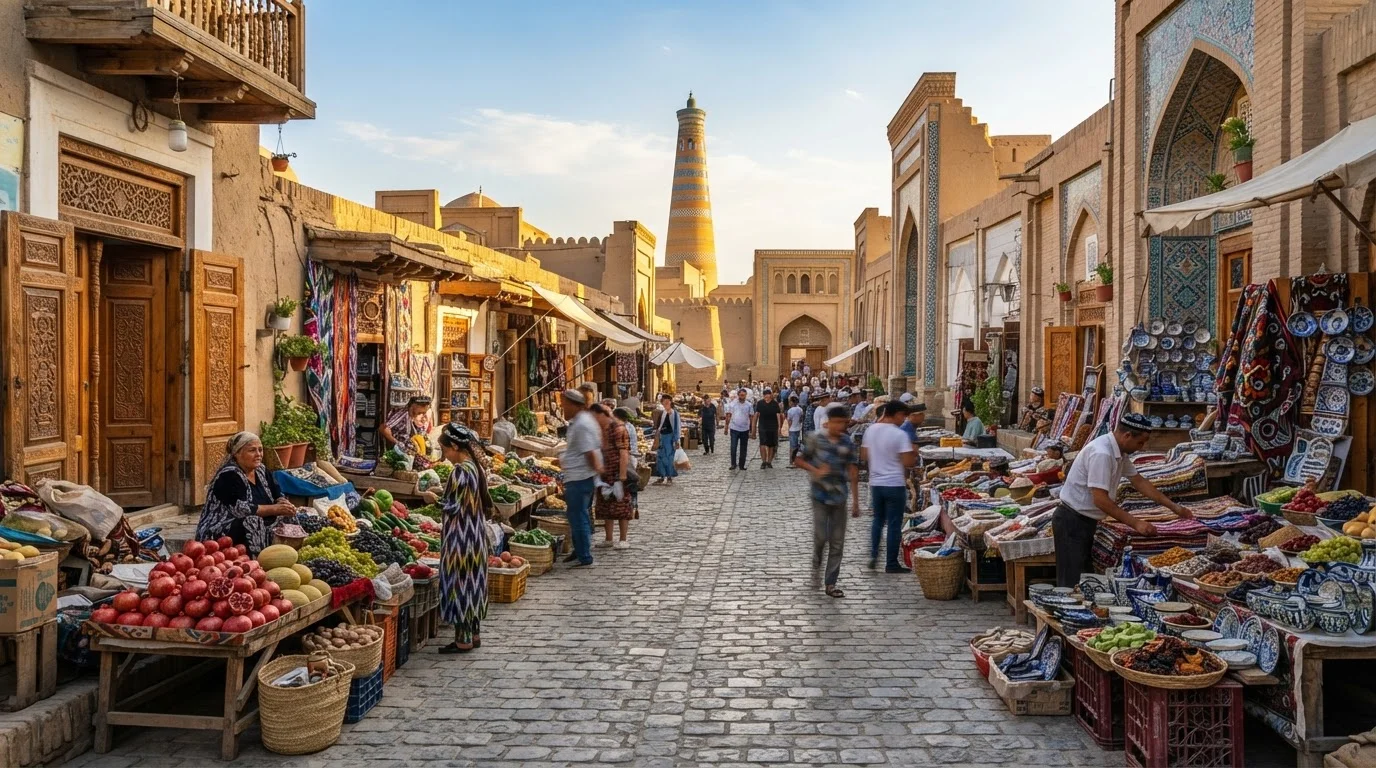
Uzbekistan's Silk Road cities — Samarkand, Bukhara, Khiva — contain some of the most architecturally striking sites in the world, and they're still genuinely affordable. Guesthouses in historic centers charge $15–25 for a private room. Local plov (rice pilaf) at a market stall costs under $2. Train travel between major cities on the Afrosiyob high-speed rail is comfortable and inexpensive by international standards.
The country has invested in visitor infrastructure over the past several years, making navigation easier without inflating prices significantly. Visa processes have also been simplified for many nationalities — verify current requirements through official sources before booking.
Silk Road landmarks and local meals in Uzbekistan remain accessible on a tight daily budget.
Bolivia
Bolivia is consistently among the least expensive countries in South America. Hostel dorms in La Paz run $7–12; private rooms in budget guesthouses are $15–20. Set lunch menus (almuerzo) at local restaurants — typically soup, a main course, and a drink — cost $2–4 and represent some of the best-value meals in the Americas.
The landscape is the main event: the Salar de Uyuni salt flat, Lake Titicaca, and the Yungas cloud forest are all accessible without expensive private tours if you're willing to use public transport and book through local operators. Altitude is a real consideration — La Paz sits above 11,000 feet — so factor in acclimatization time when planning.
Bolivia's almuerzo lunch menus provide a full cooked meal for $2–4 at local restaurants.
Cambodia
While neighboring Thailand and Vietnam get most of the Southeast Asia budget travel attention, Cambodia still offers lower costs in most categories. Outside of Siem Reap (where Angkor Wat drives up guesthouse prices slightly), towns like Kampot and Battambang offer private rooms for $10–18. Street food and market meals are $1.50–4. Local buses between cities cost $5–10.
For a fuller picture of what $40 a day looks like across the broader region, the Southeast Asia shoestring guide covers daily costs in detail. Cambodia's history and temples are substantive drawcards — Angkor alone justifies the trip — and the country's slower pace outside tourist centers rewards travelers who move beyond the obvious stops.
Cambodia's smaller towns offer private rooms and full meals well within a $40 daily budget.
Kosovo
Kosovo is one of Europe's least-visited countries and arguably its most underrated budget destination. Pristina, the capital, has a lively café culture, well-preserved Ottoman-era neighborhoods in Prizren, and hiking access to the Sharr Mountains — all at prices that feel closer to Southeast Asia than Western Europe. Hostel beds run $10–15; private rooms $20–30. A restaurant meal is $4–8.
The country uses the euro despite not being an EU member, which makes budgeting straightforward for US travelers converting from dollars. Public buses connect regional cities cheaply. Kosovo remains off most travelers' radar, which keeps prices stable and crowds thin at most sites.
Kosovo offers European cultural depth at daily costs that rival Southeast Asia's budget destinations.
Deciding between regions? The Eastern Europe vs. Southeast Asia budget comparison breaks down how costs and experiences differ across two of the world's most wallet-friendly travel zones. And if you've dismissed budget travel as inherently risky or uncomfortable, the myths about cheap travel piece is worth a read before you decide.
Making the Budget Work Once You Arrive
Accommodation and food are the obvious targets, but transport is where budgets quietly bleed out. Taxis from airports, private transfers, and ride-hailing convenience fees add up faster than most travelers anticipate. In every country on this list, local buses, minibuses, or shared taxis connect major destinations for a fraction of private transport costs — and they're the way locals actually travel. For a more systematic look at how transit spending inflates overall costs, the piece on hidden transport costs applies even when you're abroad.
Free and low-cost activities — hiking, public beaches, markets, religious sites that don't charge entry — should anchor your itinerary. Paid experiences (day tours, museum entry, cooking classes) work best when treated as occasional splurges rather than daily assumptions. With that structure, $40 a day in these destinations leaves room to breathe rather than requiring constant calculation.
This article provides general travel information for educational purposes only. Prices, conditions, visa requirements, and safety advisories change frequently. Always verify current entry requirements and travel conditions through official government sources and service providers before making travel decisions.
The content provided on our blog site traverses numerous categories, offering readers valuable and practical information. Readers can use the editorial team’s research and data to gain more insights into their topics of interest. However, they are requested not to treat the articles as conclusive. The website team cannot be held responsible for differences in data or inaccuracies found across other platforms. Please also note that the site might also miss out on various schemes and offers available that the readers may find more beneficial than the ones we cover.