

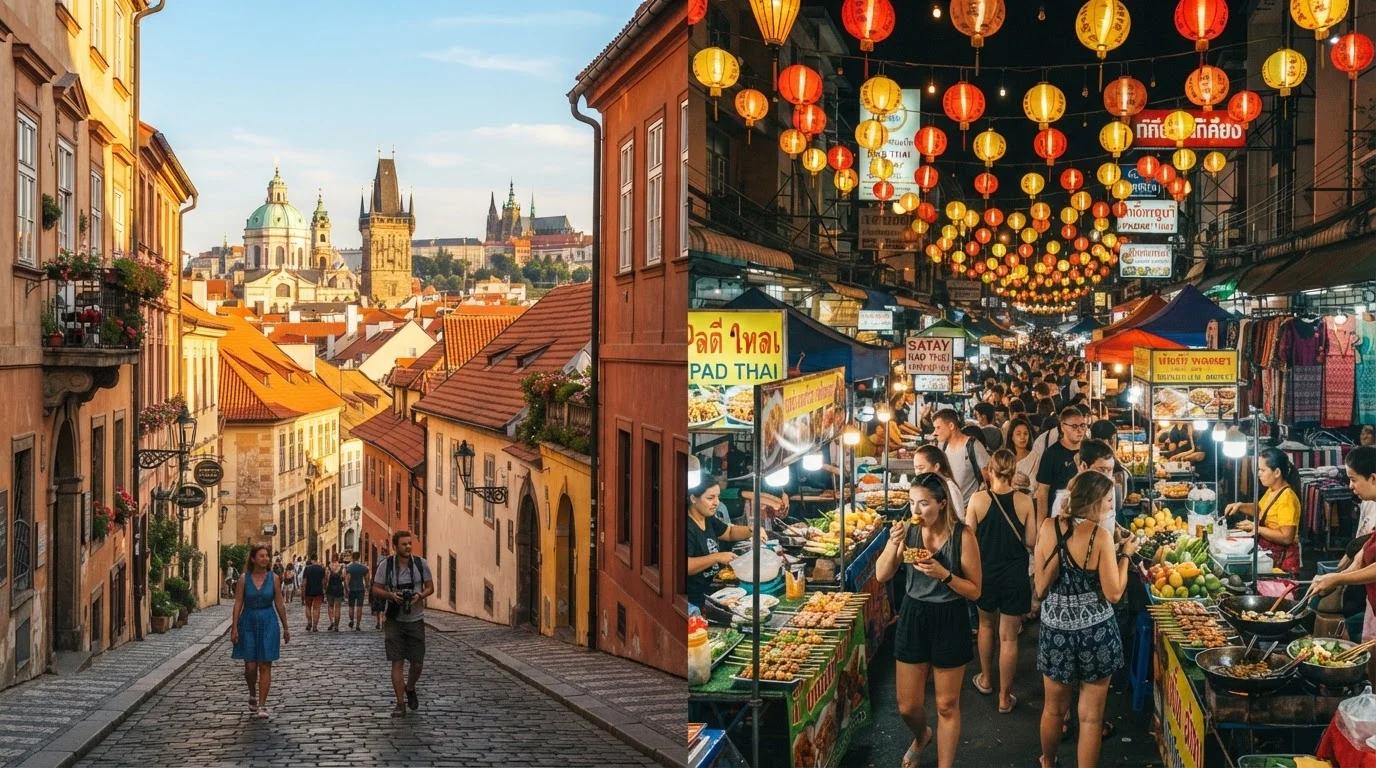
Option A
Eastern Europe
The culturally rich, underexplored value destination closer to home.
Best for: Travellers who want European history, architecture, and food culture without Western European price tags.
Option B
Southeast Asia
The classic ultra-budget region with unmatched day-to-day affordability.
Best for: Travellers prioritising the lowest possible daily spend, tropical landscapes, and diverse culinary experiences.
The Real Cost Breakdown: Daily Budgets Compared
Budget travel isn't just about where prices are low — it's about the full picture: getting there, moving around, eating, sleeping, and doing something worthwhile. Both Eastern Europe and Southeast Asia can comfortably accommodate travellers on $40–$60 a day, but they get you there differently.
In Southeast Asia, the floor is genuinely lower. In countries like Vietnam, Cambodia, and Laos, a hostel dorm runs $5–$10, street food meals average $1.50–$3, and intercity buses or trains rarely break $15. Travellers who embrace local eating and slow transport can feasibly get by on $30–$35 a day. See our realistic look at Southeast Asia daily costs for a country-by-country breakdown.
In Eastern Europe — particularly the Balkans (Albania, North Macedonia, Kosovo) and parts of Central Europe (Poland, Romania, Bulgaria) — daily costs are moderate by global standards but still far below Western Europe. Expect $12–$18 for a private room in a guesthouse, $5–$8 for a sit-down local meal, and $10–$20 for intercity bus or train legs. A realistic daily budget sits around $45–$65.
| Criterion | Eastern Europe | Southeast Asia |
|---|---|---|
| Avg. daily budget (budget traveller) | $45–$65 | $30–$50 |
| Hostel dorm bed | $12–$20 | $5–$10 |
| Local meal cost | $4–$8 | $1.50–$4 |
| Intercity transport | $10–$25 | $5–$15 |
| Round-trip flight from US (approx.) | $500–$850 | $700–$1,100 |
| Visa ease (US passport) | Mostly visa-free | Mostly visa-free or e-visa |
| English spoken widely | Yes, in cities | Yes, in tourist areas |
| Crowd levels at top sites | Low to moderate | Moderate to high |
For a broader regional comparison, the average daily travel costs reference guide puts both regions in useful global context.
Getting There: The Flight Cost Variable Nobody Talks About Enough
For US-based travellers, the price of getting there can erase weeks of in-country savings. This is where the comparison shifts significantly.
Flights from major US cities to Eastern Europe — particularly to hubs like Warsaw, Bucharest, or Sofia — frequently run $500–$850 round-trip in economy, with flight times of 9–13 hours. Flights to Southeast Asian hubs like Bangkok, Kuala Lumpur, or Ho Chi Minh City typically range $700–$1,100 and involve 18–26 hours of total travel time, often with a connection.
If you're based on the US West Coast, transpacific Southeast Asia fares can be competitive — sometimes comparable to or cheaper than East Coast-to-Europe routing. But if you're in the Midwest or East, Eastern Europe's geographic proximity is a genuine financial and logistical advantage that should be factored into any honest cost comparison.
Note: Airfare varies widely by season, advance booking time, and departure city. Always check multiple routing options before drawing conclusions about cost.Visas, Infrastructure, and Practical Friction
Ease of travel matters when you're on a tight schedule and tighter budget. Unexpected costs — visa fees, airport transfers, scams targeting tourists — add up fast.
Eastern Europe offers a relatively smooth experience for US passport holders. Most Balkan countries and EU member states in the region allow visa-free entry for 90 days. Train and bus networks are reliable in most countries, English is widely spoken in cities, and ATMs and card payments are broadly available. Albania, in particular, has emerged as a standout — offering Mediterranean landscapes at a fraction of nearby prices.
Southeast Asia is mostly visa-friendly for US travellers — Thailand, Vietnam (with e-visa), and most ASEAN nations allow straightforward entry — but the region demands more logistical flexibility. Transport between islands or remote areas requires careful planning, budget accommodation quality varies more sharply, and tourist infrastructure in some areas can make overpricing more common if you don't know local rates.
Entry Requirements Change — Always Verify
Visa policies, entry requirements, and health documentation rules can shift without much notice. Before booking, check official sources — the US State Department's travel information pages and the destination country's embassy website are the most reliable references. Do not rely solely on travel blogs or booking platforms for visa guidance.
Both regions reward travellers who research before arriving. Refer to official government sources (such as the US State Department's travel portal) for current entry requirements — visa rules change and published conditions here may not reflect the latest updates.
Culture, Experiences, and What Your Money Actually Buys
Budget travel isn't only about survival costs — it's about whether you're having experiences worth the trip. Both regions deliver, but in different registers.
Southeast Asia offers a density of natural and cultural diversity that is hard to match globally. In two weeks you can move from Thai temples to Vietnamese limestone karsts to Cambodian jungle ruins, all while eating extraordinary food for next to nothing. The region's tourism infrastructure is well-developed enough to be navigable, yet local enough that budget travellers can still feel off the beaten path in the right places.
Eastern Europe rewards slower travel. Cities like Plovdiv (Bulgaria), Mostar (Bosnia), and Kotor (Montenegro) deliver UNESCO-level history and architecture with a fraction of the foot traffic of Prague or Dubrovnik. The food scene — heavy on grilled meats, local cheeses, and cheap wine — satisfies without draining your daily budget. If underrated destinations appeal to you, consider pairing this region with our guide to countries where $40 a day goes surprisingly far.
One honest note: wherever you travel on a budget, spending mindfully matters. Squeezing prices aggressively in low-income communities has real local consequences. Our guide on travelling affordably without exploiting local economies is worth reading before either trip.
The content provided on our blog site traverses numerous categories, offering readers valuable and practical information. Readers can use the editorial team’s research and data to gain more insights into their topics of interest. However, they are requested not to treat the articles as conclusive. The website team cannot be held responsible for differences in data or inaccuracies found across other platforms. Please also note that the site might also miss out on various schemes and offers available that the readers may find more beneficial than the ones we cover.