

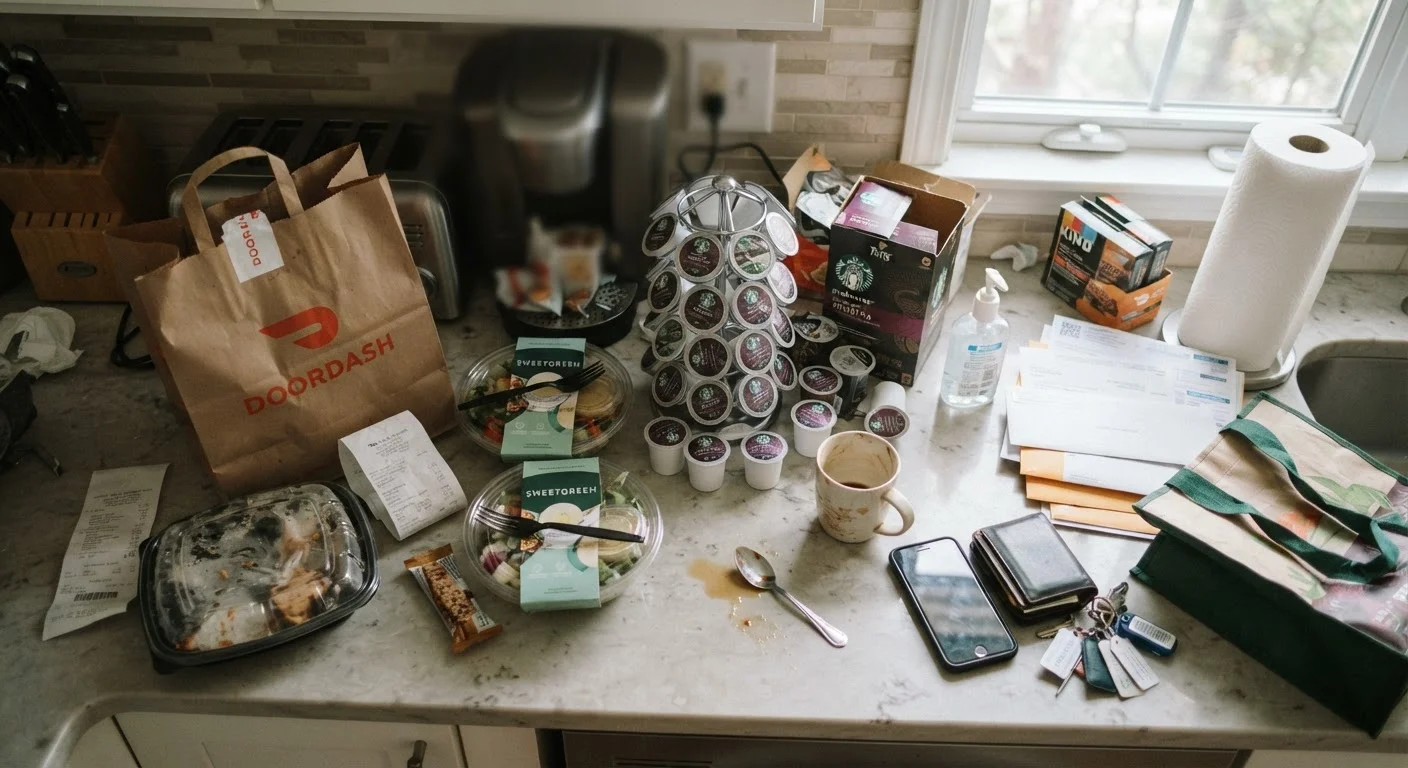
What 'Convenience Spending' Actually Means
Convenience spending isn't a character flaw — it's a rational response to being busy and stretched thin. When you're working full-time, managing a household, and trying to have some kind of life, paying a little extra to skip effort feels completely reasonable in the moment.
The problem isn't any single choice. It's that convenience spending is almost invisible by design. Each transaction is small enough to feel trivial, frequent enough to become automatic, and emotionally easy to justify. Nobody thinks twice about a $4 coffee pod or a $3 delivery fee — but those amounts are happening across dozens of categories, week after week.
This is what separates convenience costs from regular budget leaks. They don't show up as one obvious line item. They're diffused across grocery receipts, app charges, and order histories — and most people never add them up. For a deeper look at how daily small purchases compound, see how small purchases quietly drain budgets.
The Biggest Household Convenience Drains
Single-serve coffee pods. A box of 12 pods typically works out to $0.70–$1.00 per cup. Ground coffee brewed in a drip machine or French press can cost $0.10–$0.20 per cup for comparable quality. For a one-cup-a-day household, that's a difference of roughly $180–$290 a year — from one habit.
Pre-cut and pre-washed produce. Pre-cut bell peppers, shredded coleslaw mix, and spiralized zucchini often carry a 50–200% markup over buying the whole vegetable. A bag of pre-cut broccoli florets can cost three times more per pound than a whole head. Learning to read shelf unit prices is a foundational skill here — unit pricing explained covers exactly how to compare true costs at the shelf.
Food delivery fees and charges. The menu price is just the starting point. Delivery fees, service fees, small-order charges, and tipping stack on top. A $14 burrito bowl can realistically land at $22–$25 by the time it arrives. Habitual weekly orders add up fast.
Single-use and small-format packaging. Individual oatmeal packets, single-serve yogurt cups, and portioned snack packs all carry significant per-unit premiums over bulk equivalents. Buying a large tub of plain oats and portioning it yourself takes about 90 seconds and can cut per-serving cost by 60% or more.
2–4×
Cost premium for single-serve vs. bulk formats
Per-unit pricing comparisons across common grocery categories consistently show single-serve packaging costs two to four times more than bulk equivalents.
30–50%
Added cost from delivery fees and tips
Delivery fees, service charges, and standard tips routinely add 30–50% above the base menu price on food delivery orders.
$240/yr
Estimated annual savings switching from pods to ground coffee
Based on one cup per day at a per-cup cost difference of approximately $0.65, switching brewing methods can save roughly $240 annually per person.
Convenience store and gas station food purchases. A bottle of water or bag of chips at a gas station can cost two to three times the grocery store price. These purchases often happen impulsively — and they're rarely tracked.
Why These Costs Stay Hidden
Convenience spending survives budget scrutiny for a few structural reasons. First, the amounts are individually below most people's "worth worrying about" threshold. Second, they're categorized inconsistently — a delivery order might show up under "food," "entertainment," or an app name, making category totals misleading. Third, the time savings feel real and the cost feels abstract.
Recurring household charges compound this further. A water filter subscription, a cleaning supply delivery, a meal kit you didn't cancel — these overlap with convenience spending and are similarly easy to lose track of. Subscription creep is a related drain worth auditing separately.
The emotional layer matters too. Convenience purchases often happen when people are tired, hungry, or time-pressured — states that make scrutiny feel hard and spending feel justified. Recognizing that pattern is itself a useful step.
Practical Swaps That Don't Require Radical Change
The goal isn't to eliminate all convenience — it's to be intentional about which premiums you're actually paying for.
- Batch cook once a week. Two hours on a Sunday can produce lunches and dinners that make weeknight delivery orders feel unnecessary rather than essential.
- Buy whole produce, prep in advance. Wash and chop vegetables when you get home from the store. Pre-cut produce stops being a time-saver if you've already done the work.
- Switch to a manual brew method. A drip brewer, French press, or pour-over costs a modest one-time amount and produces coffee at a fraction of the per-cup pod price.
- Set a delivery "threshold." Reserve delivery for situations where you genuinely have no alternative rather than using it as a default. Even cutting delivery frequency in half produces meaningful annual savings.
- Buy staples in bulk formats. Oats, rice, dried beans, canned goods — buying larger pack sizes almost always reduces per-unit cost. Frugal food strategies covers this approach across the grocery category.
Start With One Month of Data
Before making any changes, pull up one month of bank or card statements and tag every purchase that involved a convenience premium — delivery, single-serve, pre-cut, gas station food. Total each category. Most people are surprised by at least one number. That surprise is your starting point, not a reason for guilt.
None of these swaps require perfection or deprivation. The goal is to redirect money you're currently spending on autopilot toward things you actually prioritize.
This article provides general financial information for educational purposes only and does not constitute personalised financial advice. For guidance tailored to your specific situation, consult a qualified financial adviser.
Frequently Asked Questions
It varies widely, but convenience premiums across coffee pods, delivery orders, and pre-packaged food can easily add up to several hundred dollars a month for a typical household. The total depends on how frequently each habit occurs and which categories are involved. Tracking spending by category for a single month often reveals the true figure.
Yes — when you factor in a delivery fee, service fee, and tip, a $15 meal can realistically cost $25 or more. Order twice a week and that gap compounds to over $1,000 a year above the base food cost. It's not the occasional order that's the problem; it's the default habit.
Not always — if pre-cut produce prevents food waste or enables you to cook rather than order out, the net cost may be lower. The key is being intentional. If pre-cut veg sits unused and you still order delivery, you're paying the premium twice.
Switching from single-serve coffee pods to a drip brewer or French press is one of the most impactful and low-friction changes. The upfront cost of equipment is typically recovered within a few weeks of daily use, and the ongoing per-cup cost drops substantially.
Review one month of bank or credit card statements and tag every purchase that could have been done cheaper with a little more time — delivery orders, convenience store stops, single-serve items, pre-made meals. Total each category. The ones that surprise you are your starting points.
No. This content is general financial information intended for educational purposes. It is not personalised financial advice. For guidance specific to your situation, consult a qualified financial adviser or accountant.
The content provided on our blog site traverses numerous categories, offering readers valuable and practical information. Readers can use the editorial team’s research and data to gain more insights into their topics of interest. However, they are requested not to treat the articles as conclusive. The website team cannot be held responsible for differences in data or inaccuracies found across other platforms. Please also note that the site might also miss out on various schemes and offers available that the readers may find more beneficial than the ones we cover.