

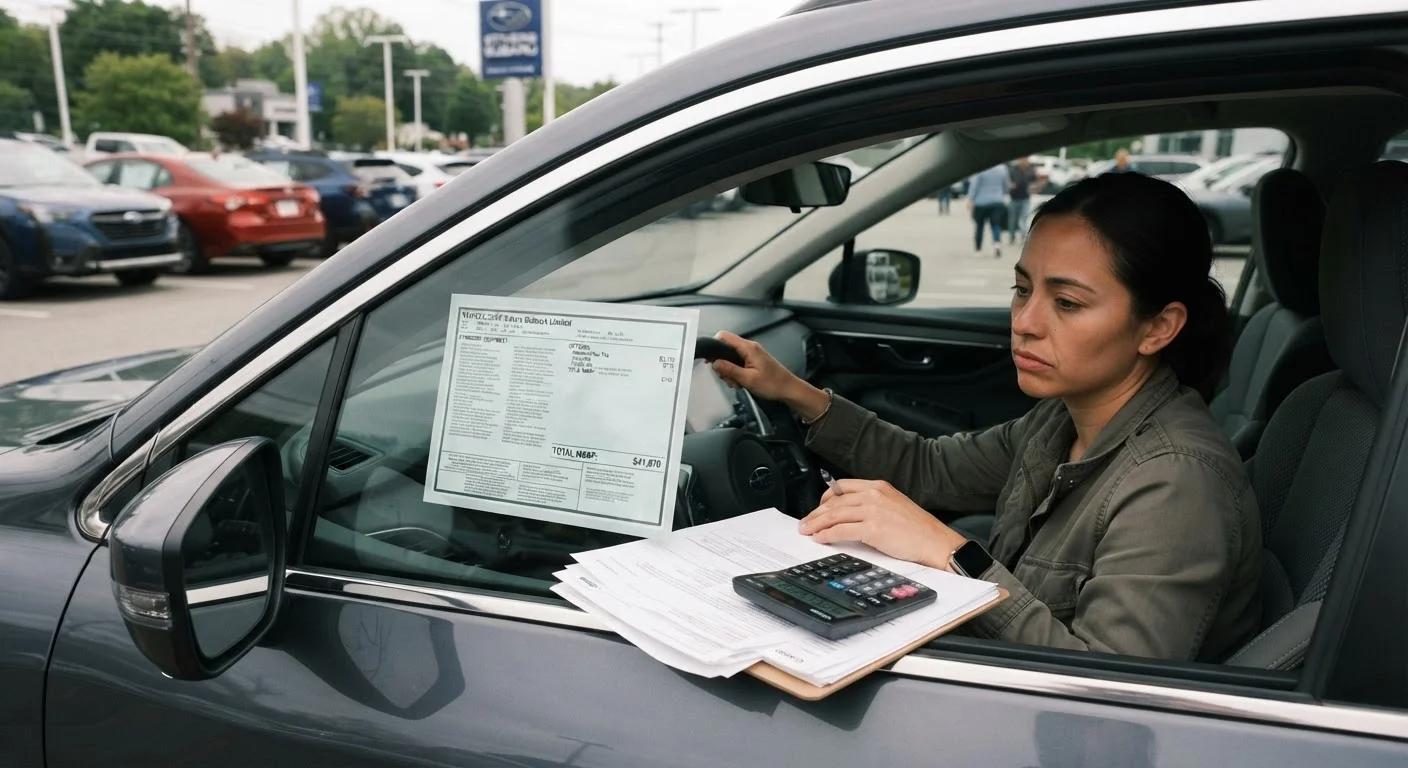
The price on the window is only the beginning
Walk onto any car lot and the sticker price feels like the main number. It's the figure in the ads, the one salespeople anchor to, and the number most buyers use to compare vehicles. But it's an incomplete number — sometimes by a wide margin.
Between taxes, government fees, dealer charges, financing interest, depreciation, insurance, fuel, and maintenance, the real cost of owning a car over several years is routinely thousands of dollars higher than the purchase price alone. According to AAA's annual driving cost research, the average American spends well over $10,000 per year to own and operate a new vehicle when all costs are factored in.
That doesn't mean buying a car is a bad financial decision — for most people, it's a practical necessity. But going in without a full picture of the costs is how people end up stretched thin or surprised. The list below breaks down every major cost layer that the sticker price quietly omits. For a broader look at the full annual picture, see what the true annual cost of owning a car looks like.
Sales tax and state fees
In most U.S. states, sales tax is calculated on the negotiated vehicle price — not the sticker. On a $30,000 vehicle in a state with a 7% sales tax rate, that's $2,100 added before you've signed anything. Some states also levy additional fees, such as tire disposal fees or environmental surcharges, that aren't included in any advertised price. Sales tax rates vary significantly by state and sometimes by county, so the same car can cost materially different amounts depending on where you register it.
Sales tax alone can add $2,000 or more to a vehicle's total purchase cost.
Dealer documentation and processing fees
Dealers routinely charge a documentation fee — sometimes called a "doc fee" — to cover the paperwork involved in processing a sale. According to consumer finance resources, these fees range from under $100 in capped states to over $800 in states with no legal limit. Unlike the vehicle price, doc fees are rarely negotiable. Other add-ons that may appear in the finance office include dealer-installed accessories, nitrogen tire fill, paint protection, and VIN etching — items that can silently inflate the final amount financed without being prominently disclosed upfront.
Documentation fees can exceed $800 in states with no cap — and they're rarely negotiable.
Annual registration and government fees
Registering a vehicle with your state motor vehicle agency is a recurring annual expense, not a one-time event. Costs vary widely by state and are often based on the vehicle's age, weight, or declared value. A new car can cost several hundred dollars to register in its first year. Some states also require annual or biennial emissions testing, which carries its own fee. For a complete picture of mandatory government charges, see a breakdown of road tax, registration, and government fees.
Registration fees recur every year and can reach several hundred dollars for newer vehicles.
Financing costs and interest
When a car is financed, the total amount repaid is always higher than the amount borrowed — sometimes significantly so. A $25,000 loan at 7% APR over 60 months results in roughly $4,900 in total interest paid. Stretching the loan to 72 or 84 months to lower the monthly payment increases total interest further and raises the risk of being "underwater" — owing more than the car is worth. The advertised monthly payment never reflects the true cost of financing; only the full loan disclosure does.
A five-year car loan can add nearly $5,000 in interest on top of the vehicle's purchase price.
Depreciation
Depreciation is the difference between what you paid for a car and what it's worth when you sell or trade it in. According to AAA's annual "Your Driving Costs" study, depreciation consistently ranks as the largest single ownership cost — averaging thousands of dollars per year for new vehicles. A new car can lose 15–25% of its value in its first year alone. This cost doesn't show up on any invoice, but it is real money leaving your net worth over time. Understanding depreciation is central to evaluating whether buying new, buying used, or leasing makes financial sense for your situation.
Depreciation is the biggest ownership cost most buyers never see on a single document.
Insurance premiums
Auto insurance is legally required in nearly every state, and premiums are determined by factors well beyond your control — your zip code, driving record, credit score (in most states), and the specific vehicle you choose all influence what you'll pay. A car with a high theft rate or expensive repair costs will carry a higher insurance premium regardless of its sticker price. Lenders typically also require comprehensive and collision coverage for financed vehicles, which raises premiums further. It's worth getting insurance quotes before finalizing a vehicle choice, not after.
Insurance costs vary dramatically by vehicle — always get quotes before you commit to a purchase.
Fuel costs over ownership
Fuel is a cost most buyers understand exists, but few calculate honestly before purchasing. The U.S. Department of Energy's fueleconomy.gov provides estimated annual fuel costs based on EPA ratings and average fuel prices. The gap between a vehicle rated at 25 mpg and one rated at 35 mpg can translate to $500–$1,000 or more in annual fuel spending depending on how much you drive and local gas prices. Over five years of ownership, that difference compounds significantly. A lower sticker price paired with poor fuel economy may cost more overall than a slightly pricier, more efficient alternative.
A 10 mpg difference between two vehicles can mean $500–$1,000 more in annual fuel costs.
Maintenance and unexpected repairs
Routine maintenance — oil changes, tire rotations, brake service, filters, and fluid replacements — adds up across the years of ownership. AAA estimates routine maintenance costs for a new sedan at several hundred dollars annually, with that figure rising as a vehicle ages. Unexpected repairs are harder to predict but statistically inevitable over a multi-year ownership period. Skipping routine maintenance to cut costs in the short term typically leads to larger repair bills later. For practical ways to manage these costs without cutting corners on reliability, see the car maintenance savings hub.
Skipping routine maintenance to save money now almost always leads to larger repair bills later.
Add it all up before you sign anything
Every item on this list is knowable before you commit to a purchase — none of it has to be a surprise. Sales tax rates are public. Doc fees can be requested upfront. Insurance quotes take minutes. Loan calculators are free. Fuel cost estimators are available on government websites. Depreciation data is published by independent automotive research firms.
The habit that protects your budget is simple: build a total cost of ownership estimate before you fall in love with a specific vehicle. If you've already bought and want to audit what you're currently spending, an annual car ownership cost audit is a structured way to find where the money is going. And if this is your first vehicle purchase, a guide to ongoing costs for first-time car owners walks through each recurring expense in plain language.
This is general information, not financial advice
The figures and ranges in this article are illustrative and based on publicly available data sources. Your actual costs will depend on your state, credit profile, vehicle choice, and driving habits. For decisions about financing, insurance coverage, or major vehicle purchases, consider consulting a licensed financial adviser or insurance professional familiar with your specific circumstances.
This article is for general informational purposes only and does not constitute financial, legal, or insurance advice. Costs and regulations vary by state and individual circumstance. Consult a qualified professional before making significant financial decisions.
The content provided on our blog site traverses numerous categories, offering readers valuable and practical information. Readers can use the editorial team’s research and data to gain more insights into their topics of interest. However, they are requested not to treat the articles as conclusive. The website team cannot be held responsible for differences in data or inaccuracies found across other platforms. Please also note that the site might also miss out on various schemes and offers available that the readers may find more beneficial than the ones we cover.