

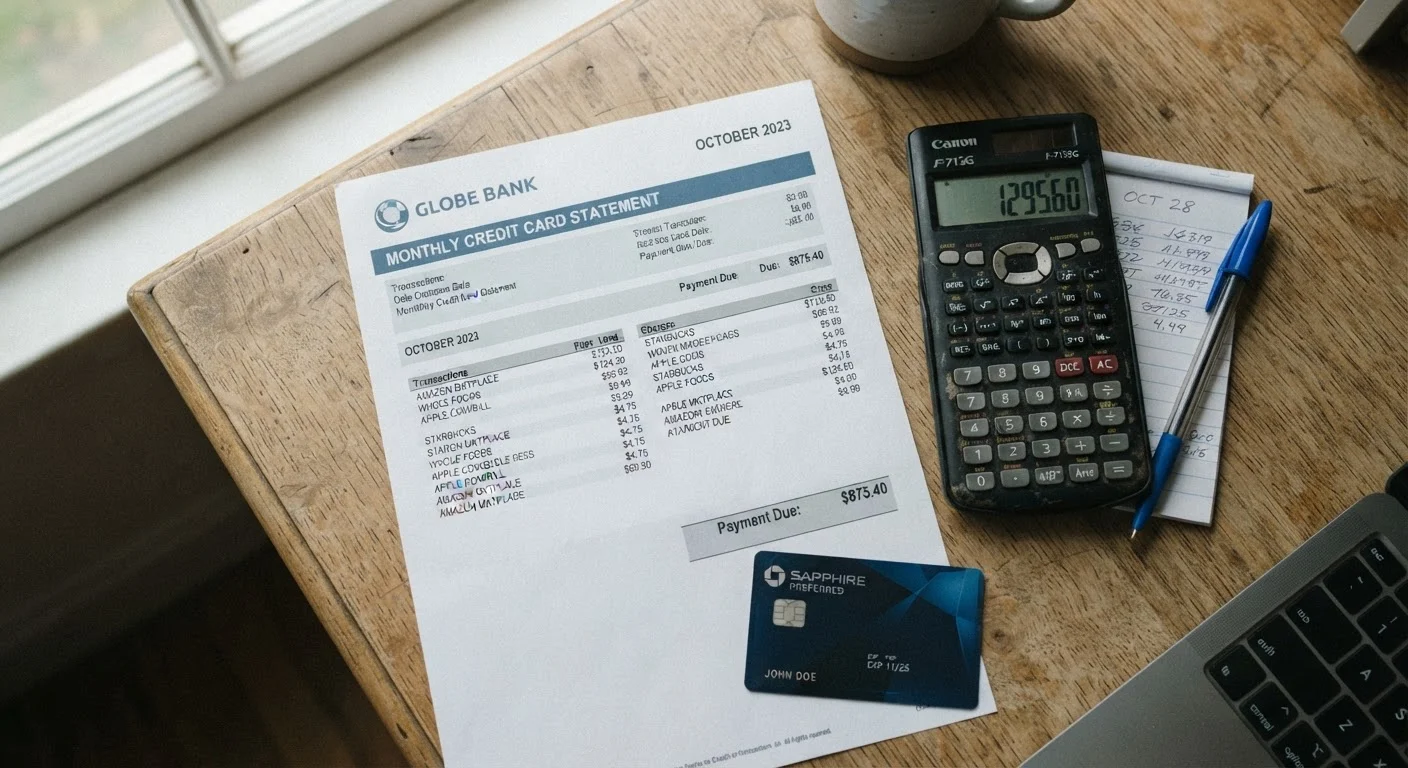
Why Minimum Payments Feel Safe But Aren't
Credit card statements display the minimum payment prominently, often right next to a much larger total balance. For a budget-conscious household managing multiple bills, the smaller number is naturally appealing. It fits the cash flow. It keeps the account current. And it feels responsible.
What the statement does not foreground is what that choice costs over time. Because minimum payments are structured to shrink alongside your balance, they create what debt researchers sometimes call a "revolving trap" — a payoff schedule that quietly stretches from months into years. For many borrowers, the minimum payment is not a stepping stone to being debt-free; it is a floor designed to keep the account profitable for the issuer.
Understanding this dynamic is not about blame — it is about knowing exactly what the math looks like so you can make an informed decision. For a deeper look at how interest compounds against you, see common interest rate misconceptions that extend debt timelines unnecessarily.
The Math Behind the Minimum
Consider a $3,000 credit card balance at a 20% annual percentage rate (APR) — close to the national average for cards that carry a balance. If your issuer sets the minimum at 2% of the outstanding balance, your first payment would be $60. That sounds manageable.
But here is what happens next: roughly $50 of that $60 covers the month's interest, leaving only $10 applied to the principal. The following month, your minimum recalculates on the slightly lower balance. And the month after that. Because the minimum shrinks as the balance falls, the payoff timeline extends dramatically — often beyond ten years for a balance of this size, with total interest paid potentially exceeding the original amount borrowed.
~10+ years
Estimated payoff time at minimums on $3,000 at 20% APR
Based on a 2% minimum payment calculation where the minimum shrinks as the balance falls — a common issuer formula in the US.
20%+
Average APR for credit cards carrying a balance
The Federal Reserve tracks average credit card interest rates; rates for accounts assessed interest have consistently exceeded 20% in recent years.
$1,000+
Potential interest on a $3,000 balance paid at minimums
Total interest paid varies by APR and issuer formula, but commonly exceeds 30–40% of the original balance over a multi-year payoff period.
This is not a hypothetical edge case. It reflects how revolving credit is structurally designed to work. The issuer earns more when you pay slowly; you pay more when you do not understand the schedule you are on.
The Hidden Cost in Real Terms
Interest does not just add a flat fee — it compounds. Each month, unpaid interest is added to your balance, and the following month's interest is charged on that higher total. Over time, this means you are effectively paying interest on interest, which is why the total cost of a balance paid at minimums can far exceed the sticker price of whatever you originally charged.
Consider everyday spending patterns — subscription services, convenience fees, impulse purchases. Small purchases that feel minor are often the ones that accumulate on cards and then sit at interest for months. The compounding effect means a $200 appliance bought on a card and paid at minimums could cost $300 or more by the time it is fully cleared.
These costs are entirely avoidable with a modest change in payment strategy — which brings us to what you can actually do about it.
A Smarter Payment Approach on a Tight Budget
You do not need to pay off your full balance each month to break the minimum payment cycle. The most effective shift is moving from a percentage-based minimum to a fixed monthly payment that does not shrink as the balance falls.
If you can afford $100 per month consistently — rather than the minimum that might start at $60 and eventually drop to $30 — you put steady, predictable pressure on the principal. Payoff timelines compress significantly, and total interest paid drops substantially. Running the numbers using your issuer's APR and current balance is a concrete first step; most issuers are required to show estimated payoff timelines on your statement under federal disclosure rules.
For households juggling debt alongside regular expenses — car costs, home bills, tech subscriptions — integrating a fixed debt payment into your monthly budget works the same way any other fixed expense does. See how a structured approach can apply to larger recurring costs in this overview of building a realistic car ownership budget. The principle is the same: know your fixed obligations, then plan around them.
Set a Fixed Payment, Not a Minimum
Instead of paying whatever your statement lists as the minimum, choose a fixed dollar amount you can sustain — ideally 3–5 times the starting minimum. Set it as an automatic payment so it does not shrink as your balance falls. This single habit change can cut years off your payoff timeline and save significant interest.
This article is for general informational purposes only and does not constitute personalised financial or legal advice. For guidance tailored to your specific situation, consult a licensed financial professional.
Frequently Asked Questions
Your account stays in good standing, so you avoid late fees and credit score damage. However, interest continues to compound on the remaining balance, meaning a large portion of each payment goes toward interest rather than principal. Over time, this can cost you far more than the original purchase price.
Most issuers use one of two methods: a flat percentage of the balance (commonly 1–3%), or 1% of the principal plus that month's interest and fees, whichever is higher. There is also usually a dollar floor — often $25 or $35 — so the minimum never drops below a set threshold.
Paying the minimum on time does not directly harm your credit score. However, carrying a high balance relative to your credit limit — known as credit utilization — can lower your score. Keeping utilization below 30% is a commonly cited guideline among credit counselors.
Even a fixed extra $25–$50 per month on a typical card balance can shave years off your repayment timeline and save hundreds of dollars in interest. The key is paying a consistent fixed amount rather than letting the minimum shrink as the balance falls.
In a genuine short-term cash crunch, paying the minimum preserves your credit standing and avoids fees. It becomes a problem when it is the default strategy rather than a temporary measure — that is when interest costs quietly compound into a much larger debt.
The content provided on our blog site traverses numerous categories, offering readers valuable and practical information. Readers can use the editorial team’s research and data to gain more insights into their topics of interest. However, they are requested not to treat the articles as conclusive. The website team cannot be held responsible for differences in data or inaccuracies found across other platforms. Please also note that the site might also miss out on various schemes and offers available that the readers may find more beneficial than the ones we cover.