

Why Most Car Budgets Fall Apart
Most people build their car budget around one number: the monthly payment. That's understandable — it's the number the dealership quotes and the one that hits your bank account on the same date every month. The problem is it typically covers only the loan principal and interest. Everything else — fuel, insurance, maintenance, registration, and the slow drain of depreciation — gets left out entirely.
Research from AAA has consistently found that the average cost of owning and operating a vehicle runs well above $10,000 per year when all expenses are included. That works out to well over $800 a month. If your budget only accounts for a $350 loan payment, you're already several hundred dollars short before you've filled the tank.
This guide walks you through each cost category and gives you a method for estimating your real monthly number. For a broader look at how these costs stack up annually, see our breakdown of the true annual cost of owning a car.
Track Actuals, Not Estimates
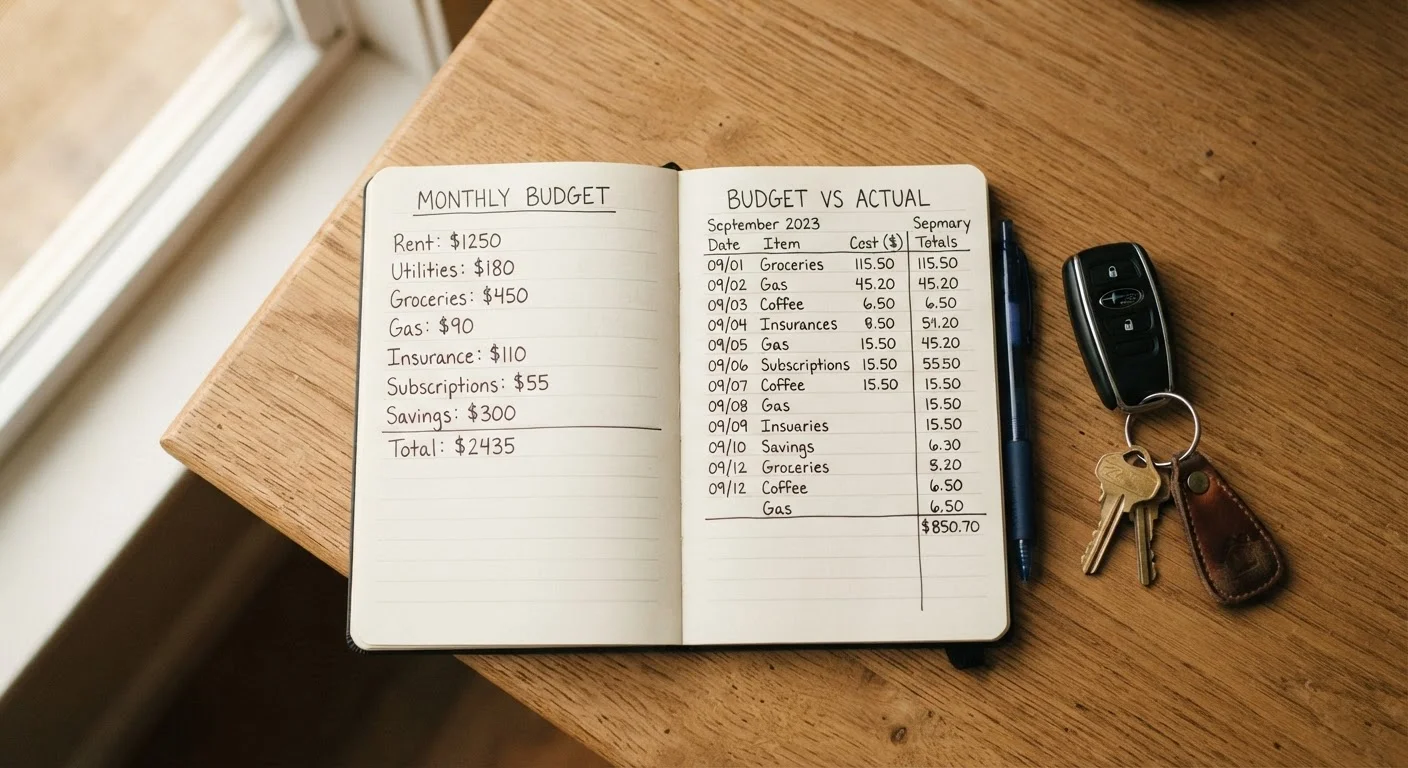
The most reliable way to know your real car costs is to log every expense — fuel receipts, service invoices, registration fees — in a spreadsheet or notes app for three to six months. Estimates give you a starting point; actual data gives you a budget that holds. If you're new to tracking these costs, our guide for first-time car owners on ongoing costs is a useful companion.
The Full Cost Picture: Every Category You Need to Account For
Before you can build a realistic budget, you need to know what belongs in it. Here are the categories every owner should track:
- Loan repayment — principal plus interest. If you financed your vehicle, this is the most visible cost. Keep in mind that paying only minimums extends the loan and increases total interest paid. Our article on how minimum payments work explains this in detail.
- Insurance — premiums vary significantly by vehicle type, your driving record, location, and coverage level. Get a current quote and use the actual monthly figure, not a rough guess.
- Fuel — calculate your average monthly mileage, divide by your vehicle's real-world fuel economy, and multiply by the current price per gallon. Check the fuel and insurance hub for practical ways to reduce this cost.
- Routine maintenance — oil changes, tyre rotations, filters, wiper blades, and brake pads. These are predictable but easy to underestimate. A general rule of thumb is to budget $100–$150 per month for a vehicle with fewer than 80,000 miles, more for higher-mileage cars. See why maintenance costs catch so many owners off guard for a full breakdown.
- Repair reserve — unplanned repairs are not optional costs; they're deferred certainties. Setting aside $75–$100 per month into a separate savings buffer means a busted alternator or a set of tyres doesn't blow up your monthly plan. For more on handling unexpected large expenses, see what happens to your budget when a big expense hits unexpectedly.
- Registration, road tax, and fees — these are annual or biannual obligations. Divide the total by 12 and include the monthly equivalent in your budget. Our article on road tax, registration, and government fees covers what to expect in each category.
- Depreciation — your vehicle loses value every month, even if it's parked. This isn't a bill you pay, but it's a real financial loss that affects your net worth and your options when you eventually sell or trade in. The owning vs. leasing comparison covers how depreciation affects both paths differently.
The content provided on our blog site traverses numerous categories, offering readers valuable and practical information. Readers can use the editorial team’s research and data to gain more insights into their topics of interest. However, they are requested not to treat the articles as conclusive. The website team cannot be held responsible for differences in data or inaccuracies found across other platforms. Please also note that the site might also miss out on various schemes and offers available that the readers may find more beneficial than the ones we cover.