

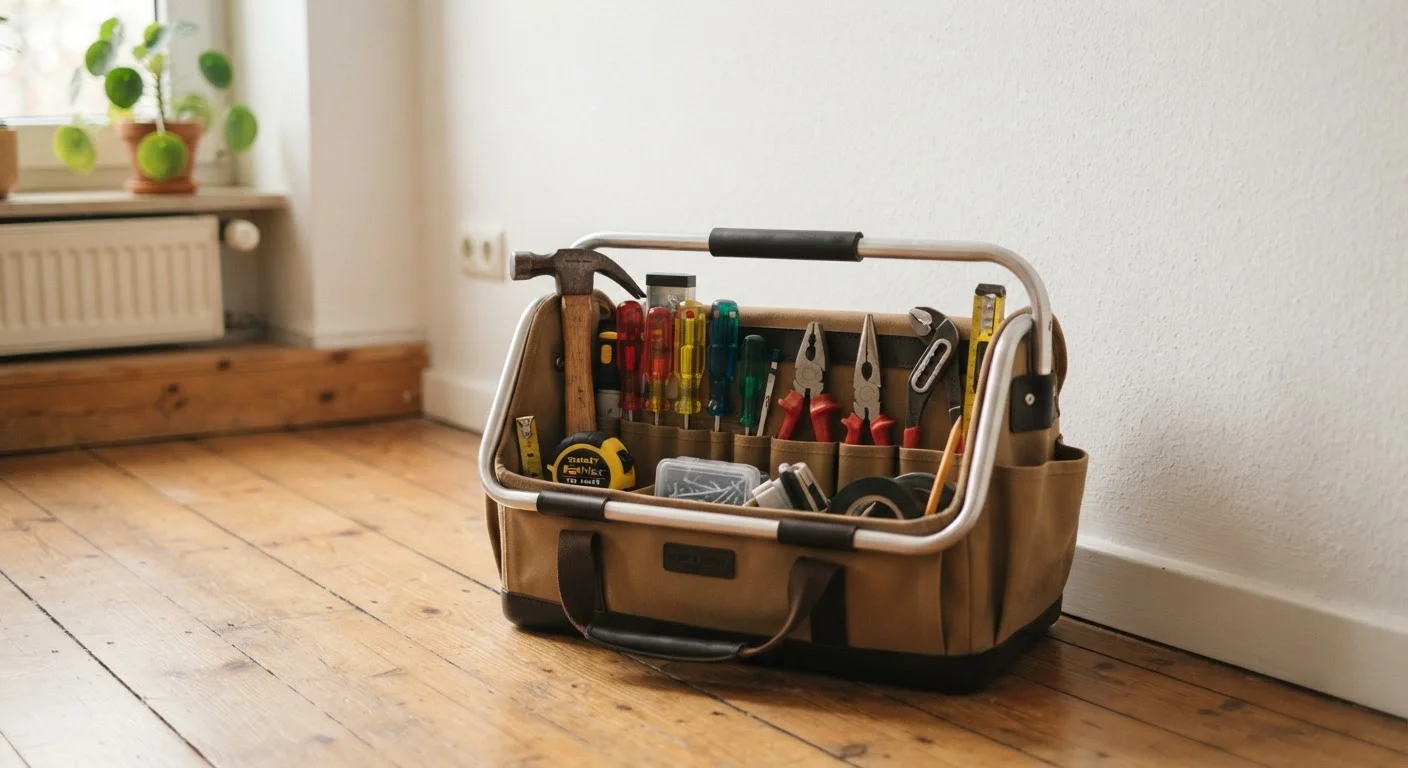
Why Renters Should Own Their Own Tools
Waiting on a landlord to fix a loose cabinet hinge or a stuck window latch can mean days of inconvenience — and in some cases, small problems worsen while you wait. Owning a focused set of hand tools lets you resolve minor issues quickly, protect your security deposit by making clean repairs, and build genuine confidence in your space.
The goal isn't to replace a licensed professional — electrical work, gas lines, structural repairs, and plumbing that connects to the mains all require a qualified tradesperson. The goal is to handle the low-stakes, everyday stuff that would otherwise cost you time, money, or leverage with your landlord. For a clear breakdown of which repairs fall safely into the DIY category, see our guide to beginner-safe DIY repairs.
A renter's toolkit doesn't need to be large. It needs to be right. The items below represent the tools and supplies that cover the widest range of common apartment fixes with the smallest footprint.
The Core Hand Tools Every Renter Needs
Start here. These tools handle the majority of everyday repairs in a rental unit:
- Screwdrivers (flathead and Phillips, multiple sizes): Cabinet hardware, outlet covers, curtain rods, furniture assembly — nearly everything is held together by a screw. A set with interchangeable bits gives you flexibility in a small package.
- Hammer: Picture hanging, tapping in anchors, minor adjustments. A 16-oz claw hammer is the versatile middle ground.
- Tape measure (25 ft): Essential before you hang anything, buy furniture, or need to describe a repair to a landlord accurately.
- Needle-nose pliers and slip-joint pliers: Gripping, bending, pulling nails, tightening loose fittings on fixtures.
- Utility knife: Scoring, trimming, opening packaging without damaging surfaces.
- Level (9–12 inches): Hanging shelves and art straight the first time prevents unnecessary wall damage.
- Hex key set (Allen wrenches): Flat-pack furniture, bike adjustments, many bathroom fixtures.
These seven categories cover the bulk of what renters encounter. Pair them with the seasonal maintenance checklist to stay ahead of issues year-round.
Supplies and Consumables to Stock
Tools accomplish little without the right materials on hand. Keep a small supply cache stocked with these essentials:
- Wall anchors and screws (assorted): Drywall in most apartments can't hold weight from studs alone. Plastic expansion anchors and toggle bolts let you hang shelves and mirrors securely.
- Painter's tape: Protects surfaces during touch-ups and helps you mark clean lines without damaging painted walls.
- Spackle or lightweight joint compound: Small nail holes and minor dings can be filled and sanded smooth before move-out, protecting your deposit.
- WD-40 or a dry lubricant spray: Squeaky hinges, stiff locks, stuck drawer slides — a lubricant resolves most friction problems without tools.
- Duct tape and electrical tape: Temporary fixes and insulation for minor wire abrasions (note: exposed wiring should always be inspected by a licensed electrician).
- Replacement batteries (AA, AAA, 9V): Smoke detectors, remotes, and thermostats will drain batteries at inconvenient times.
- Microfiber cloths and isopropyl alcohol: Surface prep before any adhesive or spackle application dramatically improves results.
Tracking which supplies run low is easier if you fold it into a broader household review. Our monthly household cost audit includes a room-by-room checklist that can help you spot maintenance needs before they become expensive problems.
Organising and Storing Your Toolkit Wisely
In small apartments, storage is as important as what you store. A canvas tote or a compact plastic toolbox with a tray insert keeps everything accessible without consuming closet space. Group screwdrivers and bits in one pocket, pliers together, and keep consumables in a separate zip bag or small bin.
Label your supplies if you share a space — it reduces the time spent hunting and ensures nothing walks off. Store sharp tools (utility knives, chisels) with blade guards or in a roll-up pouch to prevent injury when reaching in quickly.
A well-organised toolkit also makes it easier to communicate with your landlord. Being able to describe a problem precisely — using measurements, identifying hardware types — puts you in a stronger position when requesting professional repairs for issues outside your scope. For a sense of what you can confidently tackle yourself versus what warrants a call, revisit our beginner DIY repair guide.
This article is for general informational purposes only. Always verify local lease terms before making repairs, and consult a licensed professional for any work involving electrical systems, plumbing mains, structural elements, or gas lines.
The content provided on our blog site traverses numerous categories, offering readers valuable and practical information. Readers can use the editorial team’s research and data to gain more insights into their topics of interest. However, they are requested not to treat the articles as conclusive. The website team cannot be held responsible for differences in data or inaccuracies found across other platforms. Please also note that the site might also miss out on various schemes and offers available that the readers may find more beneficial than the ones we cover.