

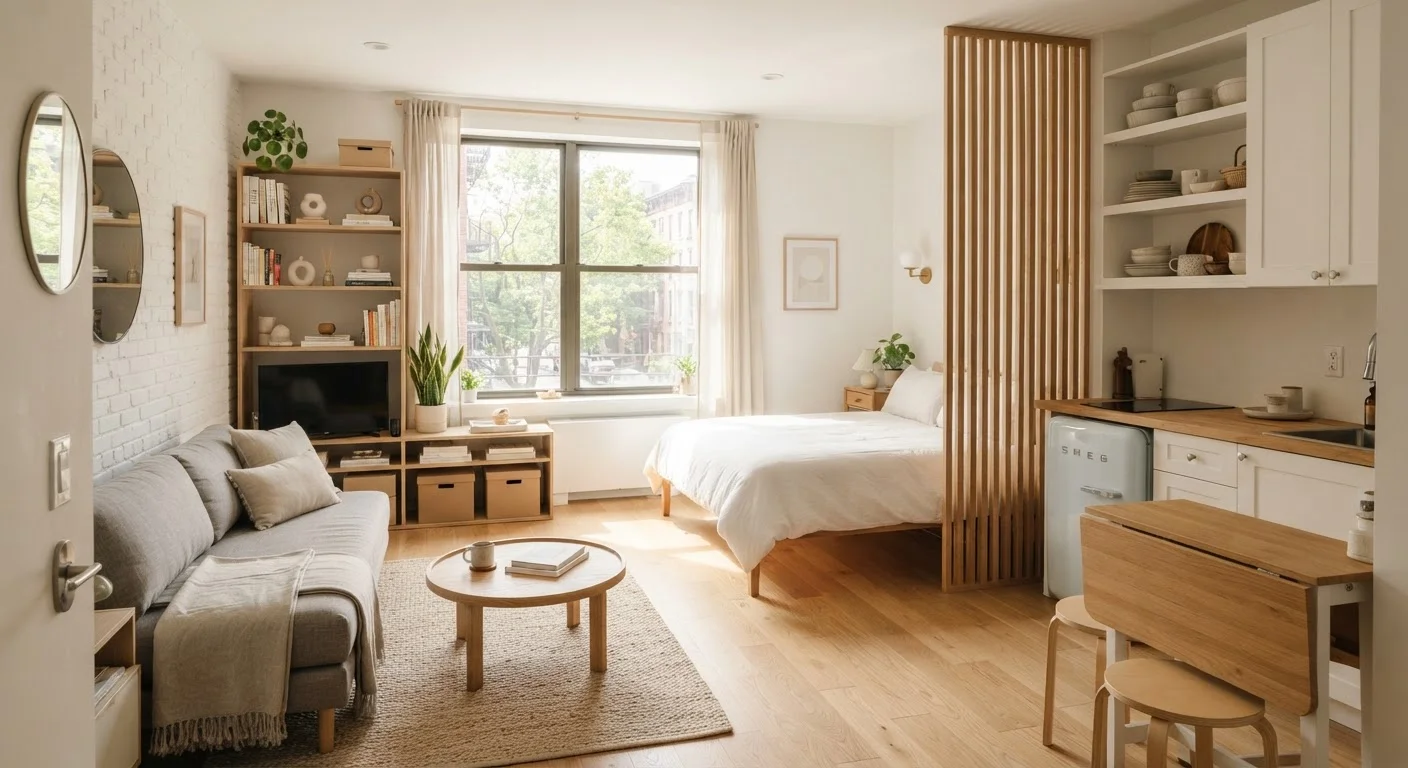
Why Small-Space Living Requires a Long-Term Strategy
Most small-home advice focuses on a single weekend fix — one big declutter, one IKEA haul, one organizational overhaul. But a truly functional small home isn't built in a weekend. It's built through layered decisions that compound over time: layout choices that stay practical through life changes, storage systems you actually maintain, and habits that stop clutter from re-accumulating.
For budget-conscious millennials juggling roommates, remote work, side hobbies, and shifting household needs, the stakes are real. A disorganized small home isn't just inconvenient — it's mentally draining and financially wasteful when you keep buying organizers that don't solve the root problem.
This guide covers every layer of the puzzle. Whether you're in a 450-square-foot studio or a modest two-bedroom, the principles below are designed to work together — and to keep working as your life evolves. For a broader look at trimming household costs while maintaining comfort, see the Complete Starter Framework for Cutting Household Expenses.
Layout Principles That Actually Work
Layout is the foundation. Before you buy a single storage bin, map how you actually move through your space on a typical weekday. Identify your activity zones — sleeping, working, cooking, relaxing — and ask whether each zone has the square footage and proximity it genuinely needs.
- Define zones with rugs, not walls. Area rugs visually separate a living space from a sleeping or working area without closing off airflow or light.
- Keep traffic paths clear. A 36-inch clearance around furniture is the ergonomic minimum for comfortable daily movement.
- Anchor large furniture to walls. Floating a sofa away from a wall can work in large rooms, but in small spaces it typically fragments the floor plan. Wall-adjacent placement preserves open sightlines.
- Prioritize natural light paths. Avoid placing tall bookshelves or furniture in front of windows. Natural light makes rooms read as larger; blocking it negates that effect entirely.
Revisit your layout seasonally. Working from home in winter may require your desk closer to a heat source; summer may shift where you spend leisure time. Treating your floor plan as fixed is one of the most common small-space mistakes.
Before buying any storage product, live with your space for at least two weeks and note exactly where things pile up naturally. Design your storage system around real behavior, not ideal behavior.
Storage solutions fail most often because they're designed for an imagined routine rather than an actual one. Observation first, purchase second, dramatically improves retention of the system over time.
When evaluating furniture for a small home, measure the clearance it requires to function — a drawer that needs 24 inches of swing space can make a tight bedroom genuinely unusable.
Functional clearance is as important as footprint dimensions, yet it's rarely listed on product pages. Many small-space frustrations trace directly to furniture that can't be used as intended in the available space.
Storage Systems Built to Last
The problem with most small-home storage solutions is that they address symptoms rather than systems. Buying a drawer organizer for a chaotic junk drawer is a band-aid. A lasting system starts with an honest inventory of what you own, what you actually use, and how frequently.
The Three-Tier Framework
- Prime real estate (eye level, arm's reach): Items used daily or weekly belong here — cooking tools, work supplies, personal care items.
- Secondary storage (lower shelves, overhead cabinets): Seasonal items, occasional-use gear, backup supplies.
- Archive storage (under-bed, high shelves, closet corners): Things kept for genuine long-term need — tax documents, sentimental items, emergency supplies.
Vertical space is chronically underused. Wall-mounted shelving, over-door organizers, and stackable bins on top of cabinets can effectively expand your storage square footage without touching the floor plan. For renters, damage-free mounting hardware (adhesive rail systems, tension rods) has improved significantly and can support meaningful loads when installed per manufacturer guidelines.
Explore how entry-level smart home basics can complement your storage systems — motion-activated cabinet lighting and smart plugs for small appliances are inexpensive additions that make organized spaces more functional.
Daily Habits That Prevent Clutter Creep
Clutter is rarely the result of a single bad day. It accumulates in micro-increments — a bag left by the door, mail piled on the counter, a jacket draped over a chair. In a small home, those micro-increments become overwhelming faster than in a larger space. Prevention requires building habits into your existing routines, not adding new chores.
- The 10-minute reset. Set a consistent daily window — after dinner, before bed — to return items to their designated homes. Ten minutes done daily prevents the two-hour weekend catch-up.
- One-in, one-out rule. Every new item entering the home displaces an existing one. This isn't minimalism philosophy — it's a practical volume cap for a finite space.
- Staged entry point. Place a small tray, hook array, or shelf at your front entry specifically for the items that migrate: keys, bags, shoes, mail. A defined drop zone prevents surface spread.
- Inbox for undecided items. A single small basket for items you're unsure about keeps uncertainty from spreading across surfaces. Review and clear it weekly.
Habits also extend outside the home. A lower-acquisition mindset — shopping intentionally rather than opportunistically — is one of the most effective long-term small-space strategies available.
Mindset Shifts for Long-Term Contentment
Small-home frustration often isn't about the space itself — it's about comparing it to a mental model of what a home should look like. Reframing that model is practical, not just philosophical.
Constraints are design briefs. Professional designers routinely work within strict size limitations. Treating your space as a design challenge — what's the smartest possible use of this square footage? — activates problem-solving rather than resentment.
Multipurpose beats single-purpose. A dining table that doubles as a desk, a storage ottoman that serves as seating and a coffee table — these aren't compromises, they're intelligent design decisions. Every item in a small home should earn its keep.
Outdoor space extends your home. A balcony, shared courtyard, or nearby park functions as an additional room when you design your lifestyle to use it. For those with outdoor access, low-effort greenery can meaningfully improve how your overall living environment feels. Our guide to building a low-maintenance garden offers practical starting points even for small outdoor areas.
Contentment in a small home is a skill, and like any skill it improves with deliberate practice and honest self-assessment.
Budget-Conscious Upgrades That Add Real Value
Not all small-home improvements require significant investment. Several targeted upgrades deliver disproportionate impact relative to their cost.
Lighting
Dim rooms feel cramped; well-lit rooms feel larger. Swap out single overhead fixtures for layered lighting — a floor lamp, under-cabinet lighting, or a desk lamp — to create depth and make spaces feel more livable without touching the ceiling. Warm-white bulbs (2700K–3000K range) generally make small interiors feel more inviting than cool-white alternatives.
Mirrors
Strategically placed mirrors reflect light and visually extend sightlines. A full-length mirror leaned against a wall, or a large-format mirror mounted opposite a window, creates a genuine perception of additional space at minimal cost.
Cohesive Color
A consistent color palette across walls, large furniture, and textiles reduces visual noise. In small spaces, visual noise reads as physical clutter even when surfaces are technically clear. Limiting your palette to two or three tones creates visual calm without any structural change.
Cord Management
Visible cable clutter is one of the most common, and most underestimated, sources of visual mess in small homes. Cable clips, adhesive cable channels, and simple velcro ties are inexpensive and take under an hour to implement across a full apartment.
For a full framework on keeping household costs manageable while improving your living environment, the Low-Cost Home Life hub is a practical ongoing resource.
The content provided on our blog site traverses numerous categories, offering readers valuable and practical information. Readers can use the editorial team’s research and data to gain more insights into their topics of interest. However, they are requested not to treat the articles as conclusive. The website team cannot be held responsible for differences in data or inaccuracies found across other platforms. Please also note that the site might also miss out on various schemes and offers available that the readers may find more beneficial than the ones we cover.