

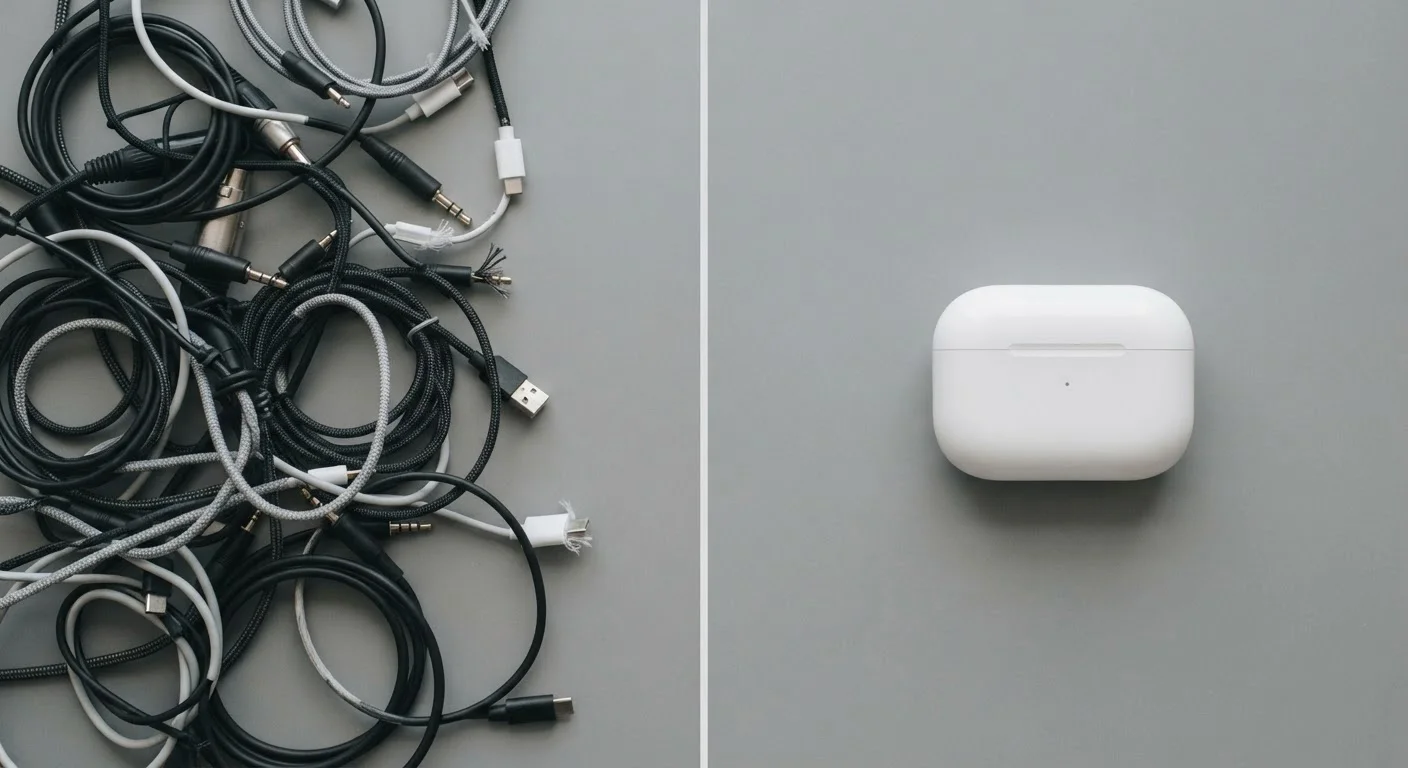
Option A
Wired Peripherals & Audio
The reliable, no-frills workhorse that never needs charging.
Best for: Anyone who prioritizes consistent audio quality, zero latency, and low ongoing cost without worrying about battery life.
Option B
Wireless Peripherals & Audio
The freedom-first option that trades simplicity for convenience.
Best for: Users who move around frequently or want a clutter-free setup and are willing to accept a slightly higher upfront cost.
The Real Cost Difference at the Budget Tier
The gap between wired and wireless pricing narrows as you spend more — but at the budget tier, it's real and it matters. A capable pair of wired earbuds or headphones typically runs $15–$35. A wireless equivalent with similar driver quality often starts at $40–$65. That $25–$30 difference isn't trivial when you're working with a tight budget.
It's not just the sticker price, either. Wireless devices carry a long-term cost that wired devices don't: battery degradation. Lithium-ion batteries lose capacity over charge cycles, and budget wireless gear rarely offers replaceable batteries. A pair of wireless earbuds that delivers eight hours of playback when new may drop to five or six hours within two years of regular use — without any way to restore that capacity cheaply. Wired gear, by contrast, either works or it doesn't. There's no gradual fade.
That said, wireless has gotten meaningfully better at lower price points over the past few years. Bluetooth 5.0 and later versions offer more stable connections and lower power consumption than earlier standards, so the functional gap between entry-level wireless and premium wireless has narrowed. What hasn't narrowed as much is the gap between wired and wireless when raw audio quality is the priority. See our breakdown of where budget earbuds cut corners for specifics on what gets sacrificed first.
| Criterion | Wired | Wireless |
|---|---|---|
| Typical entry price (audio) | $15–$35 | $40–$65 |
| Audio latency | Near zero | 40–150ms depending on codec |
| Battery management | None required | Regular charging needed |
| Long-term reliability | Cable wear is main failure point | Battery degradation over time |
| Signal interference risk | None | Possible in crowded RF environments |
| Freedom of movement | Limited by cable length | Full mobility up to ~30 ft |
| Multi-device switching | Manual cable swap required | Available on many models |
| Best use case | Stationary, desk, gaming | Commuting, gym, mobile work |
Latency, Reliability, and the Situations Where It Actually Matters
Latency — the tiny delay between audio signal and output — is essentially zero with a wired connection. Wireless Bluetooth introduces latency that varies by codec and device, ranging from around 40ms on aptX Low Latency implementations to 150ms or more on older or lower-cost hardware. For casual music listening, this is irrelevant. For video calls, gaming, or watching video content, it ranges from mildly annoying to genuinely disruptive.
Budget wireless gear is less likely to support low-latency codecs like aptX LL or LC3 — those tend to appear on higher-priced hardware. If you're buying wireless audio on a tight budget specifically to use it for gaming or video editing, you're more likely to encounter sync issues than someone spending more. Wired sidesteps this entirely.
Reliability is another practical consideration. Wireless signals can be disrupted by crowded RF environments — apartment buildings with dozens of competing Bluetooth devices, busy offices, or public transit. Wired connections don't care. For desk workers in dense urban buildings, this isn't theoretical; it's a real source of occasional frustration with otherwise decent wireless gear.
The flip side: wireless mice and keyboards have matured to the point where latency is rarely a meaningful issue for general productivity. If you're not competitive gaming, a budget wireless mouse is unlikely to feel different from its wired counterpart in day-to-day use. It's audio where the gap remains most pronounced. Be cautious about buying cheap gear you'll replace quickly — the real cost is often higher than the price tag suggests.
How to Decide Without Overthinking It
The decision framework is simpler than most product comparisons make it seem. Ask yourself one honest question: do I actually move around while using this device, or do I just like the idea of wireless? Wireless freedom is only valuable if you use it. A wireless keyboard that sits on a desk gains nothing from its battery — it just adds a charging task to your week.
For audio specifically, consider your primary use environment. Commuting, gym sessions, and walking-around listening are genuine mobility scenarios where wireless earns its premium. Desk listening, home theater audio, and gaming are stationary scenarios where wired delivers more value for the money. For peripherals like mice and keyboards, wireless makes a strong case if you regularly use a laptop in different rooms or want a cleaner desk — but not if your setup is fixed.
One underappreciated factor: cable quality on budget wired gear is often poor. Thin, non-braided cables on budget earbuds tend to tangle easily and fail at the connector point within a year or two of regular use. If you're choosing wired to save money, factor in that you may replace the item sooner than you'd like. That's a point in wireless gear's favor for some buyers — though it doesn't automatically tip the financial math. Our overview of how accessory costs add up quietly is worth reading before you finalize any peripheral decision.
This article is for general informational purposes only. Prices and product specifications vary by region and change over time — verify current details before making any purchase decision.
The content provided on our blog site traverses numerous categories, offering readers valuable and practical information. Readers can use the editorial team’s research and data to gain more insights into their topics of interest. However, they are requested not to treat the articles as conclusive. The website team cannot be held responsible for differences in data or inaccuracies found across other platforms. Please also note that the site might also miss out on various schemes and offers available that the readers may find more beneficial than the ones we cover.