

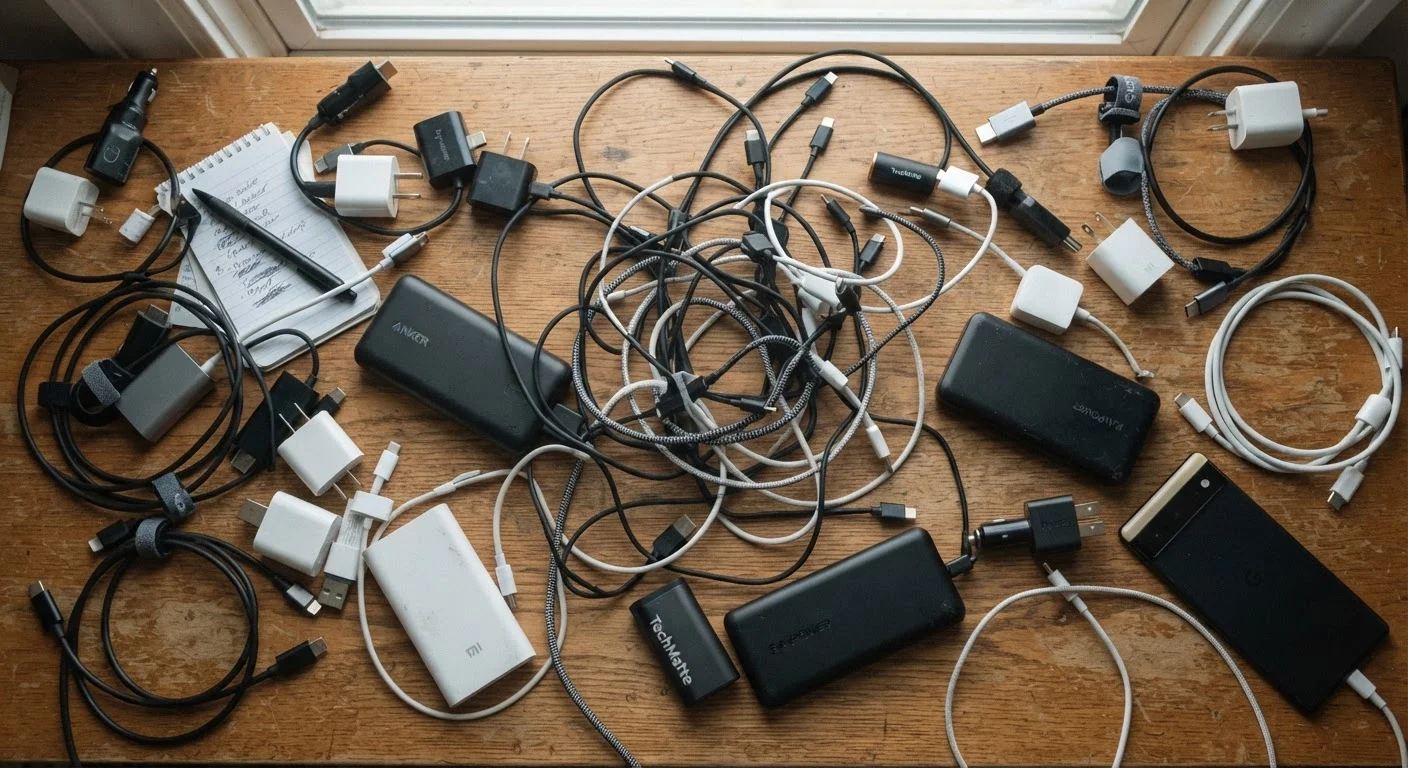
The Accessory Creep Problem
It starts with a spare cable for the nightstand. Then a travel charger. Then an adapter because your laptop and phone use different ports. Then another cable because the first one started fraying. Before you realize it, you've spent $80 to $120 on accessories over a year — more than many budget gadgets themselves cost. This pattern, sometimes called accessory creep, is one of the more invisible ways small tech purchases quietly drain spending plans.
The individual prices feel negligible. A $9 cable here, a $15 portable charger there. But these purchases tend to compound: you buy cheap, it breaks, you buy again. Or you buy a device without checking what cables you already have, and you end up with redundant gear in a drawer. According to general consumer research, the average household in the U.S. accumulates dozens of cables — many unused. This is spending without a strategy, and it's worth examining before your next purchase.
This is the same quiet-drain dynamic that shows up in other spending areas — for instance, daily convenience spending tends to follow the same invisible accumulation pattern. Accessories just happen to live in a tech-shaped box. The six principles below are designed to help you break the cycle.
Audit before you buy anything new
The single most effective habit is a five-minute drawer audit before any accessory purchase. Pull out every cable, charger, and adapter you own and identify duplicates, broken items, and connectors you no longer have devices for. Most people discover they already own something that covers the immediate need — or they find that consolidating two items into one multi-port option would eliminate future gaps.
A quick inventory also reveals a critical detail: how many of your cables are the same connector type? If you own six USB-A to Micro-USB cables for one device you barely use, buying a seventh is pure waste. The goal isn't a minimal kit — it's a functional one.
A five-minute audit usually reveals you already own what you're about to buy.
Understand wattage before buying any charger
Wattage is the number that determines whether a charger actually does its job at a useful speed. A charger rated at 5W will charge a modern smartphone, but it may take three to four times longer than a 20W or 30W alternative. If you're buying a portable power bank or wall charger without checking the wattage spec, you may be paying for something that technically works but practically frustrates.
The flip side is also true: paying for extremely high wattage when your devices don't support it wastes money. A phone that caps charging at 18W won't benefit from a 65W charger. Match the wattage to your device's maximum accepted input, which is listed in the device's official documentation or on the manufacturer's website.
Mismatched wattage means either slow charging or paying for power your device can't use.
Resist the lowest price on cables
Ultra-cheap cables — particularly those priced under $3 — are the category most likely to fail within months, creating a cycle of repurchasing that ends up more expensive than a mid-tier cable bought once. The failure modes are predictable: fraying at the connector joint, loose fit that stops making contact, and in some cases inadequate shielding that delivers slower-than-rated data or charging speeds.
This is a case where the sunk-cost dynamic is real. Our article on the hidden costs of cheap gadgets covers this pattern in more depth. A cable in the $10–$15 range with a reinforced connector and a braided jacket typically outlasts three to four bargain-bin alternatives — making it cheaper in practice.
A cable that lasts three years costs less than three cables that each last one year.
Think in terms of connector consolidation
One of the strongest arguments for pausing before any accessory purchase is the ongoing shift in connector standards. USB-C has become the dominant standard across laptops, Android phones, tablets, and increasingly iPhones. If your current device mix is connector-fragmented — some USB-C, some Lightning, some Micro-USB — it's worth thinking about whether your next device purchase will simplify or complicate that picture.
In the meantime, a USB-C to Lightning adapter and one or two USB-C cables can often cover a mixed-device household without requiring a dedicated cable per device. Adapters have a role, but buying them reactively (one for every bag, one for every room) recreates the redundancy problem in a different form.
One well-chosen adapter often replaces four cables you'd otherwise buy separately.
Evaluate portable charger capacity honestly
Portable charger (power bank) marketing leans heavily on large-number capacity figures — 20,000 mAh, 30,000 mAh — which can create the impression that bigger is always better. In practice, usable capacity after conversion losses is typically 60–70% of the stated figure. A 10,000 mAh power bank realistically delivers enough charge to top up a modern smartphone once to twice, which is sufficient for most day-trip scenarios.
A heavier, higher-capacity unit costs more and adds weight to a bag you carry daily. Unless your use case specifically demands multi-day off-grid charging, a mid-range capacity power bank will meet most needs at a lower price and lower carry weight. Identify your actual use pattern before defaulting to the largest option available.
Usable power bank capacity is typically 60–70% of the advertised figure after conversion losses.
Buy multi-device accessories intentionally
Multi-port chargers and multi-function hubs are the category where a slightly higher upfront cost most reliably pays off. A four-port USB-C wall charger that can simultaneously charge a laptop, phone, and earbuds eliminates the need for multiple single-port chargers, reduces the number of wall outlets you need, and simplifies travel packing. That consolidation has real value.
The key word is intentionally. A multi-port hub packed with ports you'll never use is just an expensive accessory with false versatility. Before buying, list the exact devices you'd connect and confirm the hub's wattage output per port supports them. Multi-device accessories are one of the few accessory categories where spending modestly more up front consistently delivers better long-term value.
A multi-port charger that replaces three single-port units saves money and drawer space.
Make Your Accessories Work Harder
The right approach to accessories isn't deprivation — it's intentionality. Before any purchase, a quick audit of what you already own will often reveal you have what you need, or that a single $20 multi-port hub solves four problems at once. That kind of consolidation mindset is the same one that pays off in other budget contexts, whether you're rethinking grocery habits or cutting subscriptions.
If you want to go deeper on the lifespan side — since accessories that fail quickly are worse value regardless of their sticker price — see our guidance on extending budget gadget longevity. And if you're weighing wired versus wireless options for peripherals, that tradeoff has its own logic worth understanding before you commit. Accessories don't have to be a budget leak — but that outcome requires a little more thought than grabbing whatever's cheapest at checkout.
This article is for general informational purposes only. Product specifications and pricing change frequently; verify current details with manufacturers or retailers before purchasing.
Before your next accessory purchase
Write down the three devices you use most and the connector type each one requires. Then check what cables and chargers you already own that match. This 60-second step eliminates the majority of redundant purchases before they happen. If you find a genuine gap, you'll also be in a better position to buy something that fills it precisely — rather than grabbing whatever's nearby.
The content provided on our blog site traverses numerous categories, offering readers valuable and practical information. Readers can use the editorial team’s research and data to gain more insights into their topics of interest. However, they are requested not to treat the articles as conclusive. The website team cannot be held responsible for differences in data or inaccuracies found across other platforms. Please also note that the site might also miss out on various schemes and offers available that the readers may find more beneficial than the ones we cover.