

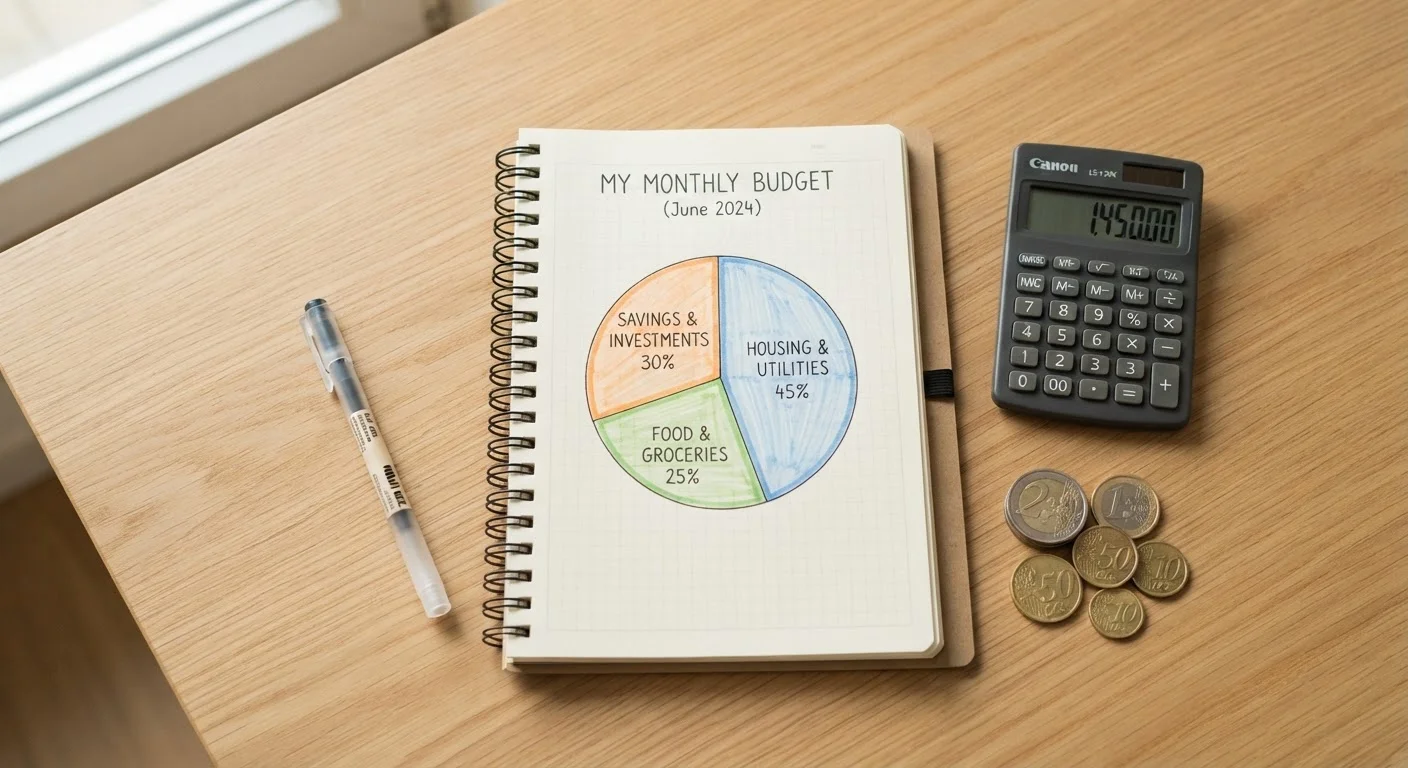
What the Three Buckets Actually Mean
The framework splits your monthly after-tax income into three categories. Understanding where each expense actually belongs is the part that trips most people up.
Needs (50%): These are non-negotiable expenses — the things that would cause real harm if unpaid. Rent or mortgage, utilities, basic groceries, health insurance, minimum loan or credit card payments, and transportation to work all belong here. The test: if skipping it would put your housing, health, or employment at risk, it's a need.
Wants (30%): This is everything that improves your life but isn't strictly required. Streaming subscriptions, dining out, travel, gym memberships, and clothing beyond basics fall here. This bucket gets uncomfortable because the line between wants and needs is blurry — a car might be a need for a rural commuter and a want for someone with solid public transit access.
Savings and debt repayment (20%): This covers building an emergency fund, contributing to a 401(k) or IRA, and paying down debt faster than the minimum. If you're carrying high-interest debt, financial education resources generally suggest prioritizing that before aggressively saving. For personalized sequencing, consult a qualified financial adviser.
For more on how to group everyday spending practically, see our guide on choosing spending categories that fit your real life.
Where the Rule Works — and Where It Breaks Down
The 50/30/20 rule is genuinely useful as a first framework. It's easy to understand, requires no spreadsheet expertise, and gives you instant feedback on whether your spending is roughly balanced. If your needs are eating 70% of your income, the rule makes that visible immediately.
But it has real limitations that are worth naming honestly.
It assumes income leaves room for choices. For households where rent alone chews through 40–50% of take-home pay — which is common in many US metro areas — hitting the 50% needs ceiling is nearly impossible without a major change like a roommate, a move, or a significant income increase. The rule doesn't solve that problem; it just names it.
The 30% wants category feels generous when money is tight. When you're trying to build any savings buffer at all, 30% on wants may be an aspirational number rather than a realistic one. Cutting wants temporarily to accelerate savings is a reasonable adaptation.
It treats all debt the same. The framework puts minimum debt payments under needs and extra debt payments under savings, but it doesn't distinguish between a 6% student loan and a 24% credit card. Those carry very different urgency, and the rule doesn't capture that nuance.
The Rule Is a Starting Template
The 50/30/20 framework was popularized in part by Senator Elizabeth Warren and her co-author Amelia Warren Tyagi in their book 'All Your Worth,' published in 2005. It was designed as a simplified guide for households, not a precision tool. The percentages were meant to reflect broad patterns in sustainable household spending, not to apply identically to every income level or cost-of-living environment.
Despite its limits, many people find the 50/30/20 structure a useful entry point before graduating to something more detailed. It's meant to simplify, not to be the final word on how you manage money.
How to Actually Apply It on a Tight Budget
Start with your real after-tax monthly income — the number on your bank statement, not your salary figure. Then list what you're currently spending in each of the three categories. Most people find this step alone is clarifying, because spending rarely matches the intended splits.
If your needs exceed 50%, the honest move is to look at where there's flexibility: Could you reduce a phone plan, renegotiate insurance (after researching options), or trim a utility? Some costs are truly fixed; others just feel that way. Our low-cost home life resources cover practical ways to reduce everyday household costs without a major overhaul.
If your wants category is crowded, a useful tactic is sorting each item by how much you'd actually miss it. Cut the ones you wouldn't notice losing first.
For the 20% savings bucket, starting with even a small, automated transfer to a savings account — before you have a chance to spend that money — is a widely recognized behavioral strategy. Pay-yourself-first budgeting is built around exactly that principle.
If you find the 50/30/20 structure too loose and want a method that assigns every dollar to a purpose, zero-based budgeting is a natural next step to explore.
This article is for general informational purposes only and is not personalized financial advice. For guidance specific to your situation, consider speaking with a qualified financial adviser.
Frequently Asked Questions
Needs are expenses you genuinely cannot go without: rent or mortgage, basic groceries, utilities, transportation to work, health insurance, and minimum debt payments. Subscriptions, dining out, and gym memberships are generally wants, not needs, even if they feel essential to your routine.
For many people on lower incomes, fixed costs alone can exceed 50% of take-home pay, making the framework hard to apply literally. In those cases, it's more useful as a directional guide — something to work toward over time — than a strict monthly target. Adjusting the splits to reflect your reality is completely reasonable.
The standard approach uses net income — the money that actually lands in your bank account after taxes and deductions. Using gross income overstates what you actually have to spend and can lead to shortfalls.
Not entirely. The 20% bucket is often described as savings and debt repayment. If you carry high-interest debt, directing part of that 20% toward extra debt payments before building savings is a common and sensible approach. The specifics depend on your own situation, and a financial adviser can help you prioritize.
The 50/30/20 rule sets broad percentage targets and is intentionally flexible, making it easier to start. Zero-based budgeting assigns a specific purpose to every dollar before the month begins, which takes more effort but leaves less room for money to slip through unaccounted. See our <a href="/money-fundamentals/budgeting-basics/the-503020-rule-vs-zero-based-budgeting-which-framework-actually-fits-your-life">comparison of the two frameworks</a> for a deeper look.
Yes, but you'll need to recalculate percentages each month based on actual income rather than an assumed fixed amount. Some people use a conservative baseline — their lowest typical month — and treat any extra income as a bonus directed toward savings or debt.
The content provided on our blog site traverses numerous categories, offering readers valuable and practical information. Readers can use the editorial team’s research and data to gain more insights into their topics of interest. However, they are requested not to treat the articles as conclusive. The website team cannot be held responsible for differences in data or inaccuracies found across other platforms. Please also note that the site might also miss out on various schemes and offers available that the readers may find more beneficial than the ones we cover.