

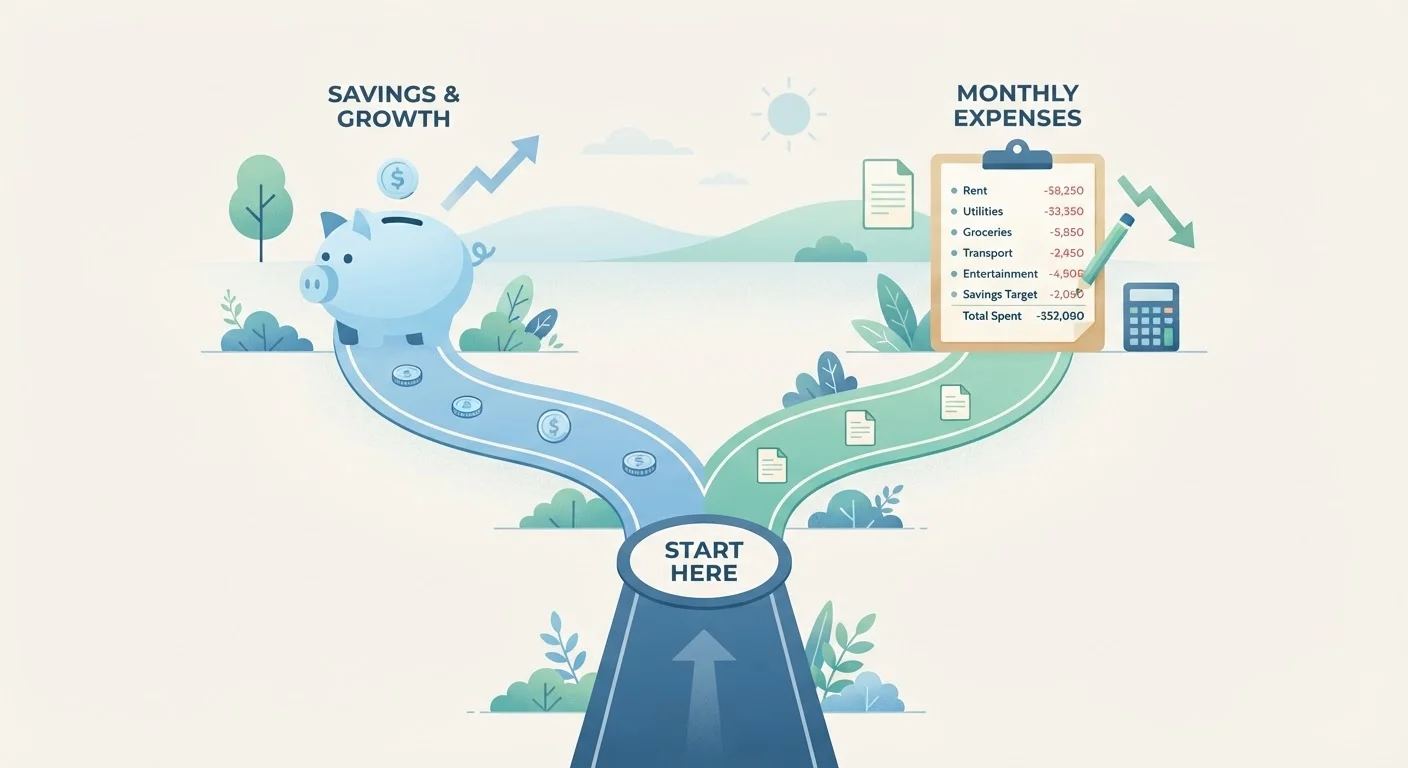
Option A
Pay-Yourself-First Budgeting
The savings-priority approach that automates your financial goals.
Best for: People who struggle to save consistently and want a low-maintenance system that protects savings before spending begins.
Option B
Traditional (Expense-First) Budgeting
The methodical, category-by-category spending plan.
Best for: Detail-oriented individuals who want full visibility into every spending category before deciding how much to save.
The Core Philosophical Split
At the heart of every budgeting method is a sequencing decision: which financial obligation gets funded first? The answer to that question separates pay-yourself-first budgeting from traditional budgeting more than any technical detail does.
Pay-yourself-first treats saving as a non-negotiable expense. As soon as income arrives, a predetermined amount is moved to savings or an investment account — before rent, groceries, or anything else. You then live on what remains. Traditional budgeting, by contrast, starts with expenses: you list out what you need to spend money on (housing, utilities, food, transportation, and so on), allocate funds to each category, and save whatever is left over after those commitments are met.
The practical consequences of that difference are significant. When saving is the first action, it tends to happen consistently. When saving is the last action, it competes with every expense that precedes it — and on tight months, it often loses. For a deeper look at the vocabulary behind both approaches, see our glossary of essential budgeting terms.
How Each Method Works in Practice
Understanding the mechanics makes the philosophical difference concrete.
Pay-Yourself-First in Practice
On payday, you set up an automatic transfer — typically to a separate savings account or retirement contribution — for a fixed amount or percentage of your income. Common starting points range from 10% to 20% of take-home pay, though even 5% builds the habit. After the transfer, the remaining balance covers all living expenses. No detailed category tracking is required; the savings goal is simply protected from the start.
Traditional Budgeting in Practice
Before the month begins (or at the start of each pay period), you estimate or record fixed expenses — rent, loan payments, insurance — and variable expenses — groceries, gas, entertainment. You allocate income to each category in order of priority. Savings, if included, appear as one of those categories, but it shares the queue with all other obligations. Any money unspent at month-end rolls into savings or rolls over to the following month.
| Criterion | Pay-Yourself-First | Traditional Budgeting |
|---|---|---|
| First money allocation | Savings transferred immediately | Expenses assigned first |
| Savings consistency | High — automated and protected | Variable — depends on monthly surplus |
| Spending visibility | Low — limited category tracking | High — full category breakdown |
| Effort required | Low after initial setup | Ongoing tracking required |
| Best income type | Steady, predictable income | Regular or variable income |
| Risk of not saving | Low — savings secured first | Higher — savings competes with expenses |
| Flexibility | Less granular month-to-month | Highly adjustable each month |
If you're curious how these compare to other structured frameworks, our side-by-side breakdown of the 50/30/20 rule and zero-based budgeting covers additional options worth considering.
Strengths and Limitations of Each Approach
Neither method is without trade-offs, and understanding both sides helps you make a realistic choice.
Pay-Yourself-First: Strengths
- Automation reduces friction. When savings move automatically, you don't have to make an active decision each month.
- Simple to maintain. Fewer categories mean less ongoing tracking.
- Builds a savings habit quickly. Consistent action reinforces the behavior over time.
Pay-Yourself-First: Limitations
- Can cause cash flow problems. If the savings amount is set too high, essential bills may become hard to cover.
- Offers limited spending visibility. Without category tracking, it's easy to overspend on discretionary items and not realize it.
Traditional Budgeting: Strengths
- Full spending visibility. Category tracking surfaces where money actually goes, which can be genuinely surprising.
- Flexible for variable expenses. Categories can be adjusted month to month as circumstances change.
Traditional Budgeting: Limitations
- Savings is often the casualty of a hard month. When expenses run high, the savings category is the easiest to cut.
- Requires consistent effort. Tracking every category demands time and discipline, which many people find difficult to sustain.
For those who want a category-level system with built-in spending discipline, zero-based budgeting is a related framework worth exploring alongside traditional methods.
Choosing the Right Starting Point for Your Situation
The right method depends less on which system is objectively better and more on which one you'll actually stick with. A few practical factors can help guide the decision.
~57%
Americans unable to cover a $1,000 emergency
A Bankrate survey found that a majority of U.S. adults could not cover an unexpected $1,000 expense from savings alone, underscoring why savings prioritization matters.
20%
Common pay-yourself-first savings target
Many personal finance frameworks, including the 50/30/20 rule, suggest allocating roughly 20% of take-home pay toward savings and debt repayment goals.
1 in 3
Adults with no monthly budget
According to NFCC research, approximately one in three U.S. adults does not track their spending with any formal budgeting method.
Consider pay-yourself-first if: your income is relatively stable, you have a specific savings goal (an emergency fund, for instance — see how sinking funds and emergency funds differ), or you find detailed tracking hard to sustain consistently.
Consider traditional budgeting if: your income is irregular or project-based, your monthly expenses vary significantly, or you're trying to identify specific spending categories to cut in order to free up more money.
It's also worth noting that these approaches aren't mutually exclusive. Some people automate a baseline savings transfer (pay-yourself-first) while also tracking major expense categories (traditional). Combining elements of both can provide the consistency of automated savings alongside the visibility of category tracking.
This is general financial information intended to help you understand your options — not personalized advice tailored to your circumstances. For decisions about your own financial plan, consider consulting a qualified financial adviser.
This article is for informational and educational purposes only and does not constitute personalized financial advice. Consult a licensed financial professional before making decisions about your own budget, savings, or financial plan.
The content provided on our blog site traverses numerous categories, offering readers valuable and practical information. Readers can use the editorial team’s research and data to gain more insights into their topics of interest. However, they are requested not to treat the articles as conclusive. The website team cannot be held responsible for differences in data or inaccuracies found across other platforms. Please also note that the site might also miss out on various schemes and offers available that the readers may find more beneficial than the ones we cover.