

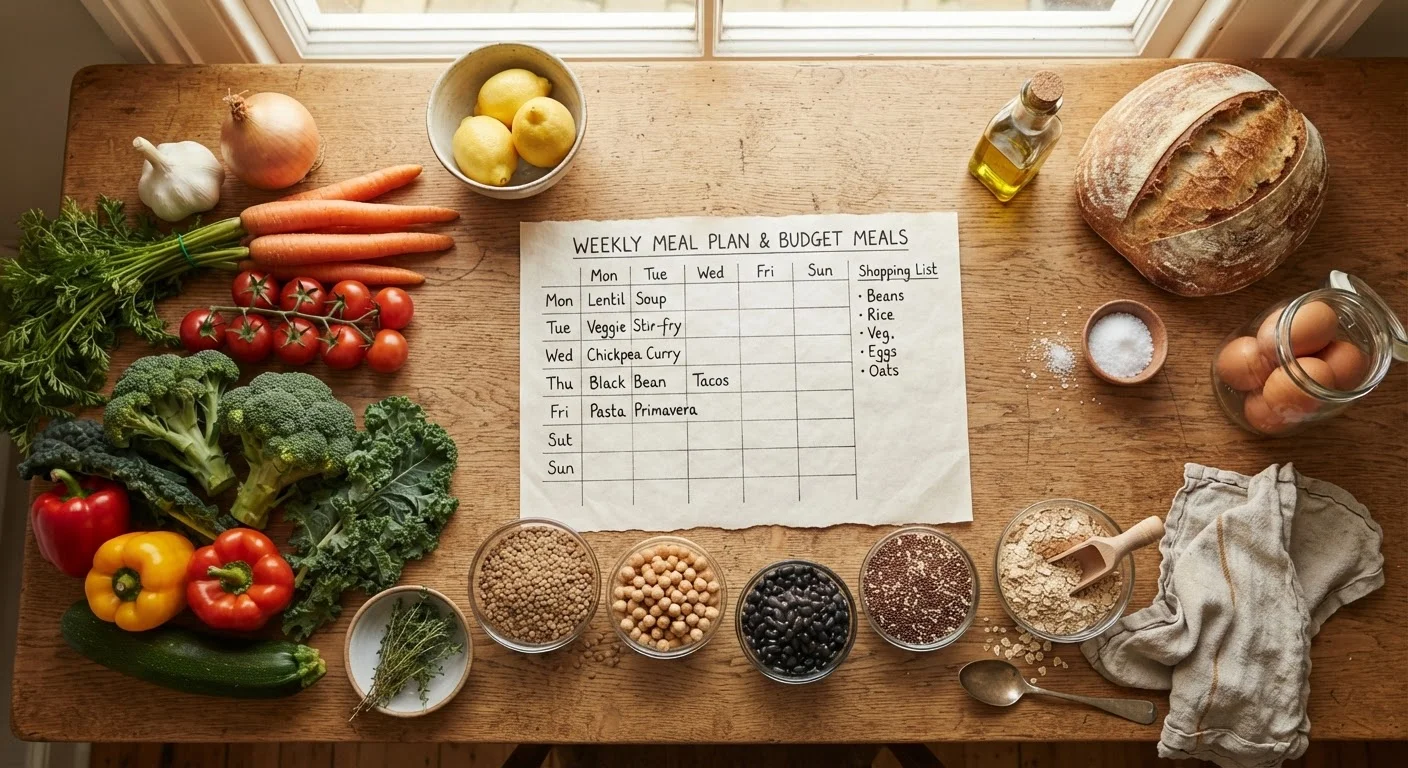
Set a Realistic Weekly Food Budget
Before you plan a single meal, you need a number. Without a hard weekly food budget, grocery shopping is just guessing — and guessing usually costs more. Start by looking at what you actually spent on food last month, including groceries and takeout. Divide by four. That's your baseline, and for most budget millennials, it's higher than expected.
A common framework from personal finance is the 50/30/20 rule — 50% of take-home pay toward needs, 30% wants, 20% savings. Food sits in the needs category, but the line between a need and a want blurs fast when you're ordering delivery twice a week. See the Budgeting Basics hub for simple frameworks to map your full monthly spending before zeroing in on food.
Once you have your baseline, set a target that's slightly lower — even 10–15% less — and treat it as a firm weekly ceiling. Writing the number down and keeping it visible (on your fridge or in a notes app) makes it real. Vague intentions don't save money; a specific dollar amount does.
Set your food budget in cash for the first month. Physically handing over bills at checkout creates a psychological friction that card payments don't — and makes overspending immediately obvious.
Behavioral economics research consistently shows that tangible payment methods reduce spending compared to abstract digital transactions, making cash a practical tool for budget enforcement.
Plan your highest-effort meals for the weekend and lean on one-pot or leftover meals mid-week. Complexity is the enemy of a plan you'll actually follow.
Decision fatigue and time pressure mid-week are the two most common triggers for abandoning a meal plan and ordering takeout, which blows food budgets faster than almost anything else.
Build Your Meal Plan Around What You Already Have
Most households are sitting on $20–$40 worth of usable food they never cook. Dry pasta, canned tomatoes, lentils, frozen vegetables — these are real meals waiting to happen. Before you write a single item on a grocery list, open every cabinet and the freezer and take stock.
This approach — sometimes called pantry-first cooking — is one of the fastest ways to lower your weekly shop. Our guide on pantry-first cooking walks through the full method, but the core idea is simple: plan meals around what you own first, then fill gaps with fresh ingredients. It directly cuts food waste, which the USDA estimates accounts for a significant share of household food spending.
When building your weekly plan, aim for five to six dinners, lunches built from leftovers, and two to three flexible breakfast options. Keep the list tight. Every ingredient you buy should appear in at least two meals — a bunch of kale used in a stir-fry and a soup costs far less per serving than one bought for a single dish.
Shop Smarter: The Grocery Strategy That Actually Works
The grocery store is designed to make you spend more. End caps, eye-level placement, bulk packaging that looks like savings — these are deliberate. A written list based on your meal plan is your defense. Stick to it.
A few habits that consistently reduce spend: shop the store perimeter for produce, dairy, and proteins, but don't ignore the middle aisles for dry goods and canned staples — that's where durable, affordable calories live. Store-brand versions of pantry items (flour, oats, canned beans, frozen vegetables) are typically equivalent in quality to name brands at meaningfully lower prices. Buying in bulk only saves money if you'll actually use the item before it expires.
Consider doing a no-spend week every couple of months — a week where you buy nothing and cook entirely from what's on hand. It's a powerful reset that forces creativity and reveals how much usable food you actually have.
~30–40%
Share of US food supply wasted annually
According to the USDA, roughly 30–40% of the food supply in the United States is wasted, representing a major avoidable cost for households.
$270+
Average monthly household food spend
The Bureau of Labor Statistics Consumer Expenditure Survey reports that average US household food-at-home spending exceeds $270 per month, with significant room to reduce through planning.
Nutrition on a Budget: Hitting Your Basics Without Overspending
Eating cheaply doesn't mean eating badly. The most affordable foods — legumes, eggs, oats, frozen vegetables, canned fish, brown rice — are also among the most nutritious. Protein is often the biggest budget concern, and here the math clearly favors plant sources: a pound of dried lentils costs a fraction of a pound of chicken and yields more servings.
A practical weekly protein rotation might include eggs for breakfast scrambles and fried rice, canned tuna or sardines for quick lunches, and lentils, black beans, or chickpeas as the base of two or three dinners. This rotation covers protein needs without requiring meat at every meal, which is where food budgets most commonly blow out.
For produce, frozen vegetables retain most of their nutritional value and cost significantly less per serving than fresh equivalents — particularly for items like spinach, broccoli, corn, and peas. Seasonal fresh produce is still worth buying for texture and variety, but frozen is a smart default for cooked dishes.
Make Your Plan Flexible Enough to Actually Use
The biggest reason meal plans fail isn't bad intentions — it's rigidity. A plan that assumes you'll cook a specific meal on a specific night ignores reality: you'll be tired on Thursday, someone will have plans on Saturday, produce will go soft before you use it. Build in flex.
Think in categories rather than fixed meals. Plan for two pasta nights instead of committing to a specific pasta dish. Plan for one stir-fry, one soup, one egg-based meal. Within those categories, you can adapt based on what's in the fridge, your energy level, and what actually looks good at the store. This meal planning as a financial habit approach reframes the whole exercise — it's a money tool, not a rigid cooking schedule.
Finally, track results. After each week, spend two minutes noting what you spent, what got wasted, and what worked. That feedback loop — not any single tip or trick — is what compounds into real, lasting food savings over time.
This article provides general budgeting and meal planning information for educational purposes only. It is not personalized financial or nutritional advice. For guidance tailored to your individual circumstances, consult a qualified financial adviser or registered dietitian.
The content provided on our blog site traverses numerous categories, offering readers valuable and practical information. Readers can use the editorial team’s research and data to gain more insights into their topics of interest. However, they are requested not to treat the articles as conclusive. The website team cannot be held responsible for differences in data or inaccuracies found across other platforms. Please also note that the site might also miss out on various schemes and offers available that the readers may find more beneficial than the ones we cover.