

Why Meal Planning Is a Money Decision
Most people think of meal planning as a way to eat better or save time. That's true, but there's a more compelling reason to do it: food is typically one of the largest variable expenses in a household budget, and it's one of the few you can actually control week to week.
Research from the USDA consistently estimates that households waste between 30–40% of the food supply at the consumer level. For a family spending $800 a month on groceries, that can mean hundreds of dollars lost annually to spoiled produce, forgotten leftovers, and duplicate pantry purchases. Meal planning directly addresses this by making every shopping trip intentional. For more on the financial mechanics of food waste, see how food waste drains your budget.
The shift in mindset matters: when you plan meals because you're managing a budget — not just because you want to cook something new — you start making different choices. You ask what needs to be used up, what's on hand, and what meals bridge ingredients across the week. That's financial thinking applied to your kitchen.
Best Practices for Meal Planning That Actually Saves Money
These practices are ordered for real-world usability, not perfection. Pick the ones that fit your routine and build from there.
Audit your pantry, fridge, and freezer before writing any grocery list.
Buying items you already own is one of the most common sources of food waste. A quick inventory before shopping ensures you build meals around existing stock, reducing both duplication and spoilage. It also shortens your shopping list, which almost always reduces the total bill.
Plan for ingredient overlap across multiple meals, not just individual recipes.
Buying a full bunch of cilantro for one taco night and discarding the rest is a common budget leak. Planning meals that share ingredients — say, roasted chicken that becomes a grain bowl and then a soup — makes every purchase work harder and cuts down on waste from partial-use produce.
Include at least one 'use-it-up' meal slot in your weekly plan.
Rigid meal plans fail when life doesn't go as scheduled — and the leftovers pile up. Designating one dinner per week as a flexible 'use whatever needs to be eaten' night gives you a built-in pressure valve that prevents food from going to waste when plans shift.
Set a weekly food budget number before planning meals — not after.
Most people plan what they want to eat and then spend what it costs. Reversing this — deciding on a spending ceiling first — forces creative problem-solving and keeps the plan grounded in financial reality rather than culinary aspiration. It also makes it easier to spot when a planned meal is disproportionately expensive.
Keep your meal plan visible and simple enough to actually follow.
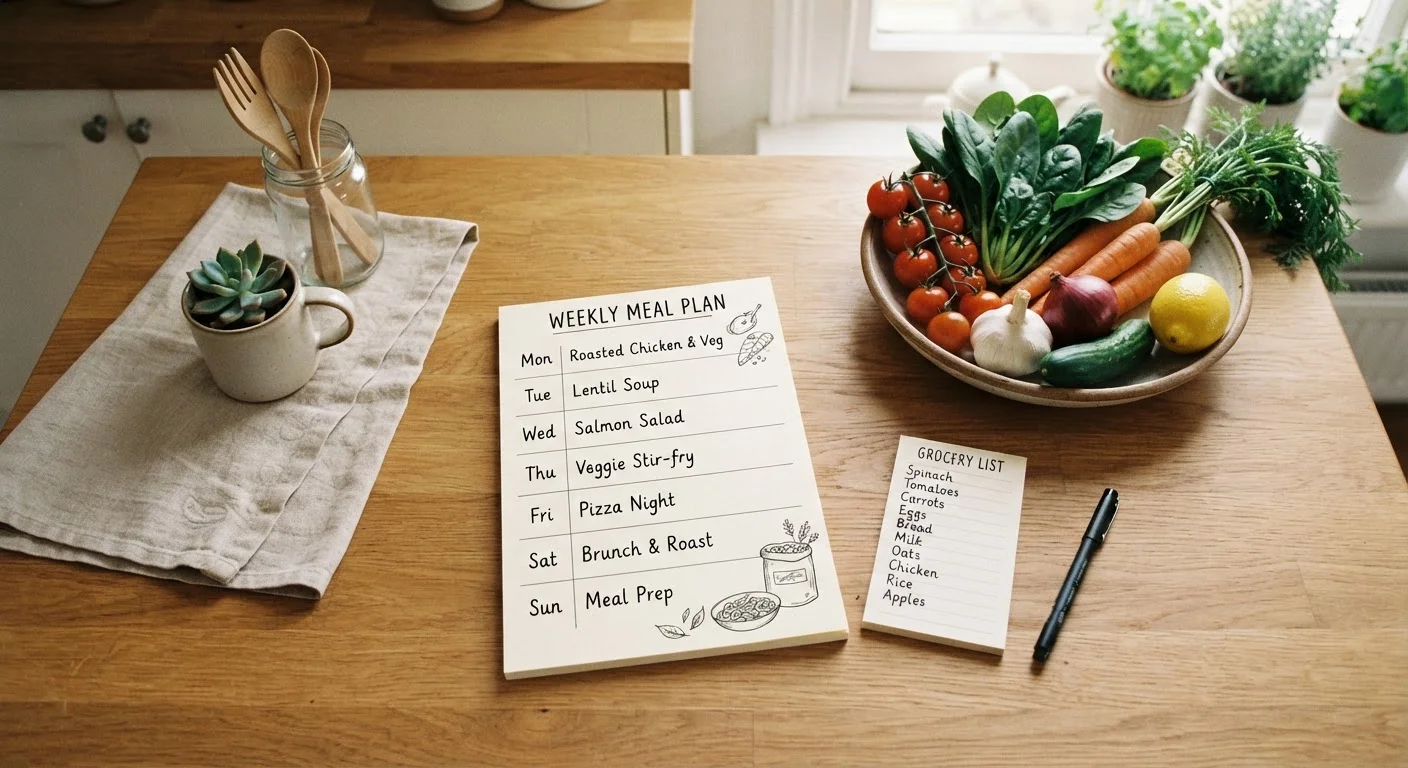
An elaborate spreadsheet nobody looks at on a Wednesday evening doesn't save money. A handwritten sticky note on the fridge does. The format matters less than consistency — plans that are easy to reference are actually used, which is what prevents costly last-minute takeout decisions.
For a fuller framework that covers budgeting alongside meal planning, the low-budget meal planning guide is a useful companion.
Quick Wins You Can Start This Week
You don't need a perfect system to see results. These immediate actions move the needle on food spending without overhauling your routine.
If you want to go further, the pantry-first cooking method builds naturally on these habits. And if time is the barrier, batch cooking on busy weeknights shows how to prep ahead without burning out.
This article provides general information for educational purposes and is not personalized financial or dietary advice. Actual savings will vary depending on individual spending habits, household size, and local food costs.
The content provided on our blog site traverses numerous categories, offering readers valuable and practical information. Readers can use the editorial team’s research and data to gain more insights into their topics of interest. However, they are requested not to treat the articles as conclusive. The website team cannot be held responsible for differences in data or inaccuracies found across other platforms. Please also note that the site might also miss out on various schemes and offers available that the readers may find more beneficial than the ones we cover.