

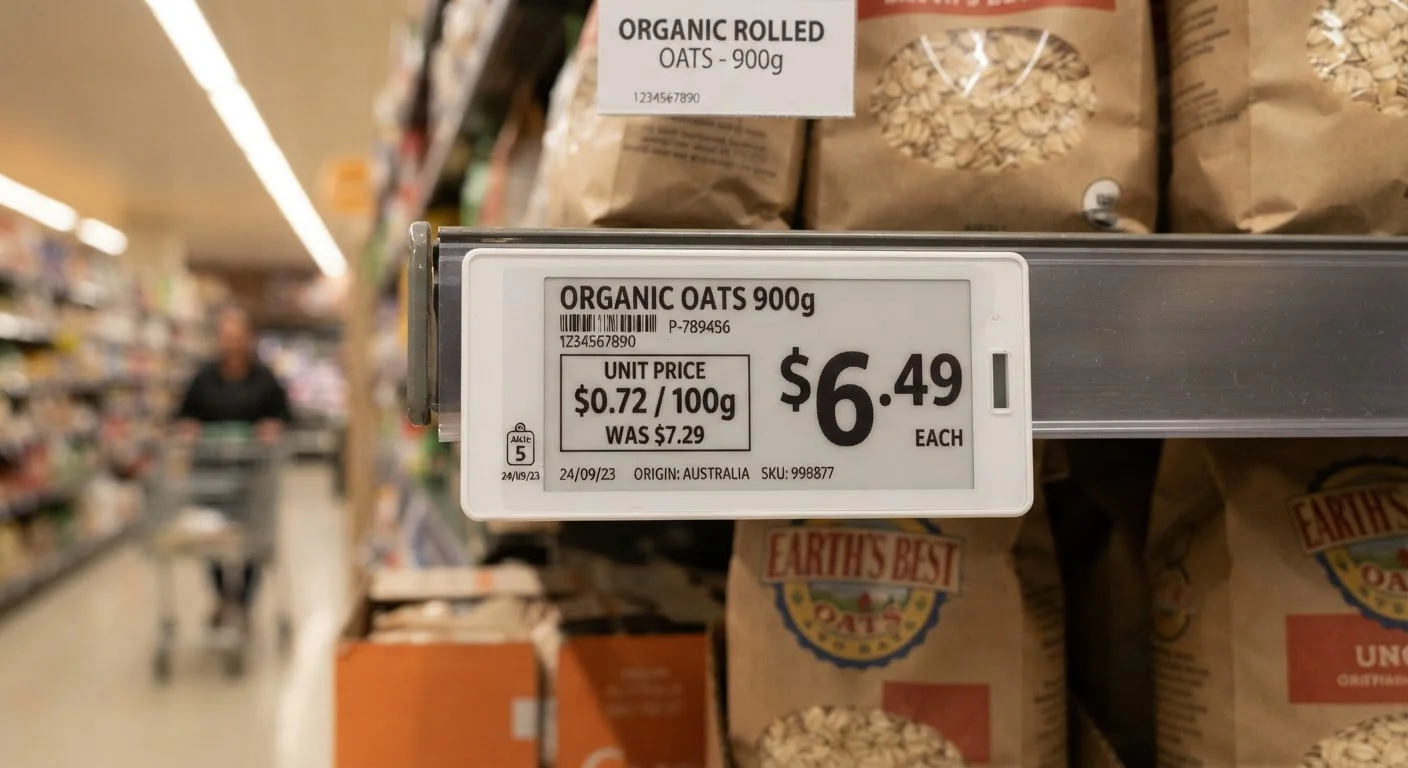
Option A
Shelf Price
The number your eye goes to first — but not the most useful one.
Best for: Quickly knowing what you'll pay at checkout for a single package.
Option B
Unit Price
The number that actually tells you what something costs.
Best for: Comparing different sizes, brands, or formats to find true value per ounce, pound, or count.
What Each Number Actually Means
Walk through any grocery aisle and you'll see two numbers on almost every shelf label. The big one — the shelf price — is what you hand over at checkout for that specific package. The small one, usually tucked in the lower corner, is the unit price: the cost per ounce, per pound, per count, or whatever standard measure applies to that product category.
Shelf price answers the question "What does this cost me today?" Unit price answers the more useful question: "What am I actually paying for the product itself, stripped of packaging size?" Those are two very different questions, and conflating them is how grocery budgets quietly leak money.
For example, a 16 oz jar of pasta sauce priced at $2.99 and a 24 oz jar at $3.99 look like two different items at two different price points. But the unit prices — roughly $0.19/oz versus $0.17/oz — tell a clearer story. The larger jar costs less per ounce, but only by a small margin. If you'd throw out a third of it before using it, the savings evaporate. Understanding this dynamic is the whole point of unit pricing as a shopping habit.
Why Shelf Price Misleads More Than It Reveals
Retailers design shelf layouts and sale signage around shelf price — because it's the number that triggers purchase decisions. A bright yellow "SALE" tag dropping a box of cereal from $5.49 to $4.99 feels like a win. But if the unit price on the store-brand alternative two shelves down is 30% lower, you're still paying a premium you didn't need to.
Package sizing compounds this problem. Manufacturers frequently adjust net weight without changing the overall package dimensions — sometimes called "shrinkflation" — meaning the shelf price can stay the same while the unit price quietly rises. Tracking shelf price alone misses this entirely.
| Criterion | Shelf Price | Unit Price |
|---|---|---|
| What it measures | Total cost of one package | Cost per standard unit (oz, lb, count) |
| Useful for budgeting a trip | Yes — reflects checkout cost | Not directly |
| Useful for comparing value | No — package sizes vary | Yes — the only fair comparison |
| Reflects shrinkflation | No — can stay flat as weight drops | Yes — rises when net weight falls |
| Shown on shelf label | Always | Usually (required in most US states) |
| Works across brands & sizes | No | Yes |
This is also where the store-brand versus name-brand comparison gets interesting. Because store brands often come in different package sizes than their name-brand counterparts, a direct shelf price comparison is almost meaningless. Our breakdown of store-brand vs. name-brand groceries shows where generic labels genuinely hold up — and unit price is the tool that makes those comparisons honest.
How to Use Unit Price in Practice
Most US states require stores to display unit pricing on shelf labels, but the format isn't standardized — you might see cost per ounce in one aisle and cost per 100g in another. The key habit is simple: before you pick up an item, glance at the unit price, not the shelf price, and use that to compare options in the same category.
A few situations where this pays off most:
- Buying in bulk: Larger sizes usually — but not always — have a lower unit price. Always verify before assuming. See when bulk buying genuinely saves money for the full picture.
- Sale items: A discounted shelf price doesn't guarantee the best unit price in the category. A non-sale competitor may still be cheaper per ounce.
- Multi-packs vs. single units: Multi-packs frequently offer a better unit price, but not universally — compare before grabbing the bundle.
If a label is missing or the unit of measure differs between products (making a direct comparison impossible), a basic calculator app on your phone can bridge the gap: divide price by weight or count.
This article is for general informational purposes only and is not personalized financial advice. Your actual savings will depend on shopping habits, store availability, and product selection in your area.
The content provided on our blog site traverses numerous categories, offering readers valuable and practical information. Readers can use the editorial team’s research and data to gain more insights into their topics of interest. However, they are requested not to treat the articles as conclusive. The website team cannot be held responsible for differences in data or inaccuracies found across other platforms. Please also note that the site might also miss out on various schemes and offers available that the readers may find more beneficial than the ones we cover.