

Our Verdict
Aftermarket parts can be a smart, budget-friendly choice for many routine maintenance items — but the risk-reward calculation shifts dramatically for safety-critical components. The right call depends on the specific part, the manufacturer's reputation, and your car's age and warranty status.
Drivers with older vehicles out of warranty who want to manage routine maintenance costs without compromising reliability on high-stakes components.
What 'Genuine' and 'Aftermarket' Actually Mean
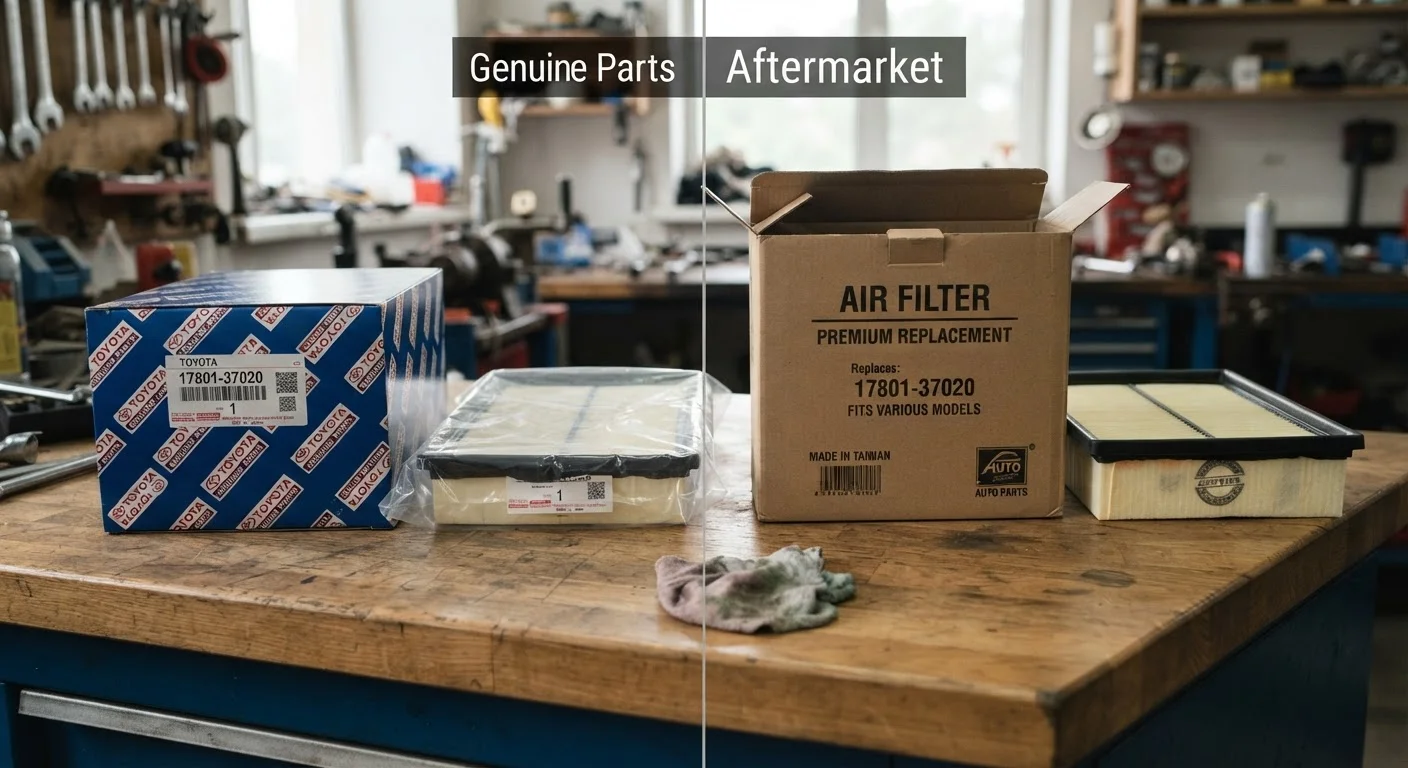
When a mechanic or parts store talks about genuine parts (also called OEM parts, short for Original Equipment Manufacturer), they mean components made by the same manufacturer that supplied your car's factory. They carry your automaker's branding and are guaranteed to match the original specifications.
Aftermarket parts are made by third-party companies and designed to fit the same vehicles. Some aftermarket manufacturers actually produce parts for OEM suppliers — meaning the underlying component can be nearly identical — while others operate at much lower quality standards. The category covers a wide spectrum, which is exactly why a blanket judgment in either direction misses the point.
For a broader look at how part and maintenance choices affect your overall ownership costs, see the real costs of car ownership hub.
Pros and Cons of Aftermarket Parts
Before making a decision, it helps to see the trade-offs laid out plainly.
Significantly lower upfront cost
Aftermarket parts routinely cost 20–50% less than genuine equivalents, sometimes more. For high-frequency items like filters, that saving adds up meaningfully over a car's life.
Wide availability and faster sourcing
Aftermarket parts are stocked at more locations than dealer-only OEM parts, which can reduce vehicle downtime — particularly helpful when a dealership has a backorder.
Competition drives quality improvements
Some aftermarket manufacturers invest in R&D and produce parts that match or exceed OEM specifications, particularly in categories like filters, belts, and lighting.
More choice for older or discontinued vehicles
Once a model ages out of production, OEM parts become scarce and expensive. Aftermarket suppliers often continue producing parts long after factory supply dries up.
Highly inconsistent quality across suppliers
Unlike OEM parts, aftermarket quality is not standardized. A poorly made part can wear faster, fit imprecisely, or fail under stress — adding repair costs that dwarf the initial savings.
Safety-critical failures carry serious risk
For components like brake systems or airbag modules, an underperforming aftermarket part can compromise vehicle safety in ways that go beyond inconvenience or cost.
May complicate warranty and insurance claims
While the law protects consumers in many warranty situations, proving that an aftermarket part didn't cause related damage can still be a practical headache during a claim.
Fit and finish often less precise
Aftermarket body panels, trim pieces, and sensors sometimes require adjustment to fit correctly, adding labor time that can offset the cost savings.
The quality gap between aftermarket manufacturers is real. A part from a well-regarded supplier with ISO certification is a different product from the cheapest option on a discount shelf. If you're considering aftermarket, understanding which maintenance tasks actually matter can help you decide where spending more is worth it.
Where Aftermarket Makes Sense — and Where It Doesn't
The part category matters more than almost any other factor in this decision.
Generally lower-risk aftermarket candidates
- Air, oil, and cabin filters — straightforward specs, widely tested, easy to verify fit
- Wiper blades — simple mechanical components with clear performance benchmarks
- Spark plugs — look for parts meeting your engine's heat range spec
- Belts and hoses — viable if you stick to recognized brands with documented material specs
Components where you should think twice
- Brake pads and rotors — substandard materials can increase stopping distances; this is not a place to gamble
- Airbag sensors and modules — compatibility issues here can mean a system that fails to deploy or deploys incorrectly
- Catalytic converters — some aftermarket units fail emissions tests or degrade faster; check your state's regulations
- Transmission components — tolerances are tight and failures are expensive
Emissions Compliance Varies by State
Some aftermarket parts — particularly catalytic converters — are subject to state-level emissions regulations that go beyond federal standards. California, for example, requires CARB-compliant (California Air Resources Board) catalytic converters. Using a non-compliant part can result in a failed emissions test. Always verify the regulatory requirements in your state before purchasing emissions-related components.
It's also worth noting that the same logic applies to small decisions that affect fuel efficiency. See how everyday vehicle choices add up at the pump for a related example of the cumulative cost of small trade-offs.
The Warranty Question
One of the most persistent myths about aftermarket parts is that using them automatically voids your car's warranty. Under the Magnuson-Moss Warranty Act, a manufacturer generally cannot void your warranty simply because you used an aftermarket part — unless they can demonstrate that the aftermarket part actually caused the damage in question.
That said, if a low-quality aftermarket part damages a related system, you may face a difficult conversation with the dealership about what caused what. Document your maintenance carefully and keep receipts. When in doubt about your specific warranty terms, review your owner's manual or consult the dealership's service department before making a decision.
~$1,000
Annual average car maintenance and repair cost
AAA's annual Your Driving Costs study has consistently estimated that maintenance and repair averages around $1,000 per year for a typical vehicle, underlining why parts costs matter.
20–50%
Typical aftermarket price discount vs. OEM
Consumer Reports and industry analyses have found aftermarket parts commonly cost 20–50% less than their genuine counterparts, though savings vary widely by part category.
The content provided on our blog site traverses numerous categories, offering readers valuable and practical information. Readers can use the editorial team’s research and data to gain more insights into their topics of interest. However, they are requested not to treat the articles as conclusive. The website team cannot be held responsible for differences in data or inaccuracies found across other platforms. Please also note that the site might also miss out on various schemes and offers available that the readers may find more beneficial than the ones we cover.