

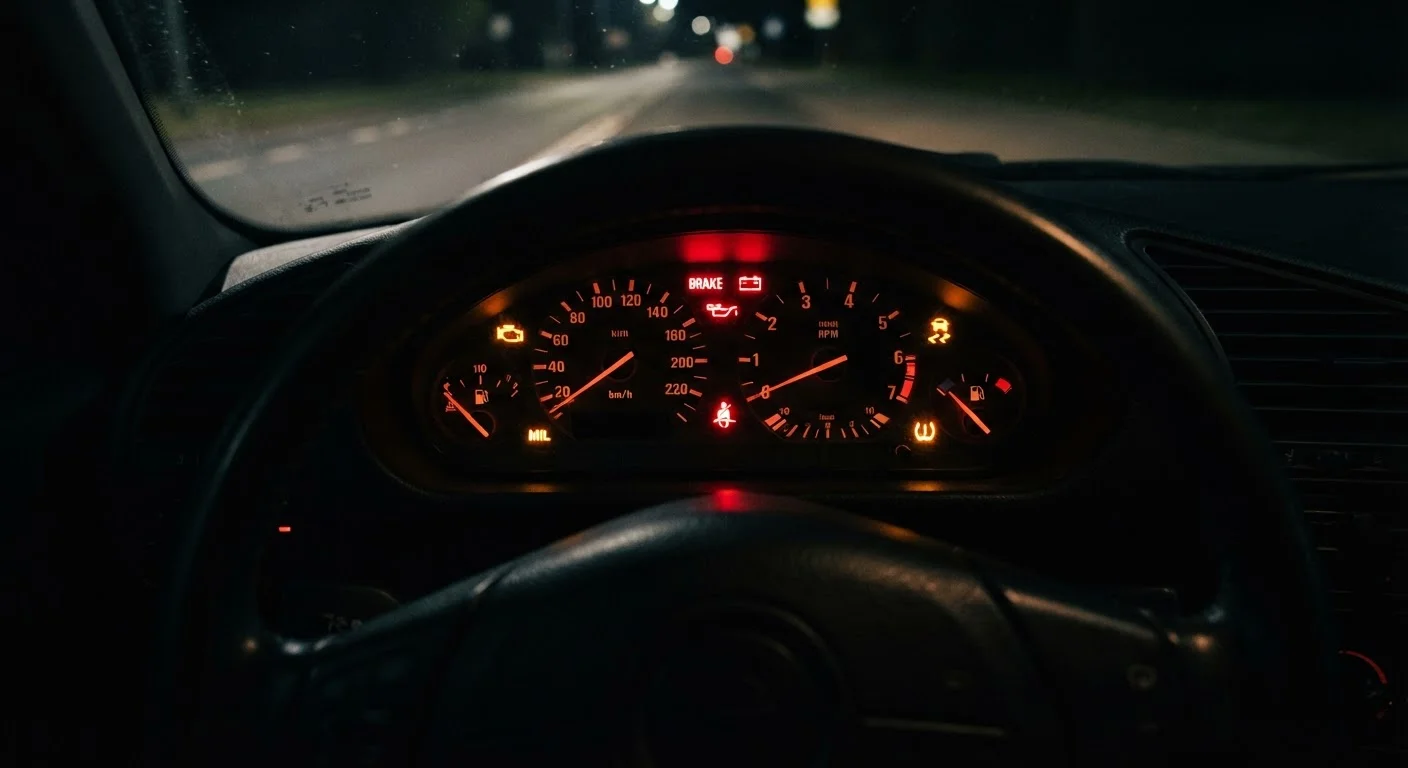
What Warning Lights Are Actually Telling You
Your car's dashboard warning lights are part of an onboard diagnostic system that monitors dozens of sensors in real time. When something falls outside normal parameters, the system logs a fault code and triggers a light. Understanding what those lights mean — and how urgently to respond — can be the difference between a $30 fix and a $3,000 repair.
| U.S. vehicles with OBD-II ports | All cars & light trucks, model year 1996+ (U.S. Environmental Protection Agency (EPA)) |
| TPMS required since | 2008 (all new U.S. passenger vehicles) (National Highway Traffic Safety Administration (NHTSA)) |
| Average cost of an OBD-II scanner (basic) | $20–$80 (General retail range; prices vary by feature set) |
| Catalytic converter replacement cost (estimate) | $945–$2,475+ (RepairPal general range; varies by make/model) |
| Engine damage from low oil pressure | Can occur within minutes of driving (General automotive engineering guidance) |
| Loose gas cap check engine triggers | One of the most common CEL causes (Widely reported in automotive diagnostics literature) |
Most drivers see a warning light and either panic or ignore it. Neither response is ideal. Instead, treat each light as a prompt to gather information before deciding what to do next. A basic OBD-II scanner — available at most auto parts retailers for $20–$80 — lets you read the fault code yourself and look it up before calling a shop. This one habit alone can prevent you from being charged a diagnostic fee just to hear what you already know. For a broader picture of how unplanned maintenance costs add up, see our piece on why maintenance costs catch so many car owners off guard.
Light-by-Light: Urgency and What to Do
Not all warning lights carry the same weight. Here's a plain-English breakdown of the most common ones:
- Red Oil Pressure Warning
- Pull over safely and turn off the engine as soon as possible. Low oil pressure can cause severe engine damage within minutes of driving. Check the oil level; if it's full, do not drive — call for assistance. This is one of the few lights that warrants immediate action every time.
- Red Battery / Charging Warning
- Your charging system isn't maintaining voltage. You may have limited driving time before the car stalls. Reduce electrical load (AC, heated seats) and head to a shop. Could be the alternator, a failing battery, or a loose belt.
- Yellow / Amber Check Engine Light (steady)
- Read the fault code before assuming the worst. Common causes include a loose gas cap, a failed oxygen sensor, or a catalytic converter issue. Steady means non-emergency — but don't ignore it for weeks, as some underlying problems worsen.
- Yellow / Amber Check Engine Light (flashing)
- A flashing CEL usually indicates active engine misfires, which can damage the catalytic converter quickly. Reduce speed and load and get to a mechanic soon — this one should not wait.
- TPMS (Tire Pressure) Warning
- One or more tires is significantly underinflated. Check all four tires with a gauge and inflate to the pressure listed on the driver's door jamb sticker (not the tire sidewall). Underinflated tires reduce fuel economy and increase blowout risk.
- Temperature Warning
- Engine overheating. Pull over and turn off the engine. Driving an overheating engine can warp the cylinder head — a repair that can cost several thousand dollars. Let the engine cool before checking coolant levels.
- Brake Warning Light
- If your parking brake is off, this is urgent. It could indicate low brake fluid, a fluid leak, or worn brake pads (on some vehicles). Have it inspected promptly — braking performance affects your safety directly.
Warning Lights Are Not a Guarantee of Severity
The same warning light can mean something minor (a loose gas cap) or something serious (a failing oxygen sensor). The only way to know for certain is to read the fault code — either with your own OBD-II scanner or at a shop. This article provides general educational guidance. For any diagnosis affecting safety or drivability, consult a qualified mechanic.
See our article on keeping running costs low without cutting corners on safety for habits that help prevent many of these lights from triggering in the first place.
Using This Knowledge to Spend Less
Responding to warning lights early is one of the most straightforward ways to avoid large, unexpected repair bills. Ignoring a low coolant warning, for example, costs nothing to address if caught early — and potentially thousands if it leads to a warped head gasket.
A few practical steps that help:
- Own a basic OBD-II scanner. Reading your own fault codes before a shop visit gives you context and negotiating clarity.
- Look up codes before authorizing repairs. Standard fault codes are publicly documented. Knowing that P0420 relates to catalytic converter efficiency helps you ask the right questions.
- Don't reset the light without fixing the cause. Clearing a code only hides the symptom. Many shops can tell when a code has been recently cleared, and the light will return.
- Track your warning light history. Recurring codes point to underlying issues that one repair didn't solve.
For a fuller picture of which maintenance tasks protect your car most when money is tight, see car maintenance on a budget: what actually matters. And for the overlooked habits that quietly inflate repair costs over time, our article on lesser-known ways drivers run up their maintenance bills is worth a read.
This article is for general informational and educational purposes only. It does not constitute personalized mechanical or financial advice. For any warning light affecting vehicle safety or drivability, consult a qualified, licensed mechanic before driving.
The content provided on our blog site traverses numerous categories, offering readers valuable and practical information. Readers can use the editorial team’s research and data to gain more insights into their topics of interest. However, they are requested not to treat the articles as conclusive. The website team cannot be held responsible for differences in data or inaccuracies found across other platforms. Please also note that the site might also miss out on various schemes and offers available that the readers may find more beneficial than the ones we cover.