

Our Verdict
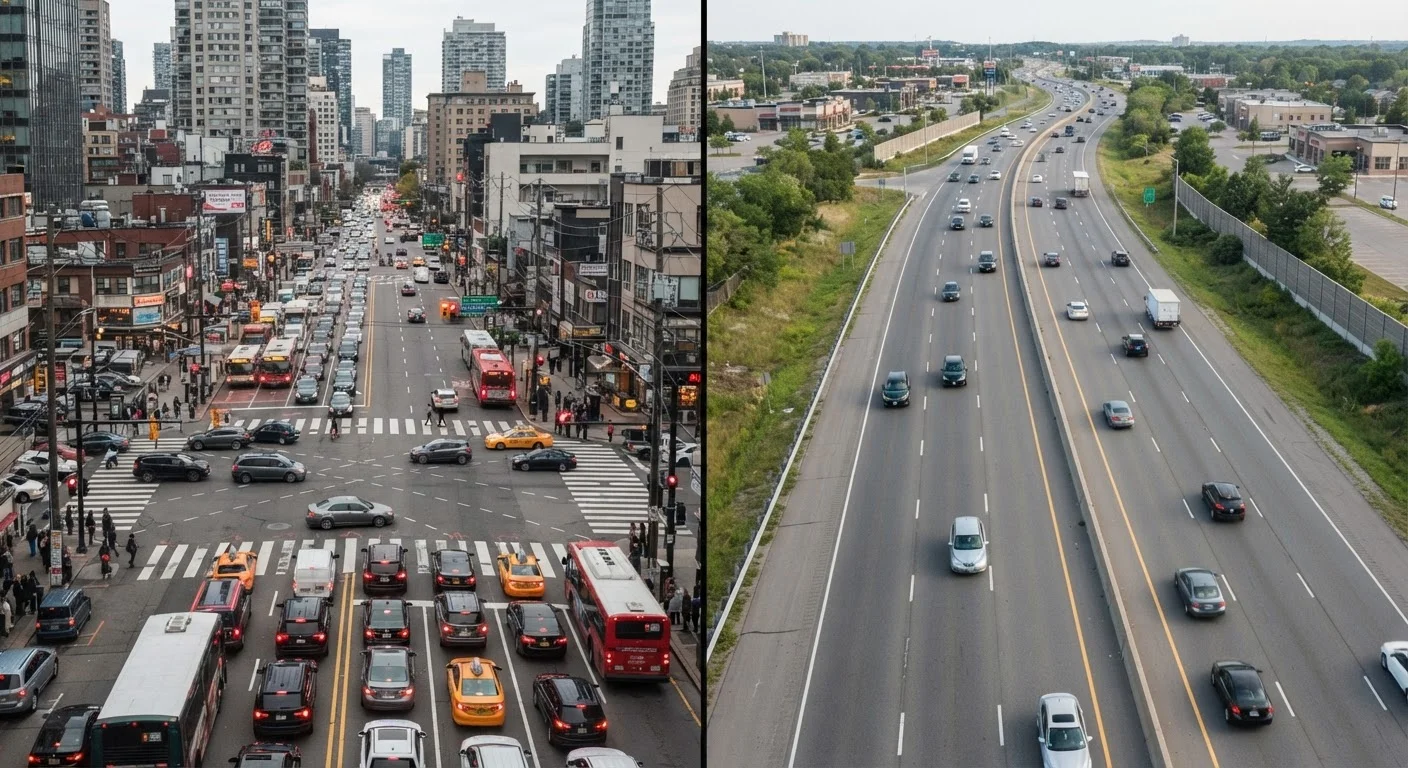
City stop-start driving costs most drivers more at the pump per mile than motorway cruising — but only when motorway speeds stay in a reasonable range. Once you push past roughly 65–70 mph, aerodynamic drag rapidly closes that gap. The bottom line: both environments have specific cost traps, and knowing which one applies to your routine is the first step toward spending less.
| Best for | Recommended |
|---|---|
| Drivers with mostly urban commutes who want to cut fuel spend | Smooth city driving habits (gentle acceleration, early coasting) |
| Frequent long-distance motorway drivers | Cruise control at 60–65 mph for optimal fuel efficiency |
| Mixed-route drivers wanting a single improvement to focus on | Eliminate aggressive acceleration in all conditions |
Why Your Route Type Changes Everything
Your car's fuel economy isn't a fixed number — it shifts constantly based on how and where you drive. The EPA rates vehicles using a combined city/highway cycle, but that blend rarely matches a real commute. Understanding the mechanical difference between the two environments explains why your wallet feels it.
In stop-start city driving, your engine cycles through idle, acceleration, and braking over and over. Each time you press the gas from a standstill, the engine demands a surge of fuel. Each time you brake, the kinetic energy you paid for is largely lost as heat — wasted. Idling at red lights burns fuel while covering zero miles.
On the motorway, the engine settles into a relatively steady state. At a consistent 60–65 mph, modern engines operate close to their efficiency sweet spot: combustion is more complete, transmission stays in a higher gear, and there's no energy lost to braking every few hundred feet. That's why highway figures on a window sticker almost always look better than city figures.
For a fuller picture of how official figures compare to what you actually spend, see our guide to fuel economy and real-world running costs.
City Driving: The Hidden Fuel Drain
Research from the U.S. Department of Energy consistently shows that aggressive driving — rapid acceleration and hard braking — can lower fuel economy by 15% to 40% in stop-and-go traffic. That's not a minor rounding error; on a $200/month fuel budget, that range represents $30 to $80 in avoidable spending.
Up to 40%
Fuel economy reduction from aggressive city driving
According to the U.S. Department of Energy, aggressive acceleration and hard braking in stop-and-go conditions can cut fuel economy by 15% to 40%.
~5 miles
Distance needed to warm engine to full efficiency
Engines run fuel-rich during warm-up; trips shorter than roughly 5 miles mean you never exit that inefficient cold-start phase.
10–25%
Extra fuel used driving 75–80 mph vs. 60 mph
The U.S. Department of Energy estimates that aerodynamic drag rises rapidly above 60 mph, significantly increasing fuel consumption per mile.
Short trips compound the problem. When a cold engine starts, it runs rich (using more fuel) until it reaches operating temperature, typically around 5 miles of driving. If most of your city trips are under that threshold, you're spending a disproportionate share of every fill-up just warming up the engine — over and over.
City driving also invites accessory load: frequent AC use in traffic, more headlight hours, and more stop-start cycles for vehicles without auto-start-stop technology. Each draws on the engine and nudges consumption higher. The everyday choices that add up at the pump covers these smaller drains in detail.
Motorway Driving: Efficient Until It Isn't
Steady-speed motorway driving is generally kinder to your fuel gauge — up to a point. The U.S. Department of Energy estimates that fuel economy typically peaks somewhere between 45 and 60 mph for most passenger vehicles, then drops as speed rises. Above 65 mph, aerodynamic drag grows exponentially: it roughly quadruples when you go from 40 mph to 80 mph.
At 70 mph versus 60 mph, you may be burning 10–15% more fuel for the same distance. Push to 80 mph and you can be looking at 25% worse economy compared to a steady 60. On a long trip, that adds up quickly.
| City Stop-Start | Motorway 60–65 mph | Motorway 75–80 mph | |
|---|---|---|---|
| Typical fuel efficiency impact | 15–40% worse than rated | Near or above rated MPG | 10–25% worse than 60 mph |
| Main efficiency killer | Frequent acceleration & braking | Minimal at moderate speed | Aerodynamic drag |
| Engine operating temperature | Often suboptimal on short trips | Fully warmed, stable | Fully warmed, stable |
| Idling fuel waste | High (lights, traffic) | None | None |
| Best mitigation habit | Gentle acceleration, early coasting | Cruise control, steady throttle | Reduce speed to 65 mph |
Cruise control earns its keep here. Maintaining a consistent speed on flat motorway sections avoids the small but repetitive fuel spikes that come from human throttle variation. On hilly routes, though, adaptive cruise that maintains speed uphill (flooring the throttle on grades) can sometimes hurt efficiency — manual speed management on steep climbs may help.
Evidence-backed driving techniques that reduce pump frequency cover this and other motorway-specific habits in more depth.
Practical Steps to Cut Costs in Both Environments
The good news is that the biggest fuel-saving levers are behavioral, not mechanical — meaning you can act on them immediately without spending anything.
For city driving:
- Accelerate gently. Pretend there's a cup of coffee on the dash. Smooth inputs save fuel; jackrabbit starts burn it.
- Coast early to stops. Lift off the throttle well ahead of red lights instead of braking late. Modern fuel-injected engines cut fuel delivery during deceleration — you can cover distance essentially for free.
- Combine short trips. Running multiple errands in one outing means the engine warms up once, not three times.
- Avoid unnecessary idling. If you're stopped for more than 60 seconds (parked, waiting), switching off the engine saves more fuel than restarting costs.
For motorway driving:
- Stay in the 55–65 mph range when traffic and safety allow. This is consistently where fuel efficiency is strongest for most passenger vehicles.
- Use cruise control on flat roads to eliminate speed creep and throttle variation.
- Reduce drag. Remove roof racks or cargo carriers when not in use — they add aerodynamic resistance that the engine must overcome at motorway speeds.
These habits also connect directly to wear-and-tear savings. Harsh driving speeds up component wear, so smoothing out your inputs reduces both fuel and repair costs simultaneously.
If you want to tie fuel strategy to the bigger picture of recurring ownership expenses, the complete guide to managing fuel and insurance costs walks through both together.
This article is for general informational purposes only and does not constitute personalized financial advice. Fuel economy figures vary by vehicle, load, conditions, and driving behavior. Consult a qualified professional for advice tailored to your situation.
The content provided on our blog site traverses numerous categories, offering readers valuable and practical information. Readers can use the editorial team’s research and data to gain more insights into their topics of interest. However, they are requested not to treat the articles as conclusive. The website team cannot be held responsible for differences in data or inaccuracies found across other platforms. Please also note that the site might also miss out on various schemes and offers available that the readers may find more beneficial than the ones we cover.