

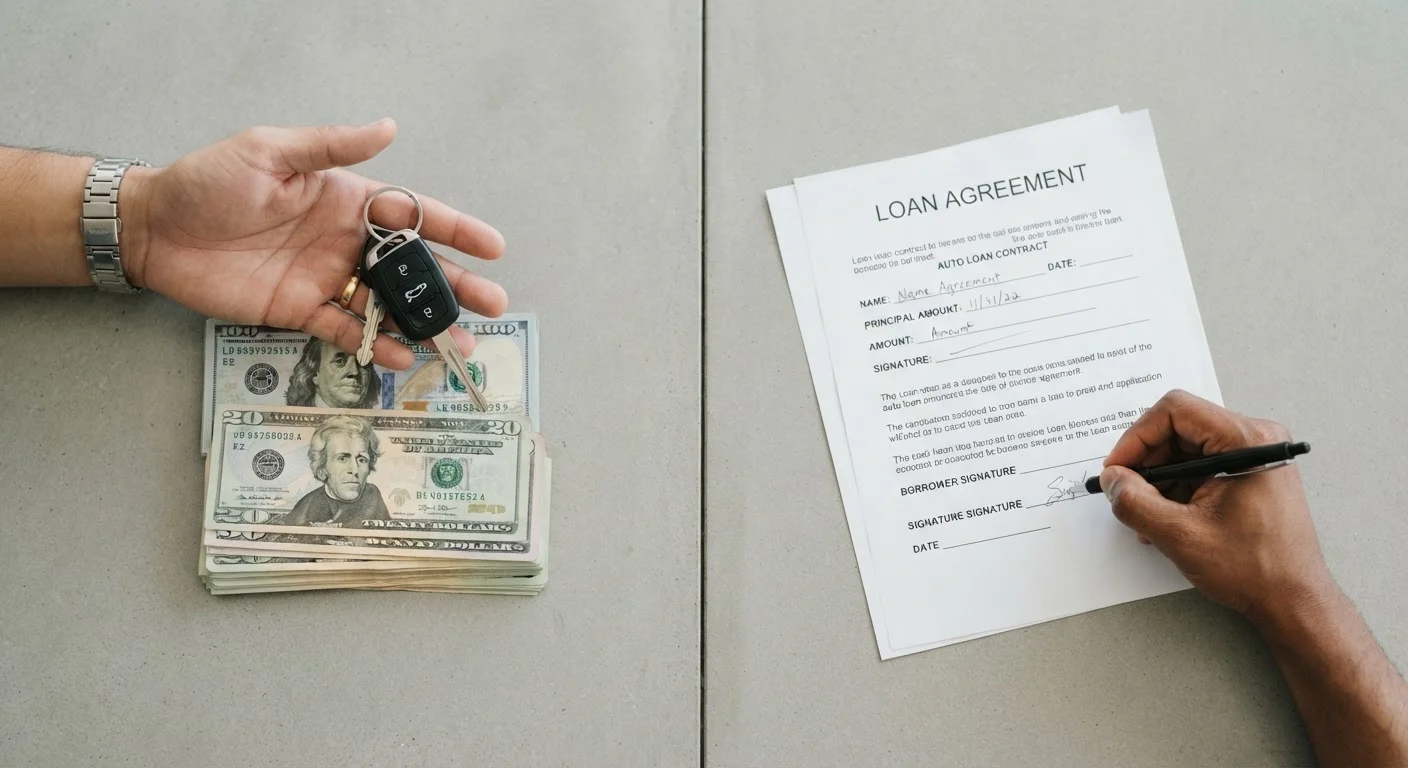
Option A
Paying Cash
The debt-free, interest-free approach to car ownership.
Best for: Buyers who have savings ready and want to minimize total cost and monthly obligations.
Option B
Auto Financing
Spreading the cost over time while preserving cash on hand.
Best for: Buyers who need to preserve liquidity or who qualify for a rate low enough to make financing worthwhile.
The Real Cost of an Auto Loan
When you finance a car, you're not just paying the purchase price — you're paying the purchase price plus interest, spread across a loan term that typically runs 48 to 72 months. According to data from the Federal Reserve, the average interest rate on a new-car loan in recent years has hovered between 6% and 9% for borrowers with good credit, and significantly higher for subprime borrowers.
Here's a straightforward example: a $25,000 loan at 7% APR over 60 months generates roughly $4,700 in total interest. That's money that goes to a lender, not toward the car itself. Longer loan terms lower your monthly payment but increase total interest paid — a trade-off that often catches buyers off guard.
Beyond interest, financing can also affect your insurance costs. Lenders typically require comprehensive and collision coverage, which may be more than you'd carry on a paid-off vehicle. For a full picture of recurring ownership expenses, see our guide to managing fuel and insurance costs.
| Criterion | Paying Cash | Auto Financing |
|---|---|---|
| Total interest paid | $0 | Thousands over loan term |
| Monthly cash flow impact | No ongoing payment | Fixed monthly payment required |
| Liquidity after purchase | Reduced significantly | Cash reserves preserved |
| Insurance requirements | Your choice of coverage | Lender may require full coverage |
| Credit impact | No loan added to credit file | On-time payments can build credit |
| Opportunity cost | Foregone investment returns | Interest paid to lender |
| Negotiating position | May have cash-price leverage | Dealer may focus on monthly payment |
What You Give Up When You Pay Cash
Paying cash feels like the obvious money-saving move — and in pure interest terms, it is. But there's a concept called opportunity cost that complicates the picture. When you hand over a lump sum for a car, that money is no longer available to earn returns elsewhere.
If you drain a savings account earning 4–5% APY to avoid a 6% auto loan, the math is relatively straightforward: you saved more in interest than you lost in yield, and cash wins. But if you liquidate investments or pull from a retirement account, the real cost can be substantially higher — especially if early withdrawals trigger taxes and penalties.
Paying cash also means less financial flexibility. If an unexpected expense hits — a medical bill, a job change, a home repair — you don't have that cushion to fall back on. For budget-conscious drivers, maintaining an emergency fund typically takes priority over eliminating a manageable loan payment.
The upfront-vs-ongoing cost framework applies here too: paying more now isn't always the lowest-cost decision once you account for what that capital could otherwise do.
Head-to-Head: Key Comparison Points
The table below summarizes the practical differences between the two approaches across dimensions that matter most for budget-minded buyers. Neither column is a clear winner in every row — which is exactly why this decision is personal.
$4,700+
Estimated interest on a typical auto loan
Based on a $25,000 loan at 7% APR over 60 months — a common scenario for buyers with good credit.
68 months
Average new-car loan term in the U.S.
According to Experian's State of the Automotive Finance Market report, average loan terms have been lengthening, increasing total interest paid.
~$735
Average monthly new-car payment
Experian data indicates average monthly payments for new vehicle loans have risen substantially in recent years, straining tight budgets.
If you're also weighing whether to buy at all versus lease, our comparison of owning vs. leasing a car on a tight budget covers that angle in detail.
How to Think Through Your Own Situation
No calculator can make this decision for you, but a few questions can sharpen your thinking:
- After buying cash, would you still have 3–6 months of expenses saved? If not, financing to preserve your cushion is worth considering.
- What interest rate would you qualify for? Your credit score heavily influences this. A rate above 8–9% makes financing noticeably expensive; a rate below 4–5% changes the math considerably.
- Do you carry other high-interest debt? If you're managing credit card balances or personal loans above 15–20% APR, directing cash toward those debts first — and financing the car — often reduces your total interest paid. The approach to prioritizing high-interest debt is worth reviewing before you decide.
- New or used vehicle? Used cars typically carry higher loan rates than new ones. The total cost comparison between new and used cars can help you factor depreciation and maintenance into your financing math.
Once you've bought the car, revisiting your full ownership costs annually is smart. Our annual car ownership audit walks through every line item worth reviewing.
This article is for general informational purposes only and does not constitute personalized financial or investment advice. Individual circumstances vary significantly. Consult a licensed financial adviser before making major purchase or borrowing decisions.
The content provided on our blog site traverses numerous categories, offering readers valuable and practical information. Readers can use the editorial team’s research and data to gain more insights into their topics of interest. However, they are requested not to treat the articles as conclusive. The website team cannot be held responsible for differences in data or inaccuracies found across other platforms. Please also note that the site might also miss out on various schemes and offers available that the readers may find more beneficial than the ones we cover.