

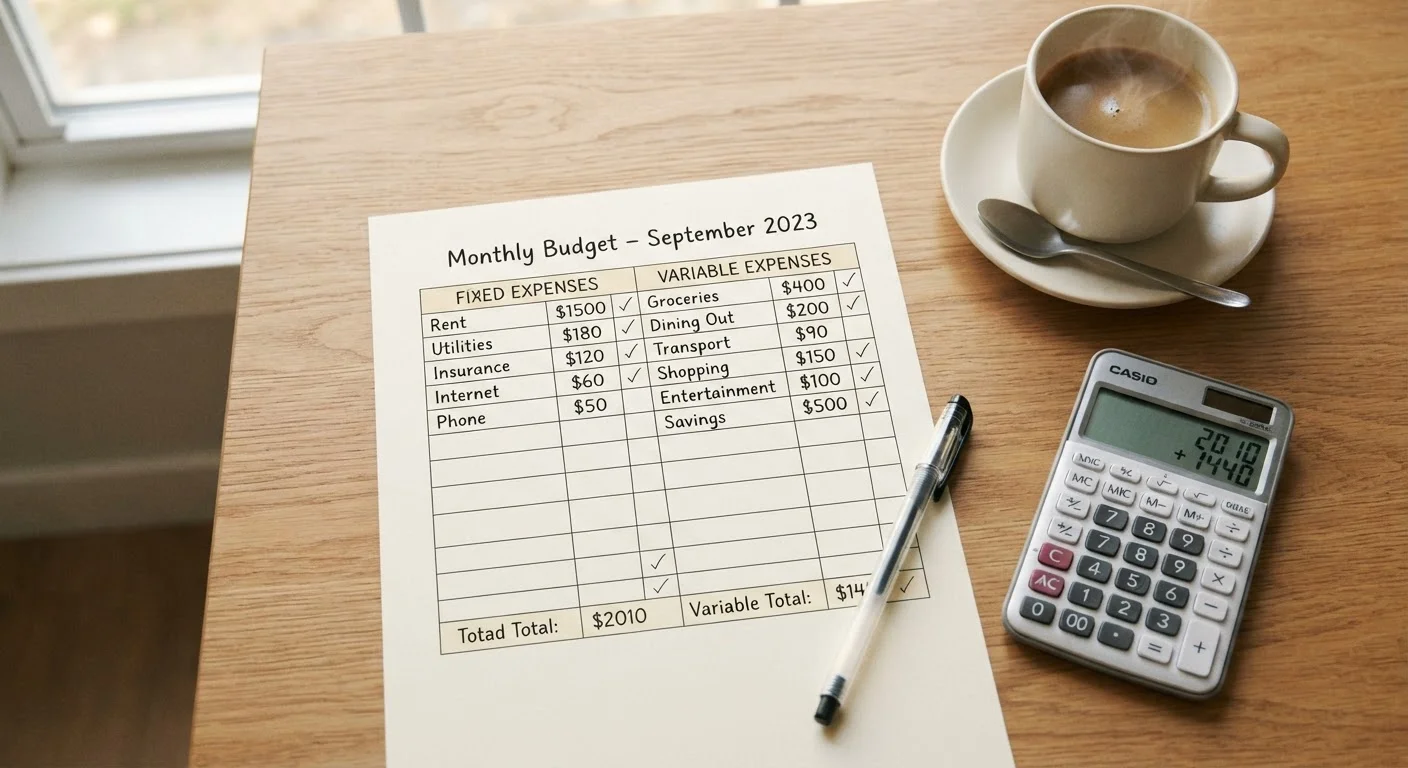
The Two Categories That Underlie Every Budget
Before you can make a budget work, you need to understand what your money is actually doing. Every expense you have behaves in one of two fundamental ways: it either stays constant regardless of your choices, or it moves up and down based on how you live. That's the fixed vs. variable distinction, and it's the foundation of sound budgeting.
A fixed expense is one where the amount is set — by a lease agreement, a loan contract, or a subscription plan — and doesn't change from one billing cycle to the next. A variable expense is one where the amount shifts depending on your consumption, habits, or circumstances. Understanding which category each of your costs falls into is the first practical skill covered in any solid budgeting glossary.
Getting this distinction right isn't just academic. It directly shapes which spending decisions you have control over right now and which require longer-term planning to change.
Fixed Expenses: Your Non-Negotiable Baseline
Fixed expenses form the floor of your monthly budget — the amount you owe regardless of what else happens that month. Common examples include:
- Rent or mortgage payment
- Car loan or lease payment
- Student loan payment
- Insurance premiums (auto, renter's, health)
- Internet service (on a contract plan)
- Fixed-rate subscription services
Because these costs are set by agreements you've already signed, they can't typically be reduced without a significant action: moving, refinancing, canceling, or renegotiating. That's not a reason to ignore them — it's a reason to evaluate them carefully before committing. For ideas on keeping household fixed costs manageable, the Low-Cost Home Life hub covers practical approaches to affordable everyday living.
Start with Fixed Costs Before Anything Else
When building a new budget, list every fixed expense first and sum them up. Subtract that total from your monthly take-home pay before allocating anything to variable categories. This single step prevents the common mistake of overspending on discretionary items and then scrambling to cover non-negotiable bills.
Once you've listed your fixed expenses, add them up. That total is your baseline — the minimum your budget must cover before you allocate a single dollar elsewhere.
Variable Expenses: Where Most of Your Flexibility Lives
Variable expenses are the costs that change based on what you do. They include:
- Groceries
- Gas and transportation (beyond a fixed car payment)
- Dining and takeout
- Entertainment and leisure
- Clothing
- Utilities (electricity, water, gas)
- Personal care
Because variable expenses respond to your decisions, they're where most short-term budgeting adjustments happen. If your income drops or you're building an emergency fund, variable costs are the first place to look for reductions. This behavioral flexibility is also why grouping your spending categories thoughtfully matters — variable costs can blur together quickly without a clear structure.
One nuance worth noting: variable doesn't mean unimportant or optional. Groceries are variable but essential. The variability just means you have some control over the amount.
Why the Distinction Changes How You Budget
Treating every expense the same leads to frustrating budgets that fall apart mid-month. Separating fixed from variable costs lets you take two distinct approaches.
For fixed expenses, the goal is to right-size your commitments over time. Could you find a less expensive housing situation? Refinance a loan at a lower rate? Cut a subscription you no longer use? These decisions don't happen overnight, but they permanently lower your baseline.
For variable expenses, the goal is real-time awareness and intentional limits. Tracking what you spend on groceries, dining, or entertainment each month — and setting targets — gives you immediate levers to pull when you need to free up cash.
This two-track thinking is foundational to most established budgeting frameworks. Whether you prefer a structured system or a more automated approach, the overview of budgeting approaches explains how different methods handle this split. Similarly, comparing traditional and pay-yourself-first budgeting shows how the sequencing of fixed and variable costs differs by method.
This article is for general informational and educational purposes only. It does not constitute personalized financial advice. For guidance specific to your situation, consult a qualified financial professional.
Frequently Asked Questions
Common fixed expenses include rent or mortgage payments, car loan payments, student loan payments, and certain insurance premiums. These amounts are set by a contract or agreement and don't change month to month unless you renegotiate or refinance.
Groceries, dining out, gas, entertainment, and utility bills are typical variable expenses. The amount you spend in each category shifts depending on your behavior, consumption, and circumstances in a given month.
Utilities like electricity, water, and gas are generally variable because usage — and therefore the bill — changes month to month. Some providers offer budget billing programs that average your annual usage into equal monthly payments, effectively making them act like fixed costs.
Variable expenses typically offer more immediate flexibility because they depend on choices you make day to day. Fixed expenses usually require a larger commitment, such as moving, refinancing, or canceling a contract, to meaningfully reduce.
List your fixed expenses first to establish your non-negotiable baseline — the minimum you must spend each month. Then map your variable expenses against what's left of your income. This sequencing helps you see how much discretionary room you actually have.
Recurring subscriptions — streaming services, gym memberships, software plans — are technically fixed because they charge a set amount on a predictable schedule. However, they're also discretionary, meaning they can be canceled. This makes them a useful target when you need to lower your fixed-cost baseline.
The content provided on our blog site traverses numerous categories, offering readers valuable and practical information. Readers can use the editorial team’s research and data to gain more insights into their topics of interest. However, they are requested not to treat the articles as conclusive. The website team cannot be held responsible for differences in data or inaccuracies found across other platforms. Please also note that the site might also miss out on various schemes and offers available that the readers may find more beneficial than the ones we cover.