

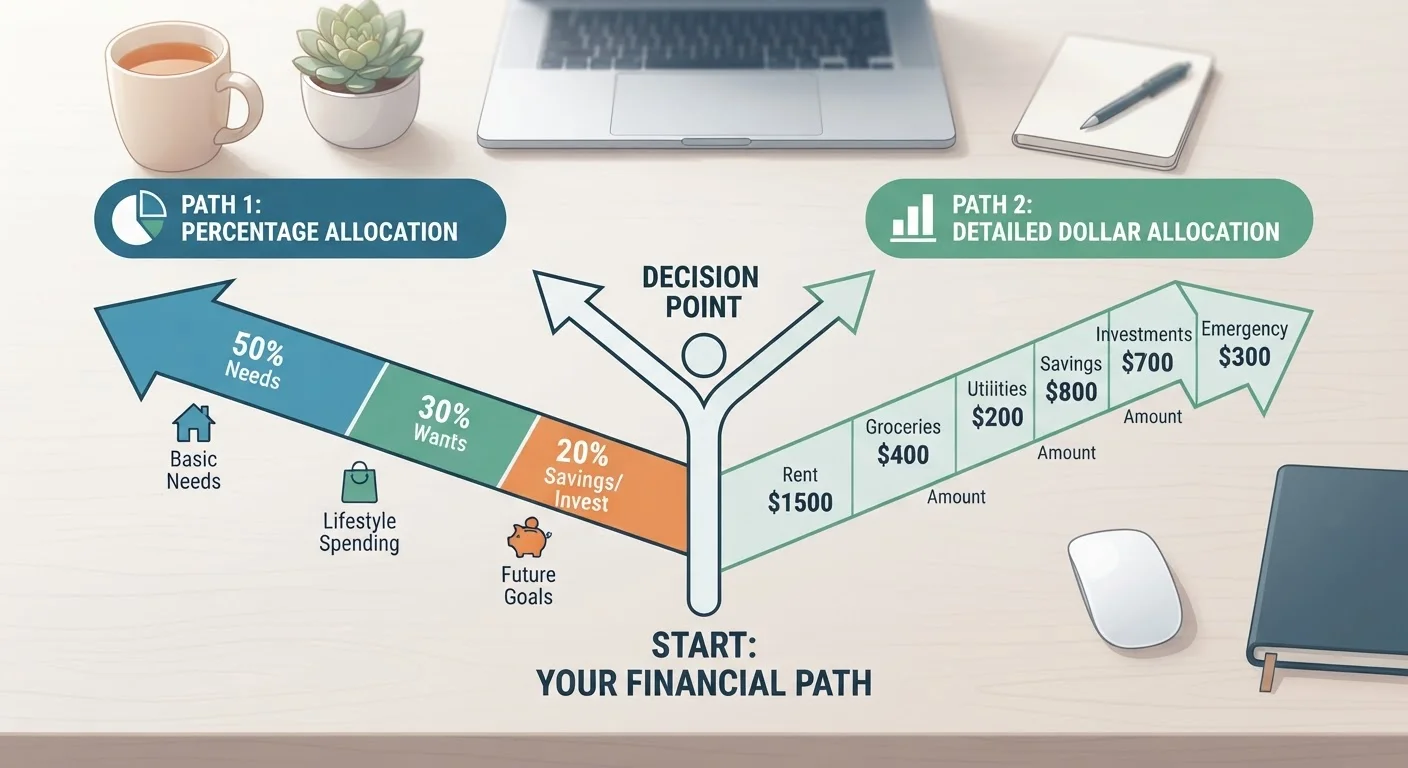
Option A
The 50/30/20 Rule
The straightforward percentage-based framework for budgeting beginners.
Best for: People who want a low-maintenance structure that doesn't require tracking every transaction.
Option B
Zero-Based Budgeting
The detail-oriented method that assigns a purpose to every dollar.
Best for: People who want precise control over their spending and are comfortable reviewing their budget monthly.
How Each Framework Works
The 50/30/20 rule — popularized in personal finance circles over the past two decades — divides your after-tax income into three buckets: 50% toward needs (housing, utilities, groceries, minimum debt payments), 30% toward wants (dining out, subscriptions, entertainment), and 20% toward savings and additional debt repayment. The appeal is simplicity: once you know your take-home pay, the math is immediate. For a deeper look at how the rule applies to tight budgets, see The 50/30/20 Rule Explained.
Zero-based budgeting (ZBB) works differently. You start with your projected monthly income and subtract every planned expense — rent, groceries, savings contributions, debt payments, streaming services, even a coffee fund — until the math reaches exactly zero. No dollar is unaccounted for. You begin fresh each month, which means the budget reflects your actual upcoming obligations rather than a standing template. For a full walkthrough of the method, Zero-Based Budgeting: Giving Every Dollar a Job covers the mechanics in detail.
Side-by-Side Comparison
Understanding where these two frameworks diverge across practical dimensions helps you assess fit before committing to either.
| Criterion | 50/30/20 Rule | Zero-Based Budgeting |
|---|---|---|
| Setup time | Minimal — calculate percentages once | 30–60 min per month to build |
| Ongoing maintenance | Low — review category totals periodically | High — track and reconcile line items monthly |
| Spending visibility | Broad — category-level only | Granular — every expense named |
| Adaptability to variable income | Limited — percentages shift but totals are unclear | Strong — rebuilt from actual income each month |
| Best starting point for | Budgeting beginners | Detail-oriented or debt-focused individuals |
| Risk of overspending | Moderate — categories are broad | Lower — every dollar pre-assigned |
| Works well with irregular bills | Less well — fixed splits don't flex easily | Yes — irregular costs planned each month |
One distinction worth emphasizing: the 50/30/20 rule works from percentages, so its structure stays constant regardless of income. ZBB works from actual dollar amounts, which means every income change triggers a full budget revision — more work, but also more precision.
Where Each Framework Tends to Struggle
The 50/30/20 rule runs into real friction for many US millennials because the 50% needs ceiling is often unrealistic. In high cost-of-living cities, rent alone can consume 40–45% of take-home pay before a single other need is funded. When needs structurally exceed 50%, the remaining percentages compress, and the framework's clean logic breaks down. It also gives little visibility into where within a category money is going — you might stay under 30% on wants but never know which specific habits are quietly draining your budget.
Zero-based budgeting's main friction is time and consistency. Building a line-item budget from scratch each month can take 30–60 minutes and requires honest estimates of irregular expenses. If you have unpredictable income — freelance work, hourly shifts, gig work — projecting a reliable starting number is genuinely hard, and an underestimated income figure can throw the whole budget off before the month starts.
A Note on Income Assumptions
Both frameworks assume you can reliably estimate your monthly take-home income. For W-2 employees with consistent paychecks, this is straightforward. If your income varies — from freelance contracts, tips, or hourly shifts — consider basing your budget on a conservative estimate (such as your lowest recent month) rather than an optimistic average. Building on an underestimated income means any surplus becomes a bonus you can redirect intentionally, rather than a shortfall that breaks your budget mid-month.
Choosing the Right Fit — or Combining Both
The decision isn't always either/or. Some people use the 50/30/20 framework as a diagnostic check — running their actual spending through the percentage splits quarterly to spot category drift — while using zero-based budgeting for their day-to-day monthly plan. This hybrid approach captures the high-level perspective of one method and the precision of the other.
If you're weighing other budgeting philosophies alongside these two, Pay-Yourself-First vs. Traditional Budgeting explores a third school of thought — one that prioritizes savings automation over categorizing expenses at all. And if you're managing a household on a tight budget, the ideas in Low-Cost Home Life can help reduce the fixed costs that make any budgeting framework harder to maintain.
Ultimately, the framework you actually use outperforms the one that looks best on paper. Start with whichever method matches your current bandwidth, and adjust as your financial situation changes.
This article is for general informational and educational purposes only and does not constitute personalized financial, tax, or legal advice. Consult a qualified financial professional for guidance specific to your circumstances.
The content provided on our blog site traverses numerous categories, offering readers valuable and practical information. Readers can use the editorial team’s research and data to gain more insights into their topics of interest. However, they are requested not to treat the articles as conclusive. The website team cannot be held responsible for differences in data or inaccuracies found across other platforms. Please also note that the site might also miss out on various schemes and offers available that the readers may find more beneficial than the ones we cover.