

Our Verdict
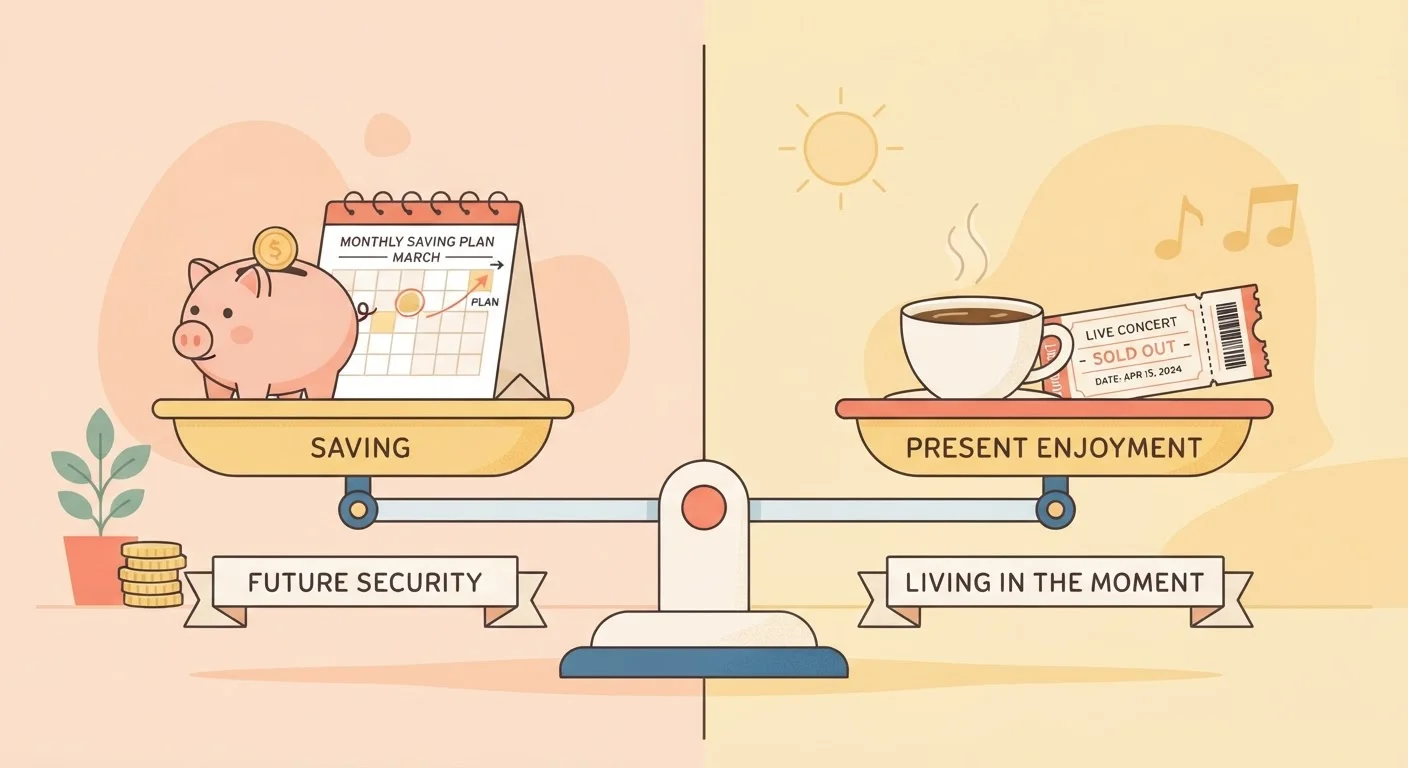
Neither extreme works reliably. Pure delayed gratification sets an unsustainable standard that often collapses under the weight of deprivation, while spending freely today without a savings plan stores up serious risk. A blended approach — where saving is automated, spending on what matters most is intentional, and guilt is taken out of the equation — tends to hold up across income levels and life stages.
Millennials on tight budgets who feel stuck between responsible saving and wanting to actually live their lives will get the most value from this framework.
Why This Tension Feels So Personal
Money decisions are rarely just mathematical. For many millennials navigating student debt, high housing costs, and stagnant wage growth, the question of whether to save now or spend now is loaded with anxiety, identity, and social pressure. Frugality communities online can make extreme sacrifice look admirable, while consumer culture pushes constant spending. Neither message is especially helpful when you're trying to build a realistic plan on a limited income.
The delayed gratification model — rooted in the idea that discipline today creates freedom tomorrow — has genuine merit. But so does the counter-argument: life is uncertain, and deferring every form of enjoyment indefinitely is both psychologically costly and, for many people, ultimately unsustainable. Understanding both sides is the first step toward building a framework that actually holds.
This tension also intersects with lifestyle creep, where rising income invisibly inflates spending — a pattern that makes the discipline side of this debate feel even harder to maintain.
The Case for Delayed Gratification
Deferring spending in favor of saving or debt repayment creates measurable long-term advantages. Compound interest rewards early savers disproportionately: money saved at 25 has decades more time to grow than money saved at 40. Similarly, paying down high-interest debt early reduces the total interest paid, which is the financial equivalent of a guaranteed return.
Compound growth rewards early, consistent savers significantly
Money invested or saved at a young age has more time to compound, meaning the mathematical advantage of starting early is substantial — even with modest contributions.
Reduces high-interest debt faster, lowering total cost
Prioritising debt repayment, especially on credit cards or personal loans, reduces the total interest paid, functioning as a guaranteed return that most investments can't reliably match.
Builds financial resilience through an emergency buffer
An emergency fund accumulated through disciplined saving insulates against income disruption, reducing the likelihood of having to take on new debt when unexpected costs arise.
Develops lasting budgeting habits and self-discipline
Consistent practice of restraint strengthens financial habits over time, making saving feel less effortful and more automatic as the behavior becomes ingrained.
There is also a behavioral dimension. People who practice intentional restraint tend to develop stronger financial habits over time — budgeting becomes automatic rather than effortful. And building an emergency fund early means that a job loss or medical bill doesn't immediately trigger a debt spiral. For more on balancing competing financial goals simultaneously, see our article on paying off debt while building savings.
The Case for Spending on Life Now
Research in behavioral economics consistently shows that anticipating reward and then denying it repeatedly depletes willpower and creates a phenomenon sometimes called "decision fatigue." A budget with zero flexibility is often more fragile, not less — one bad week can trigger an all-or-nothing spending episode that erases months of progress.
Extreme restriction breeds burnout and impulsive backlash
Budgets with no flexibility are behaviorally fragile. When deprivation becomes overwhelming, it often leads to compensatory overspending that undoes months of careful saving.
Defers life satisfaction to an uncertain future
Health, relationships, and priorities shift unpredictably over a lifetime. Postponing all enjoyment until a future milestone assumes a certainty about the future that rarely holds.
Ignores the real psychological cost of constant sacrifice
Chronic financial restriction without any relief can contribute to stress, resentment, and a negative relationship with money — outcomes that undermine long-term financial well-being.
Can cause social isolation and relationship strain
Refusing all discretionary spending, including shared meals or group activities, can damage relationships and create a sense of exclusion that erodes motivation over time.
There is also the "someday" problem. Plans that defer all enjoyment to a future milestone — retirement, debt freedom, a specific savings number — can fail to account for life's unpredictability. Health changes, family circumstances, or shifting priorities mean that "later" is never guaranteed. Spending intentionally on experiences or relationships that matter now is a legitimate financial priority, not just a weakness.
The 'Someday' Trap Is Real
Many people mentally attach all enjoyment to a future state — "when I'm debt-free," "when I earn more," "when I retire." Behavioral research suggests this pattern can persist indefinitely, with the goal simply shifting forward. Building deliberate, present-tense enjoyment into a budget is not a concession to weakness — it is a strategy for making the plan survivable. Small planned pleasures, like a modest travel fund, can sustain motivation across years of disciplined saving.
Building a Middle Ground That Holds
The most durable personal finance strategies are not about maximum sacrifice — they're about sustainable systems. A few principles help most people find workable balance:
- Automate savings first. Set up automatic transfers to savings or retirement accounts on payday, before discretionary spending decisions arise. This removes the daily temptation to redirect those funds.
- Budget a deliberate 'fun money' category. Assigning a specific, guilt-free amount for discretionary spending — even a modest one — reduces the psychological pressure that leads to impulsive splurges.
- Distinguish between spending that depletes and spending that enriches. Mindless consumption rarely satisfies. Intentional spending on things genuinely valued — travel, community, skill-building — tends to deliver more satisfaction per dollar.
- Revisit your plan as income changes. A rigid plan built for one income level rarely survives a raise or a pay cut intact. Schedule a quarterly review.
If you're looking to apply this balance to everyday purchases, Everyday Money Wins offers quick, practical tactics that don't require sacrificing everything you enjoy. Similarly, early tech spending habits illustrate how small, consistent decisions compound into meaningful savings over time.
36%
Americans with no emergency savings
According to Bankrate's 2023 Annual Emergency Savings Report, approximately 36% of U.S. adults had no emergency savings at all, highlighting the real cost of prioritising present spending exclusively.
~10 years
Difference in compounding between starting at 25 vs. 35
Financial planning models consistently show that a decade's head start on retirement saving can result in dramatically higher balances at retirement age, even with identical contribution rates.
This article is for general informational and educational purposes only and does not constitute personalised financial advice. Financial decisions depend on individual circumstances. Consider consulting a qualified financial adviser before making significant changes to your budget or savings strategy.
The content provided on our blog site traverses numerous categories, offering readers valuable and practical information. Readers can use the editorial team’s research and data to gain more insights into their topics of interest. However, they are requested not to treat the articles as conclusive. The website team cannot be held responsible for differences in data or inaccuracies found across other platforms. Please also note that the site might also miss out on various schemes and offers available that the readers may find more beneficial than the ones we cover.