

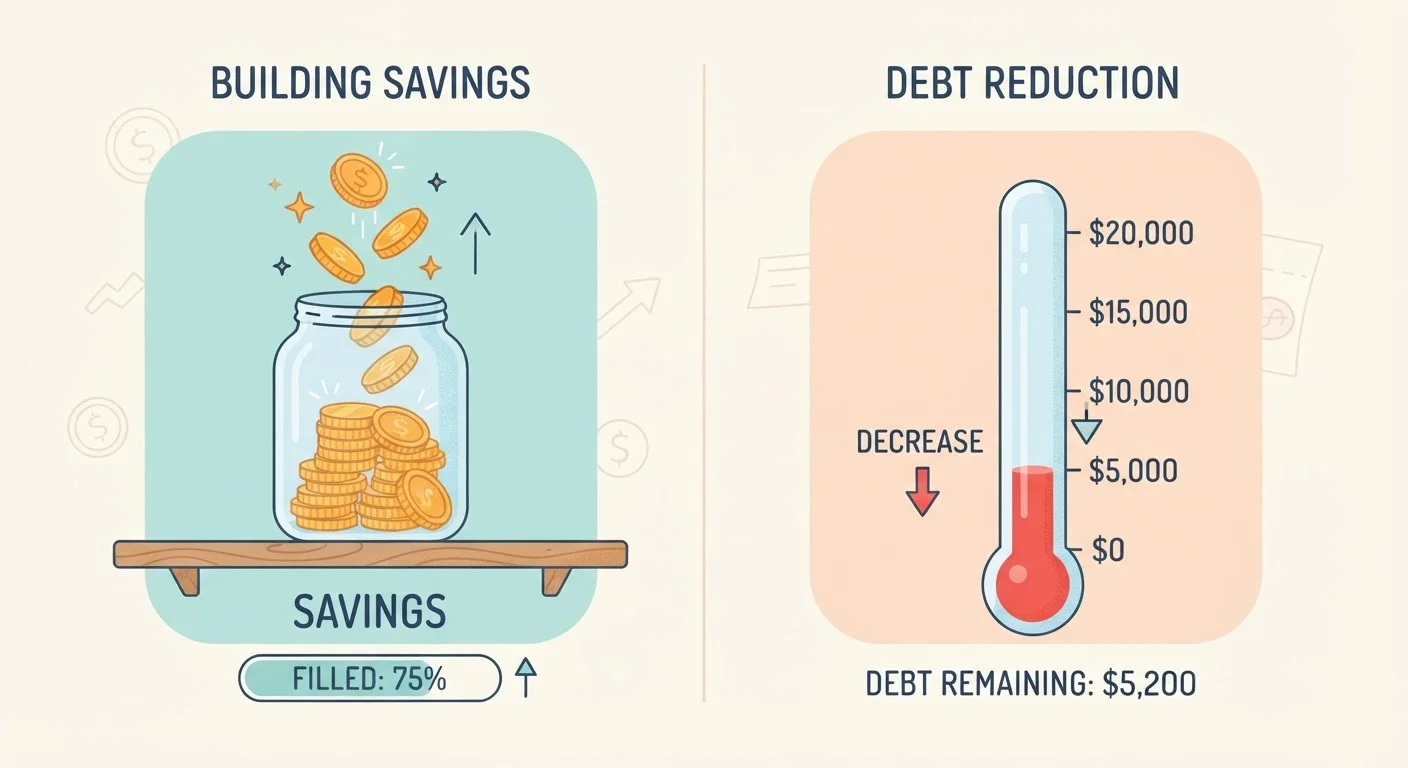
The False Choice Between Debt and Savings
Personal finance culture often presents debt repayment and saving as a binary: eliminate debt first, then save. It's a tidy narrative, but it doesn't hold up against how real financial life works. Emergencies don't wait. Opportunities — like an employer contributing matching funds to your retirement account — have deadlines. And spending years directing every spare dollar toward debt with nothing in reserve is a single setback away from starting the cycle over.
The parallel approach reframes the question. Instead of asking which goal comes first, it asks how to allocate limited dollars across both goals based on their actual cost to your finances. That's a more useful question — and one with practical answers even on a constrained budget. See our complete guide to the savings and debt balancing act for a broader framework on navigating this trade-off.
Debt Type Affects the Strategy
Not all debt demands the same urgency. Credit card debt at 22% interest is a very different problem from a federal student loan at 4.5% or a 0% medical payment plan. The interest rate is the most important factor in deciding how aggressively to prioritize any individual debt over other financial goals. If you're weighing how to structure repayment, our comparison of the avalanche and snowball methods walks through how each approach functions in practice.
Why a Safety Net Changes the Math
The single most important argument for saving while carrying debt is the emergency fund. Without one, any unplanned expense — a medical copay, a car repair, a gap in hours — gets charged to a credit card or financed in some other way. That new debt typically arrives at a higher interest rate than what you were already paying, which sets back progress considerably.
A starter emergency fund of roughly $500 to $1,000 doesn't eliminate every risk, but it reduces the probability that a moderate disruption becomes a debt spiral. Once that cushion exists, the calculation shifts: extra dollars can be directed more aggressively toward repayment without the same vulnerability. You can learn more about the different savings tools that support this kind of protection in our breakdown of emergency funds vs. sinking funds.
~28%
Americans with no emergency savings
According to Bankrate's annual emergency savings report, roughly one in four U.S. adults report having no emergency fund at all.
$1,000
Typical cost of a common household emergency
Research from the Pew Charitable Trusts has found that a significant share of households experience an unexpected expense of $400 or more each year, with many disruptions exceeding $1,000.
20–22%
Average credit card APR in recent years
The Federal Reserve's consumer credit data shows credit card interest rates have remained at historically elevated levels, underscoring the cost of carrying revolving balances.
How to Actually Split Your Budget Between Both Goals
There's no universal ratio, but there is a logical sequence most people can follow:
- Cover minimum payments on all debts. Missing minimums triggers fees and credit score damage — always pay at least the minimum on every account.
- Build your starter emergency fund. Before directing extra money anywhere else, accumulate a small cash buffer in a separate account.
- Capture any employer retirement match. If your employer matches retirement contributions up to a percentage of your salary, contribute at least enough to receive the full match. Forgoing a match is the equivalent of turning down part of your compensation.
- Put extra dollars toward high-interest debt. Once the above are handled, target the debt costing you the most in interest. See practical approaches to prioritizing high-interest debt for a closer look at how to structure this.
- Revisit periodically. As balances drop and income changes, adjust the split. What made sense with $8,000 in debt may look different at $2,000.
The Behavioral Case for Doing Both
Beyond the math, there's a psychological dimension. People who save nothing while paying off debt often feel like they're running in place — all sacrifice, no visible progress in a savings account. That experience is a known contributor to what researchers call debt fatigue, the point at which motivation collapses and spending discipline erodes.
Maintaining even a modest savings balance creates a tangible marker of financial progress. It reinforces the identity of someone building stability, not just digging out. That mindset shift matters more than most purely financial analyses acknowledge. If you find extreme frugality hard to sustain over time, our piece on delayed gratification vs. enjoying money now explores how to find a middle ground that lasts.
Additionally, the habits formed by consistent saving — however small the amounts — tend to persist after debt is gone. The alternative, saving nothing for years and then attempting to build the habit from scratch, is harder than it sounds. Everyday money habits worth building from scratch offers a practical starting point if you're building those routines now.
Automate Both to Remove the Decision
Set up automatic transfers to savings and automatic extra debt payments on the same day your paycheck lands. When the allocation happens before you see the money in your checking account, you eliminate the temptation to redirect it. Even small automated amounts — $15 to savings, $25 extra to debt — build meaningful habits over time.
This article is for general informational and educational purposes only. It does not constitute personalized financial, investment, tax, or legal advice. For guidance specific to your situation, consult a licensed financial professional.
Frequently Asked Questions
Not necessarily. Paying off all debt before saving leaves you without a financial buffer, meaning any unexpected expense could force you to borrow again. A balanced approach — maintaining a small emergency fund while paying down debt — is generally more resilient for people on tight budgets.
Start by covering minimum payments on all debts, then build a small emergency fund of $500–$1,000. After that, compare the interest rate on your debt to any guaranteed return on savings (like an employer match). Direct extra money toward whichever gap is costliest to leave unaddressed.
A minimal emergency fund is still worth maintaining even with high-interest debt. Without it, one car repair or medical bill can push you to borrow more at an even higher rate. For long-term savings beyond an emergency cushion, prioritizing high-interest debt payoff usually makes mathematical sense.
High-interest debt in particular erodes wealth because you pay more in interest than modest savings can earn. However, completely ignoring savings while in debt can also delay wealth-building. The goal is to reduce the drag of interest costs while maintaining forward momentum on savings — not to sacrifice one entirely.
Even a very small savings transfer — as little as $10 per paycheck — keeps the savings habit active while debt is your primary focus. Consider whether any discretionary spending can be trimmed. And if cash flow is extremely tight, prioritize the emergency fund first, then redirect that amount to extra debt payments once it's funded.
If your total debt feels unmanageable, you're missing minimum payments, or you're unsure how your retirement accounts, taxes, or debt types interact, a licensed financial counselor or certified financial planner can provide guidance tailored to your situation. General articles like this one are educational starting points, not personalized advice.
The content provided on our blog site traverses numerous categories, offering readers valuable and practical information. Readers can use the editorial team’s research and data to gain more insights into their topics of interest. However, they are requested not to treat the articles as conclusive. The website team cannot be held responsible for differences in data or inaccuracies found across other platforms. Please also note that the site might also miss out on various schemes and offers available that the readers may find more beneficial than the ones we cover.