

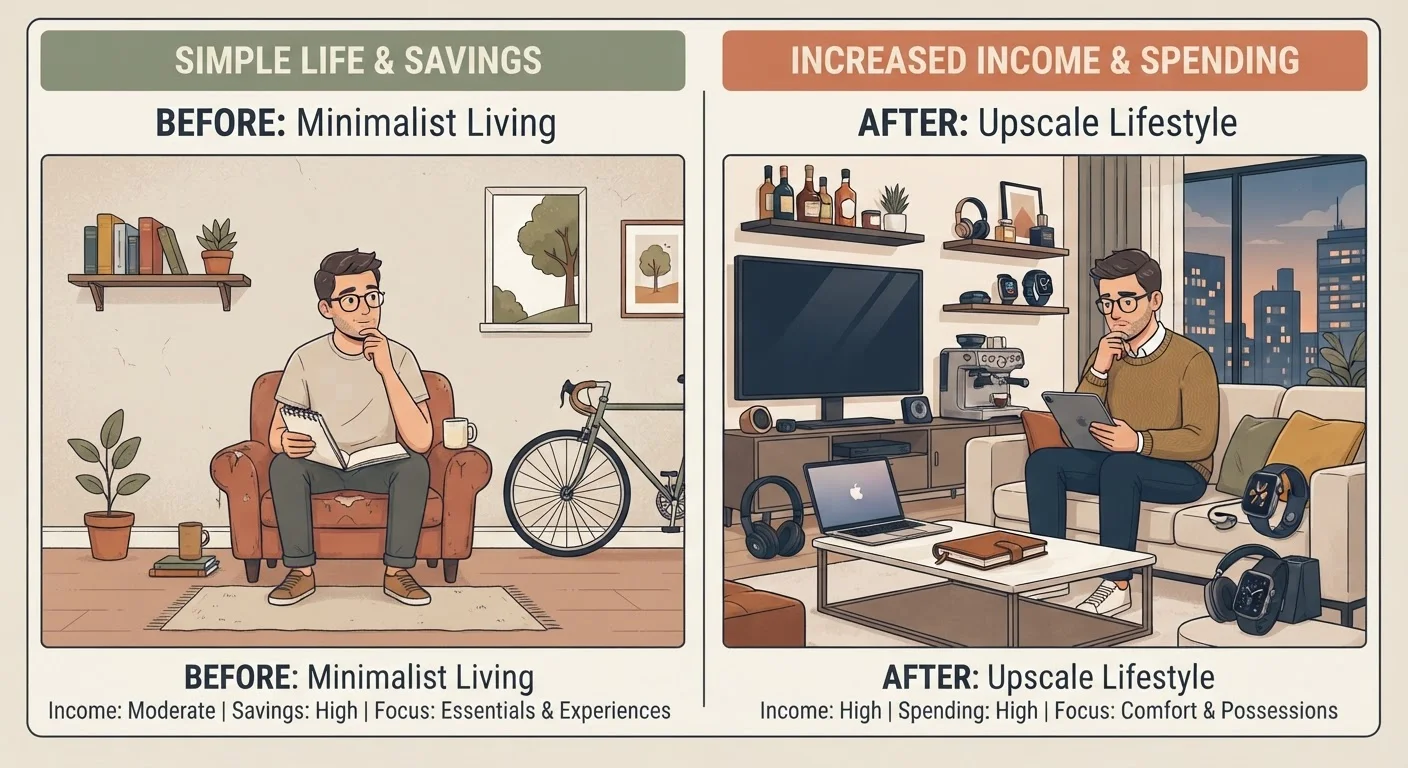
Why More Income Doesn't Always Mean More Financial Breathing Room
It's a common and quietly frustrating experience: you land a raise, switch to a better-paying job, or pick up a side income — and within six months, you feel just as financially tight as before. Your bank account tells a different story than the one you expected when you negotiated that salary bump. This is lifestyle inflation at work.
The mechanism is simple even if the experience is disorienting. As income rises, so does the perceived "floor" of what feels like a reasonable standard of living. The apartment that felt fine at $45,000 a year starts to feel cramped once you're earning $65,000. The lunch you packed starts to feel like a sacrifice when colleagues are ordering delivery every day. Each individual upgrade feels justified — and often is — but together they quietly absorb the entire income gain.
This isn't a character flaw or a sign of poor discipline. It's a predictable outcome of how the human brain processes reward and comfort. Understanding the pattern is the first step toward interrupting it.
The Psychology Behind the Pattern
Two psychological forces drive lifestyle inflation more than any others: hedonic adaptation and social comparison.
Hedonic adaptation refers to the brain's tendency to normalize new conditions quickly. A streaming upgrade, a nicer car, or a bigger apartment generates a genuine boost in satisfaction — briefly. Within weeks or months, that improvement becomes the new baseline, and the mind resets its expectations upward. The pleasure fades; the cost remains.
Social comparison compounds the effect. When income rises, the social context often shifts too — new job, new colleagues, new neighborhood — and the reference group for "normal" spending changes with it. Peer pressure doesn't have to be overt to influence behavior. Observing how people around you spend quietly reshapes what feels adequate.
“We tend to adapt very quickly to improvements in our circumstances, and what once felt like a luxury soon feels like a necessity. This adaptation is one of the central challenges in personal financial planning.”
— Behavioral Economics Research Consensus, Well-documented principle across consumer psychology and financial planning literature
These forces are well-documented in behavioral economics research. They don't make someone irresponsible; they make someone human. But awareness of them creates room for choice where there previously seemed to be none.
Where Lifestyle Creep Shows Up Most Often
Lifestyle inflation rarely arrives as a single large decision. It accumulates through a pattern of smaller ones — each plausible, each forgettable on its own. Common categories include:
- Housing: Upgrading to a larger or better-located apartment when a lease ends, even without a household change that requires more space.
- Food and dining: Shifting from home-cooked meals to frequent takeout or restaurant spending. Grocery bill creep can compound this quietly even before dining habits shift.
- Subscriptions: Adding streaming, fitness, app, and delivery services one at a time. Recurring household subscriptions and monthly tech bills are two of the most common and invisible entry points.
- Convenience spending: Pre-cut produce, same-day delivery, premium app versions — the real cost of convenience compounds across dozens of small choices each week.
- Transportation: Trading a reliable used vehicle for a newer model when finances improve, adding a monthly payment where there previously wasn't one.
None of these choices is inherently wrong. The problem is when they happen automatically, driven by inertia rather than intention.
Apply the "Half-the-Raise" Rule
When you receive a salary increase, consider directing at least half of the after-tax gain straight to savings or debt repayment before adjusting your lifestyle. This approach lets you enjoy some of the benefit of higher earnings while making measurable progress on financial goals. It's a middle path that avoids both lifestyle creep and joyless austerity.
Practical Ways to Slow Lifestyle Creep
The goal isn't to refuse every upgrade or live indefinitely below your means. It's to make spending decisions deliberately rather than by default. A few evidence-backed approaches:
- Automate savings first. When income increases, set up a direct transfer to savings or a retirement account before the raise hits your spending account. If the money never appears in checking, it's harder to spend.
- Apply a waiting period. For non-essential upgrades, impose a 30-day consideration window. Many impulses lose urgency without requiring willpower to resist them daily.
- Audit subscriptions and recurring charges regularly. A quarterly review of your bank statement — looking specifically for recurring charges — frequently reveals services you've forgotten and don't actively use.
- Define your "enough." Explicitly identifying what a comfortable, satisfying life looks like for you — rather than measuring against what others have — creates a more stable target than the ever-moving reference point of social comparison.
It's also worth examining the emotional side of spending. If upgrades are serving as a reward for stress or a buffer against anxiety, that pattern is worth understanding separately. Finding a workable balance between enjoying money now and saving for later is a more sustainable framing than strict deprivation.
~70%
Americans living paycheck to paycheck at various income levels
Surveys conducted by multiple financial research organizations consistently find that a majority of U.S. adults report difficulty covering expenses even at moderate to high income levels, reflecting the broad reach of lifestyle inflation.
1 in 3
Adults who haven't increased savings after a raise
Research by financial wellness organizations suggests that a significant share of workers who receive income increases do not adjust their savings rate upward within the following year.
This article is for general informational and educational purposes only. It does not constitute personalized financial advice. For guidance tailored to your individual circumstances, consult a licensed financial professional.
Frequently Asked Questions
Lifestyle inflation means your spending grows alongside your income, so you don't feel wealthier even as you earn more. It happens gradually through small upgrades — a nicer apartment, more takeout, extra subscriptions — that each feel reasonable in isolation.
Not necessarily. Some spending increases are healthy and intentional — better healthcare, improved nutrition, or a safer neighborhood. The problem arises when upgrades happen automatically and unconsciously, crowding out savings and long-term financial goals.
A key signal is that your savings rate hasn't improved despite earning more than you did a few years ago. Reviewing bank statements from two to three years back and comparing spending categories can make the pattern visible.
The most reliable method is to automate a portion of every raise directly into savings or a retirement account before it touches your checking balance. Treating savings as a fixed expense — not what's left over — interrupts the creep cycle.
Hedonic adaptation means the brain quickly resets its baseline to the new normal, making recent upgrades feel ordinary rather than exciting. Combined with social comparison — spending to keep pace with peers — income gains feel absorbed almost immediately.
A cost-of-living increase reflects broader price rises — rent, groceries, utilities — that you can't easily opt out of. Lifestyle inflation refers to discretionary spending upgrades you choose, often without a deliberate decision. Both can strain a budget, but only one is within your direct control.
The content provided on our blog site traverses numerous categories, offering readers valuable and practical information. Readers can use the editorial team’s research and data to gain more insights into their topics of interest. However, they are requested not to treat the articles as conclusive. The website team cannot be held responsible for differences in data or inaccuracies found across other platforms. Please also note that the site might also miss out on various schemes and offers available that the readers may find more beneficial than the ones we cover.