

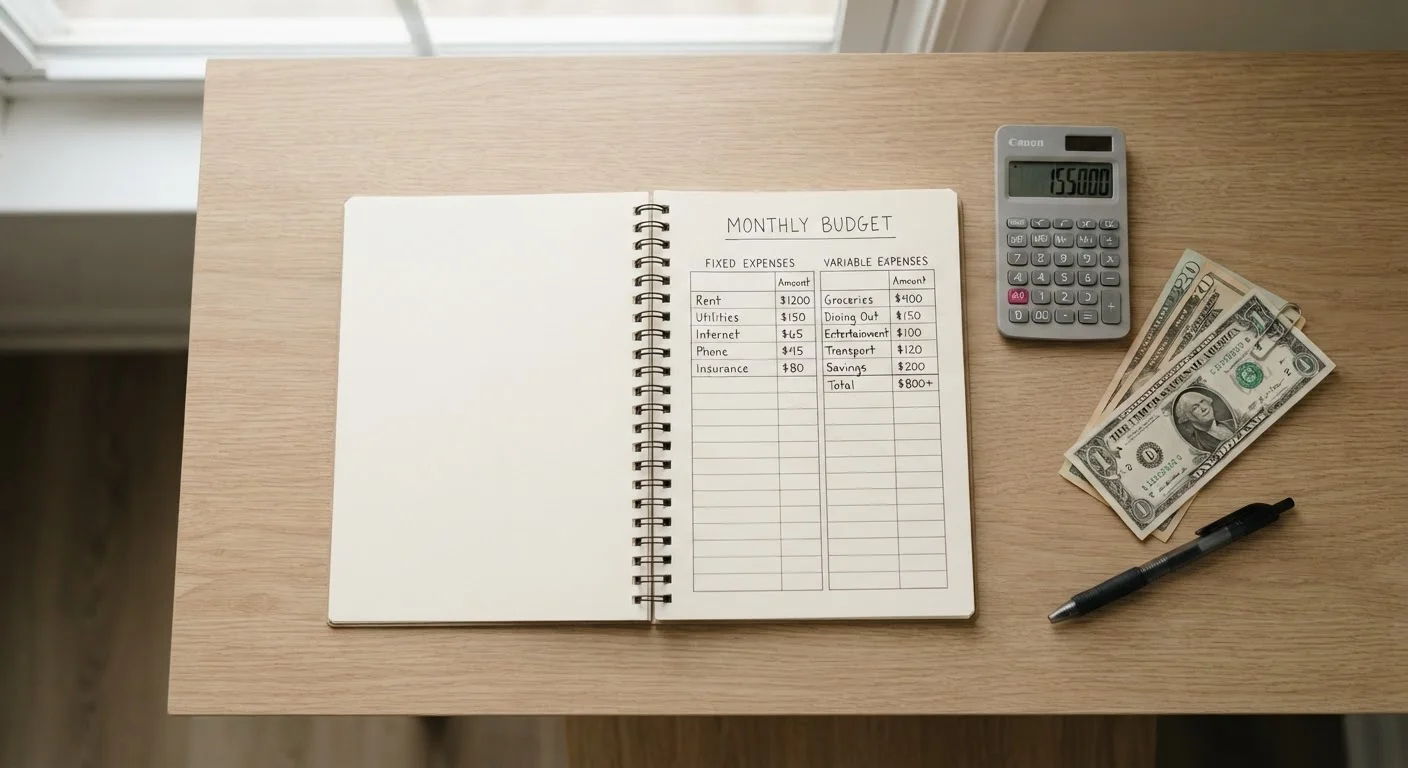
Why the Two Categories Exist
Every dollar leaving your account each month is doing one of two things: it's either locked in by a contract or commitment, or it's adjustable based on how you live day to day. That's the core logic behind separating expenses into fixed and variable buckets.
Fixed costs are predictable by definition. Your landlord expects the same check on the first of every month. Your auto lender debits the same amount every cycle. Because these numbers don't move, they form the floor of your budget — the minimum you must cover before anything else.
Variable costs sit above that floor, and they're the numbers that actually respond to your decisions. Spending $90 on groceries one week and $140 the next isn't a budgeting failure — it's the nature of variable costs. The point isn't to make them perfectly flat; it's to understand their range and set a realistic ceiling.
For a deeper look at how these two categories interact to form the structure of any budget, see the building blocks of a monthly budget.
How Each Type Affects Your Debt-Payoff Strategy
When you're carrying debt — credit cards, personal loans, student loans — your fixed expenses directly determine how much room you have to accelerate payments. High fixed costs compress your margin. If rent, car payments, and minimum debt payments already consume 70% of your take-home pay, the leverage you have is almost entirely in the variable column.
This is why budgeters who focus exclusively on cutting lattes miss the bigger picture. Trimming variable costs creates incremental gains. Reducing a fixed cost — negotiating rent at renewal, refinancing a high-interest loan, dropping a recurring subscription — creates permanent structural relief that shows up every month without ongoing effort.
Target One Fixed Cost Reduction Per Quarter
Rather than trying to overhaul your entire budget at once, identify one fixed expense every three months that you can renegotiate, downsize, or eliminate. Even a $30 monthly reduction adds up to $360 in annual savings — money that can go directly toward debt payoff or a sinking fund.
That said, fixed costs take time to renegotiate or eliminate. In the short term, variable expenses are where you find cash quickly. The practical approach is to pursue both tracks: look for one fixed-cost reduction opportunity every few months while actively managing variable spending day to day.
If your income itself is unpredictable, the pressure intensifies. See how to budget on an irregular income for methods that account for income swings alongside both cost types.
The Hidden Category: Periodic Fixed Expenses
One of the most common budget-busting traps is forgetting costs that are fixed in amount but don't show up monthly. Annual car insurance premiums, biannual dental cleanings, quarterly software renewals — these are predictable in size but easy to overlook when you're planning month to month.
The solution is a sinking fund: a savings bucket earmarked for a known future cost. Divide the annual total by 12 and transfer that fraction to the fund each month. When the bill arrives, the money is already there. No scrambling, no debt.
~67%
Americans living paycheck to paycheck
A 2023 LendingClub report found roughly two-thirds of U.S. consumers were spending most or all of their monthly income, underscoring how little margin most households have for unplanned costs.
3–6 months
Recommended emergency fund coverage
Most consumer financial guidance suggests covering three to six months of essential fixed expenses — the predictable floor of a budget — as a baseline emergency fund target.
$400
Average unexpected expense Americans struggle to cover
Federal Reserve consumer finance surveys have consistently found a significant share of U.S. adults would have difficulty covering a $400 emergency expense without borrowing, illustrating the stakes of unplanned periodic costs.
This technique also applies to irregular large costs that aren't truly periodic — appliance failures, car repairs, medical copays. For a detailed approach to absorbing those shocks, see what to do when a big unexpected expense hits.
One practical nuance worth knowing: some services give you the choice between monthly and annual billing. That billing structure affects whether a cost behaves as a smaller monthly variable or a larger periodic fixed. Understanding the true cost difference between annual and monthly billing can save money over time if you choose the right structure for your cash flow.
Putting It to Work in a Real Budget
Start by listing every recurring expense you had over the last three months. Label each one: fixed, variable, or periodic fixed. This audit alone often surfaces costs people have forgotten — a streaming service, a gym membership, a domain renewal — that are silently draining the budget.
Once categorized, your fixed and periodic-fixed costs become the non-negotiable commitments in your monthly plan. Build around them. Then set realistic ceilings for each variable category based on your actual recent spending, not aspirational numbers.
From there, two budgeting philosophies offer different starting points for how you assign what's left. The pay-yourself-first approach vs. traditional expense-first budgeting each handle the fixed/variable structure differently — one prioritizes savings before discretionary spending, the other covers costs first and saves what remains.
The Budgeting Basics hub has additional frameworks for building this kind of structured monthly plan, and Everyday Money Wins surfaces quick tactics for managing variable costs in real time.
This article is for general informational and educational purposes only and does not constitute personalized financial advice. For guidance specific to your situation, consult a qualified financial professional.
Frequently Asked Questions
Rent or mortgage payments, car loan installments, and minimum debt payments are classic fixed expenses. They are contractually set and do not change month to month unless you renegotiate the terms of the agreement.
Groceries, utility bills, gas, and entertainment spending are common variable expenses. The amount you spend in these categories shifts based on your choices and circumstances each month.
It tells you where you actually have flexibility. Fixed costs require structural changes to reduce, while variable costs can be trimmed through day-to-day decisions. This distinction guides where you focus your energy when money is tight.
Most utility bills are variable because the amount changes with your usage. However, some utility providers offer budget billing programs that average your costs over 12 months, effectively making them fixed for budgeting purposes.
Divide the annual total by 12 and set that amount aside each month in a dedicated savings bucket, sometimes called a sinking fund. This prevents large periodic bills from disrupting your monthly cash flow.
Yes. If you refinance a loan, move to a less expensive apartment, or cancel a subscription, the previously fixed amount changes permanently. After any such change, update your budget to reflect the new baseline.
The content provided on our blog site traverses numerous categories, offering readers valuable and practical information. Readers can use the editorial team’s research and data to gain more insights into their topics of interest. However, they are requested not to treat the articles as conclusive. The website team cannot be held responsible for differences in data or inaccuracies found across other platforms. Please also note that the site might also miss out on various schemes and offers available that the readers may find more beneficial than the ones we cover.