

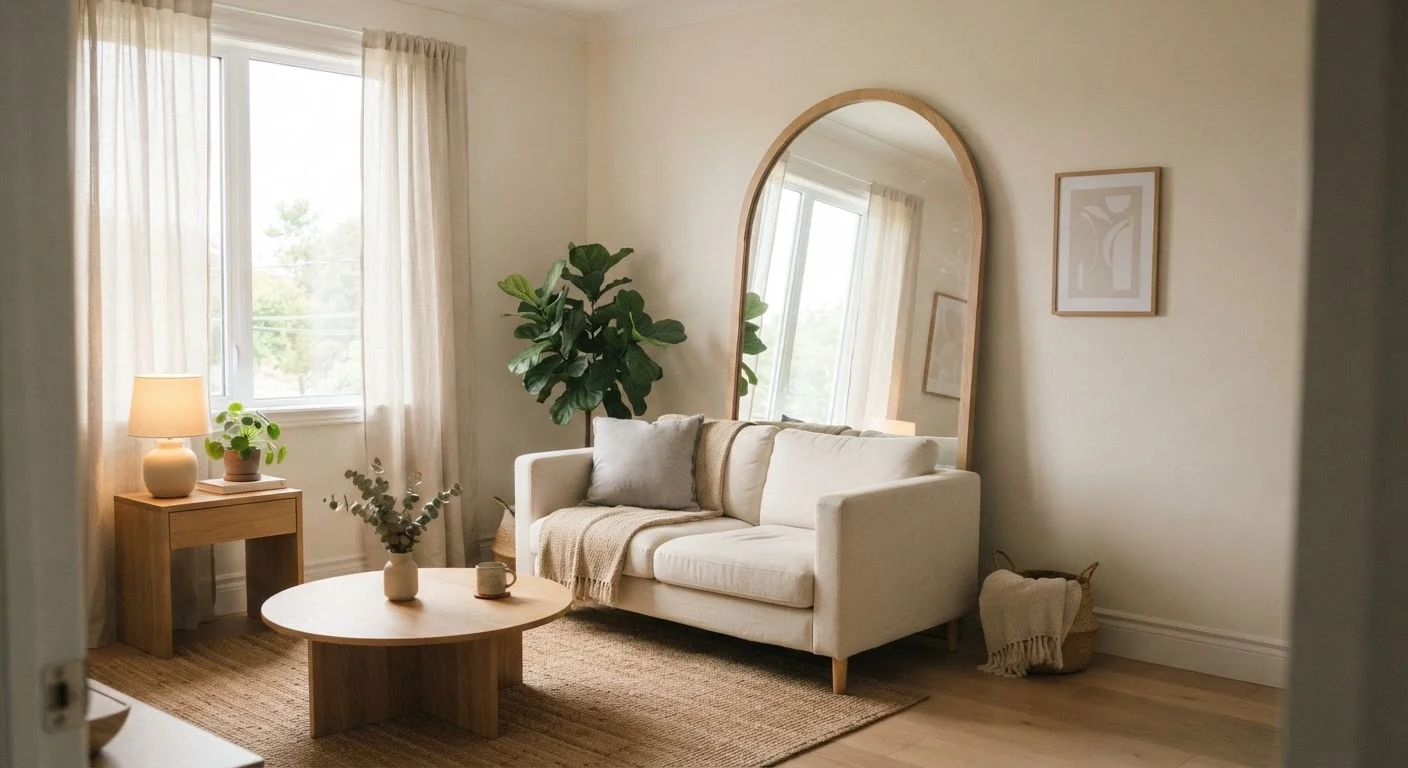
Why the 'Just Add a Mirror' Advice Falls Flat
Walk into almost any decorating conversation about small spaces and someone will say it: mirrors make rooms look bigger. It's one of those ideas that gets passed around so often it feels like settled science. Except it isn't — or at least, it's nowhere near the whole story.
Mirrors create the illusion of expanded space by reflecting what's already in front of them. That's the key word: reflection. Whatever a mirror sees, it duplicates. If what it sees is a crowded shelf, a blank dark wall, or a doorframe cutting across the room — that's exactly what it adds to your visual field. Repetition of the wrong things doesn't open a room; it compresses it.
The mechanics of mirror placement in small spaces are genuinely worth understanding, especially if you're renting or working with a modest layout and don't want to spend money on decor that makes things worse. Before you add mirrors or rethink lighting, it also helps to audit how you're using your walls — see our guide on using vertical space strategically for a complementary approach.
Myth
Any mirror in a small room will make it feel larger — the bigger the better.
Fact
A mirror only expands perceived space when it reflects something that creates depth or light. Reflecting clutter or a dark wall makes the room feel more cramped.
Size is secondary to what the mirror reflects. A large mirror hung opposite a cluttered bookshelf simply doubles the visual complexity of the room. Before hanging any mirror, stand in its intended location and look at what it will face. If what you see is a mess, a dark corner, or a blank wall, the mirror will replicate that — not expand past it. The goal is to reflect either a light source (ideally a window) or a clean, visually open surface.
Myth
Hanging a mirror on the wall opposite the main window is always the right move.
Fact
This placement works well only when the window view and room are tidy; direct opposite placement can also cause uncomfortable glare in bright conditions.
Opposite-window placement is frequently recommended because it reflects natural light effectively. But the reflected image includes everything between the mirror and the window — furniture, foot traffic zones, and the window treatment itself. In compact rooms with heavy curtains or a window blocked by furniture, the effect is diluted or counterproductive. Perpendicular placement — on the wall beside rather than across from the window — often produces a subtler but more consistent brightening effect throughout the day without glare spikes.
Myth
Grouping several small mirrors together creates the same effect as one large mirror.
Fact
Multiple small mirrors fragment the reflection into disconnected pieces, reducing depth perception rather than enhancing it.
The spatial illusion created by a mirror depends on a continuous, uninterrupted reflection that the brain reads as an extension of the room. When you arrange several small mirrors — even if their combined area equals a single large one — the gaps between frames break that continuity. The eye registers them as wall decorations, not as space. They can still be attractive and add light, but they function differently than a single large reflective surface. If budget limits you to smaller mirrors, a vertical arrangement in a narrow column comes closer to a continuous effect than a scattered grid.
Myth
Mirrors always make a room brighter because they reflect light.
Fact
Mirrors reflect existing light but do not generate it. In a room with poor natural or artificial light, a mirror redistributes dim light — it doesn't amplify it.
This is one of the most persistent mirror myths. A mirror in a north-facing room with one small window will not dramatically brighten the space — it will reflect whatever dim light already exists. The quality and quantity of your light source determines what the mirror can do. If your room is genuinely dark, addressing the lighting first — through window treatments, light placement, or bulb choices — will make any mirror you add far more effective. A mirror is a multiplier, not a source. For a fuller treatment of this topic, see our guide on natural light strategies for small homes.
Myth
Mirrors should always be hung at eye level for the best effect.
Fact
For spatial expansion, mirrors should be hung so their bottom edge is close to floor level or they lean floor-length — not centered at standing eye level.
Hanging a mirror at conventional picture height — with its center around 57–60 inches from the floor — positions its top edge well below the ceiling and its bottom edge hovering mid-wall. This creates a visual horizontal band that effectively cuts the room in half. For small-space purposes, a mirror that extends from near the baseboard to near the ceiling reads as an architectural element, not decor, and convincingly suggests additional room depth. Even a leaning floor mirror achieves this better than a centered-height hang. Reserve eye-level placement for decorative mirrors where spatial expansion is not the goal.
What Actually Works — and Why
Once you strip away the folklore, a clearer picture emerges. Mirrors do work — but under specific conditions that are easy to replicate once you know what to look for.
Reflect a light source, not another wall. The single most effective placement is perpendicular to — or directly across from — a window. When a mirror catches natural light, it scatters that light deeper into the room, and the reflected exterior view creates a genuine sense of depth. This is why mirrors near windows feel so transformative. For more on maximizing natural light in compact layouts, see what actually moves the needle with natural light.
Go floor-length when possible. A mirror that runs from near the floor to near the ceiling doesn't divide — it extends. The vertical continuity tricks the eye into reading the wall as open space rather than a solid surface. This pairs well with the principle of treating wall height as usable design real estate. A leaning floor mirror in a corner can also serve double duty, making the floor plan feel wider without any installation at all.
Frame matters more than most people expect. A heavy ornate frame eats into the reflective surface and adds visual mass. In a small room, a thin-framed or frameless mirror reads as part of the architecture rather than a piece of decor — and that architectural quality is what produces the convincing spatial effect.
Don't Skip Wall Anchoring for Large Mirrors
Floor-leaning or oversized wall mirrors can weigh significantly more than standard art pieces. Always use wall anchors rated for the mirror's weight, and if you're renting, check your lease before drilling. An improperly secured large mirror is a genuine safety hazard — particularly in households with children or pets.
Finally, mirrors work best as part of a coherent spatial strategy. If the layout itself is fighting you — awkward furniture placement, unclear zones — no mirror will fix that. Before you rearrange or add anything, run through this pre-rearrangement checklist to avoid compounding the problem.
The content provided on our blog site traverses numerous categories, offering readers valuable and practical information. Readers can use the editorial team’s research and data to gain more insights into their topics of interest. However, they are requested not to treat the articles as conclusive. The website team cannot be held responsible for differences in data or inaccuracies found across other platforms. Please also note that the site might also miss out on various schemes and offers available that the readers may find more beneficial than the ones we cover.