

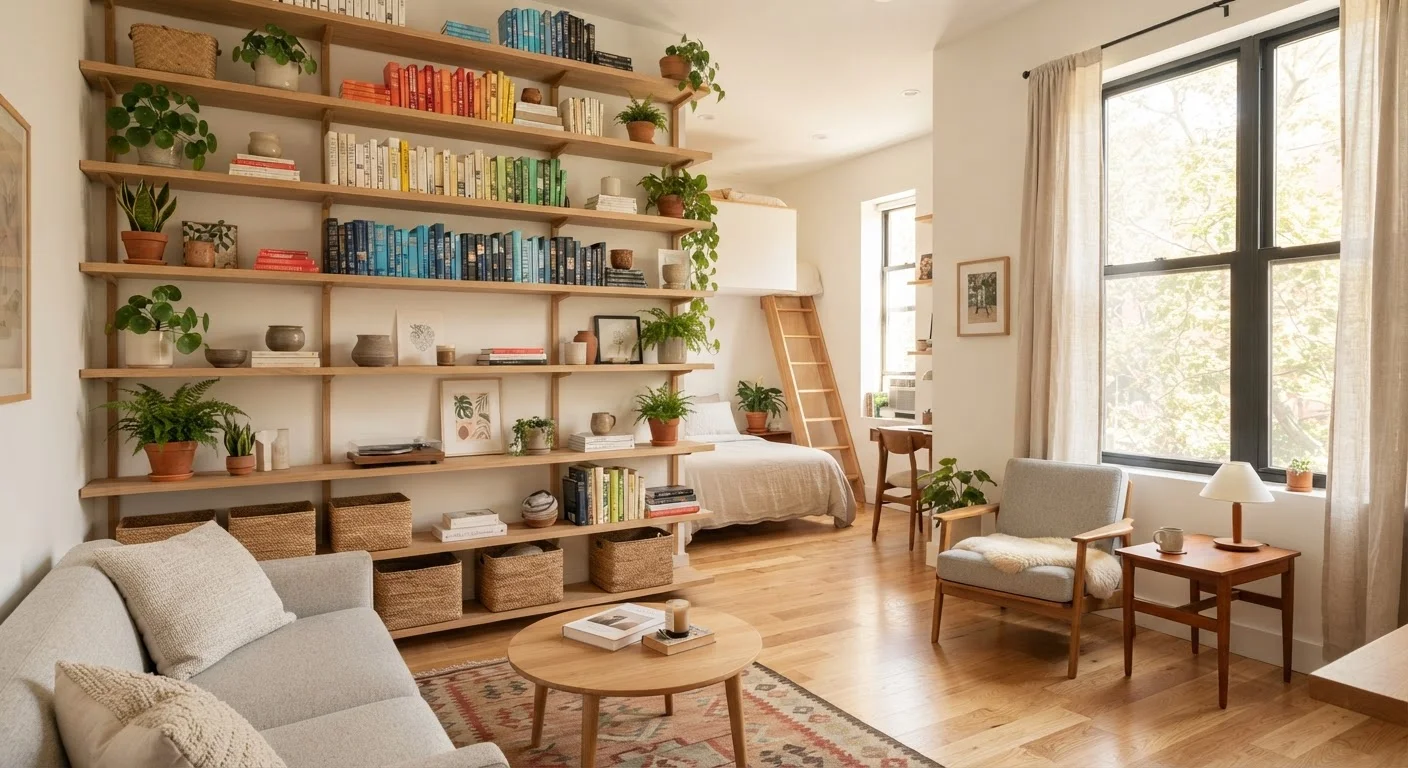
The dimension renters consistently leave on the table
Walk into almost any small apartment and you'll find the same pattern: furniture arranged across the floor, storage pushed against walls at standing height, and then — nothing. Three or four feet of bare wall stretching up to the ceiling, completely unused. Renters optimise horizontally by instinct, shuffling furniture around to gain a few extra inches of walkway, while the vertical dimension sits empty.
This isn't a minor inefficiency. In a 500-square-foot apartment, the wall surface above eye level represents hundreds of square feet of potential storage that costs nothing to access — it just requires thinking in a direction most people don't. The strategies below are practical, renter-friendly, and don't require a contractor. For a broader grounding in small-space vocabulary and design principles, the Small Space Living reference guide is a useful companion to this list.
Mount shelves in the dead zone above eye level
Most renters install shelving at roughly eye height and stop there — but the space between a standard shelf and the ceiling is often two feet or more of completely unused wall. This "dead zone" is ideal for items you need occasionally: seasonal bedding, archived documents, backup supplies, or display pieces.
Floating shelves installed near ceiling height (typically 7–8 feet up) keep rarely-used items accessible without cluttering your primary living space. Use sturdy, wall-anchored brackets rated for the load you plan to store. For renters concerned about wall damage, removable heavy-duty adhesive mounting strips have improved dramatically in recent years, though you should verify weight limits and test on your specific wall surface before loading them fully.
The two feet between your top shelf and the ceiling is prime, untouched storage territory.
Use freestanding floor-to-ceiling systems instead of furniture
Freestanding shelving units that run from floor to ceiling — sometimes called tension-pole shelves or pressure-fit units — require no drilling at all. They brace against the floor and ceiling using an adjustable tension mechanism, making them genuinely lease-friendly.
The advantage over conventional bookshelves isn't just height: these systems create a visual column of storage that reads as a deliberate design feature rather than overflow clutter. In a living room or bedroom, a full-height unit anchors the wall and draws the eye upward, which subtly makes the ceiling feel higher. This visual trick pairs naturally with the strategies covered in how wall colour shapes perceived room size.
Tension-pole shelving reaches the ceiling without a single hole in your wall.
Stack storage vertically in every cabinet and closet
Interior vertical space is just as squandered as wall space. Most closets ship with a single rod and one shelf above it — a design that wastes roughly half the available height. Adding a second hanging rod below the first (for shorter items like shirts, jackets, or folded pants on hangers) immediately doubles hanging capacity without touching a wall.
Inside cabinets, stackable bins, tiered shelf risers, and over-door organisers all exploit the gap between stored items and the shelf above. The goal is to eliminate dead air inside every enclosed storage space. This same vertical logic applies to under-bed clearance — our guide to under-bed storage covers that dimension in detail.
A second hanging rod in your closet can double garment storage at virtually no cost.
Choose furniture with vertical proportions
Low, wide furniture (squat bookshelves, long credenzas, flat ottomans) spreads your visual attention horizontally, which emphasises how little floor space you have. Tall, narrow furniture does the opposite — it pulls the eye upward and makes rooms feel more spacious in the dimension that actually has room to grow.
A narrow bookcase that reaches 6 feet holds more volume than a wide one that stops at 4, while consuming less floor footprint. Similarly, a tall wardrobe used as a room divider can simultaneously create zone separation and provide substantial storage — a combination explored further in our piece on room dividers that define zones without shrinking space.
When evaluating furniture on a budget, ask whether a piece's height-to-footprint ratio works in your favour. This is one of the criteria worth applying to multi-function furniture as well.
Tall, narrow furniture costs you less floor space while giving you more storage volume.
Hang storage on the back of every door
The back of a door is a flat, vertical surface that almost no one thinks of as storage real estate. Over-door organisers — available in fabric, wire, and solid panel formats — can hold shoes, cleaning supplies, pantry overflow, office supplies, toiletries, or craft materials depending on the room.
A standard interior door offers roughly 20 square feet of usable back surface if you hang organisers from top to bottom. That's comparable to a medium-sized bookcase, with zero floor impact and no mounting hardware required. This approach works in kitchens, bathrooms, bedrooms, and entryways equally well, making it one of the most versatile vertical-storage moves available to renters.
Each door in your home offers roughly 20 square feet of free, floor-independent storage surface.
Create visual anchors to prevent vertical storage from feeling chaotic
Loading walls with shelving from floor to ceiling is effective for storage — but without some visual organisation, it can make a space feel overwhelming rather than efficient. The fix is intentional grouping: cluster items by category or colour, leave occasional open sections of wall, and use baskets or uniform bins at higher levels to visually calm rows of mixed objects.
A simple rule: keep the top third of any vertical storage arrangement lighter and more curated (plants, books, decorative objects) and use the lower, more accessible two-thirds for functional, frequently-used items. This creates a gradient that feels deliberate. For how light interacts with these upper spaces, see our notes on maximising natural light in compact rooms.
Organised grouping transforms wall-to-wall shelving from chaotic to intentional.
Making it work without making a mess
Vertical storage done well looks considered, not desperate. The goal isn't to fill every inch of wall from baseboard to crown moulding — it's to recover usable capacity in spaces that currently contribute nothing, while keeping the overall environment calm and functional.
Measure your ceiling height before buying
Standard US ceiling heights vary between 8 and 9 feet, but older buildings and some studios can be lower. Measure your actual ceiling height before purchasing any freestanding floor-to-ceiling system — even a one-inch discrepancy can prevent the tension mechanism from seating properly. Take width measurements at multiple points on the same wall, since walls aren't always perfectly straight.
Start with one wall or one room and apply two or three of the strategies above before expanding elsewhere. That gives you a chance to see what works in your specific layout — ceiling heights, wall materials, and natural light all affect how vertical storage reads in practice. For ideas on how your space's broader layout choices affect livability, comparing studio and one-bedroom layouts offers a useful perspective on how configuration shapes daily life at home.
This article is for general informational purposes only. Always verify that any installation method is appropriate for your specific wall type and complies with your lease agreement. For structural or load-bearing concerns, consult a qualified professional.
The content provided on our blog site traverses numerous categories, offering readers valuable and practical information. Readers can use the editorial team’s research and data to gain more insights into their topics of interest. However, they are requested not to treat the articles as conclusive. The website team cannot be held responsible for differences in data or inaccuracies found across other platforms. Please also note that the site might also miss out on various schemes and offers available that the readers may find more beneficial than the ones we cover.