

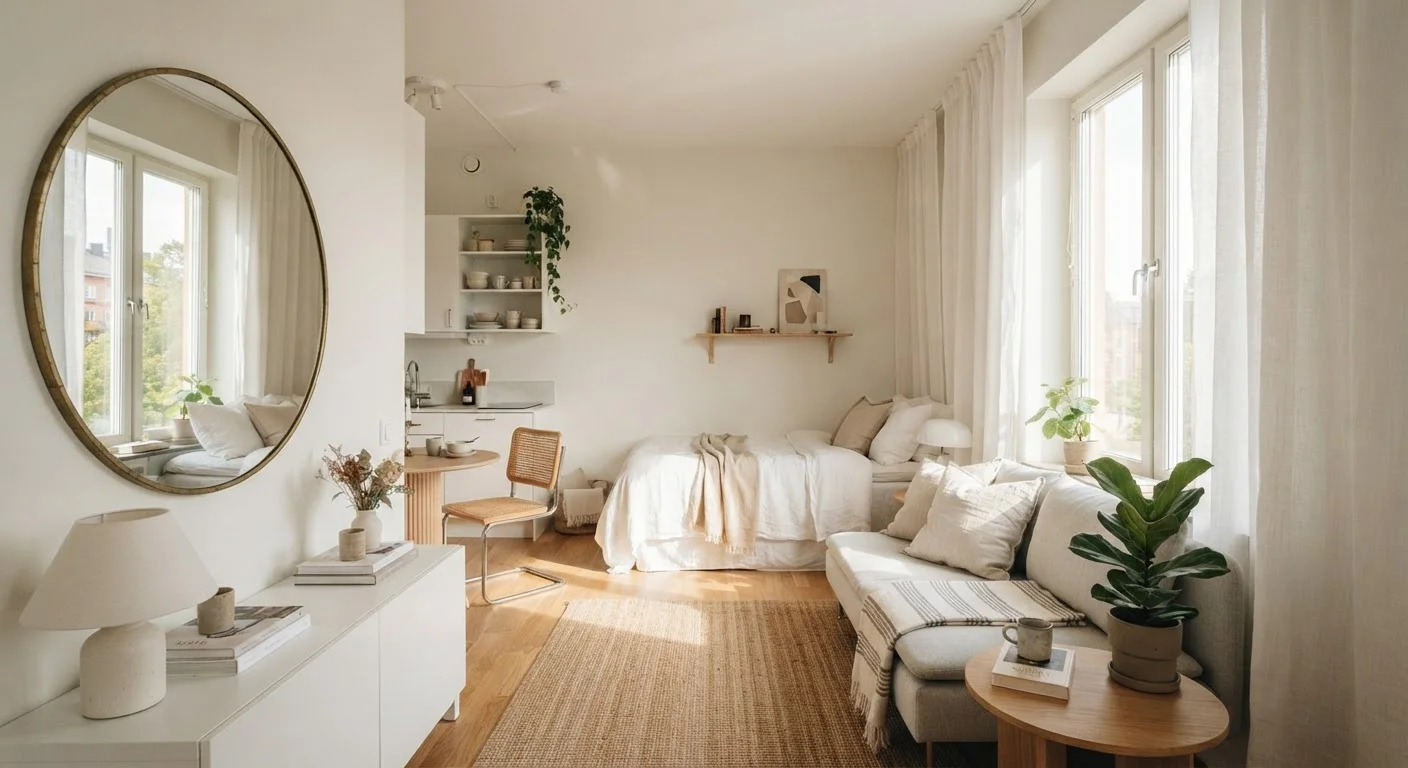
Why Natural Light Matters More in Compact Spaces
In a larger home, poor lighting in one room is an inconvenience. In a small home, it defines the entire atmosphere. Natural light doesn't just illuminate — it signals depth, height, and openness to the brain. When it's blocked or diffused badly, even a well-designed compact space feels like a storage unit.
The good news is that most light problems in small homes are self-inflicted by fixable choices: the wrong window treatments, furniture in the wrong places, or surfaces that absorb rather than reflect. You don't need bigger windows to solve them. For a broader foundation in small-space design thinking, the small-space living reference guide covers the core vocabulary and concepts worth knowing.
The Practices That Actually Make a Difference
These aren't decorating tips — they're functional interventions grounded in how light physically behaves in enclosed spaces. Each one addresses a real, common failure mode.
Swap heavy window treatments for light-filtering or sheer alternatives.
Thick drapes and room-darkening blinds are the most common light-killers in small homes. Replacing them with sheer panels or top-down/bottom-up cellular shades preserves privacy while letting diffused daylight reach deep into the room — a functional change that costs little and has immediate visual impact.
Position large mirrors perpendicular to — not directly opposite — your primary window.
A mirror placed directly across from a window simply reflects the window back at you, creating glare rather than redistributing light. Angling a large mirror 45–90 degrees to the window scatters daylight laterally across the room, raising the overall ambient brightness. Placement matters more than mirror size.
Keep furniture below window sill height wherever possible.
Tall bookshelves, armchairs with high backs, and stacked storage units placed near windows act as physical light blockers. Keeping the zone within roughly three feet of any window clear — or filled only with low-profile furniture — preserves the light path and maintains a visual connection to the outdoors that makes spaces feel larger.
Use matte white or pale cool-toned finishes on ceilings and upper walls.
Light hitting a dark or warm-toned ceiling gets absorbed rather than bounced. Painting ceilings and crown molding a true white (or repainting if they've yellowed) increases how far incoming daylight travels into a room. This is one of the highest-return improvements for renters who have permission to paint.
Clean windows thoroughly on both inside and outside surfaces.
A layer of grime, dust, or mineral deposits on glass can reduce light transmission significantly — estimates from building science literature suggest even moderate soiling can cut transmittance by 10–20%. This costs nothing but time and has an outsized effect in apartments where windows are rarely cleaned from the exterior.
Layer artificial lighting at multiple heights to compensate during low-light hours.
Natural light strategies work best when the room doesn't depend on a single overhead fixture to carry all the ambient load. Floor lamps, task lights, and under-shelf LED strips placed at varied heights mimic the gradient of natural light, reducing the flatness that makes small rooms feel enclosed after dark.
Renters: Know Your Lease First
Most strategies here require zero permanent changes — but a few, like installing new window hardware or removing existing blinds, may technically require landlord approval. Always check your lease before modifying any fixtures. Most landlords are receptive when changes are reversible and improve the property.
For guidance on how wall color interacts with all of this, see what the evidence says about light and dark walls — the relationship is more nuanced than conventional wisdom suggests. And if you're considering mirrors, the common mirror myths worth unlearning will save you from the most common placement mistakes.
Start Today: Three Immediate Changes
You don't need to redesign anything to see results. The three actions below require no tools, no purchases, and no landlord approval — and they'll give you real-time feedback on what's actually limiting light in your space.
Once you've addressed the basics, layering in smarter storage vertically can further open up sightlines and reduce visual clutter that makes rooms feel dim. The guide to using vertical space effectively is a practical next step. For more budget-friendly household ideas, Low-Cost Home Life covers a wide range of approaches worth exploring.
The content provided on our blog site traverses numerous categories, offering readers valuable and practical information. Readers can use the editorial team’s research and data to gain more insights into their topics of interest. However, they are requested not to treat the articles as conclusive. The website team cannot be held responsible for differences in data or inaccuracies found across other platforms. Please also note that the site might also miss out on various schemes and offers available that the readers may find more beneficial than the ones we cover.