

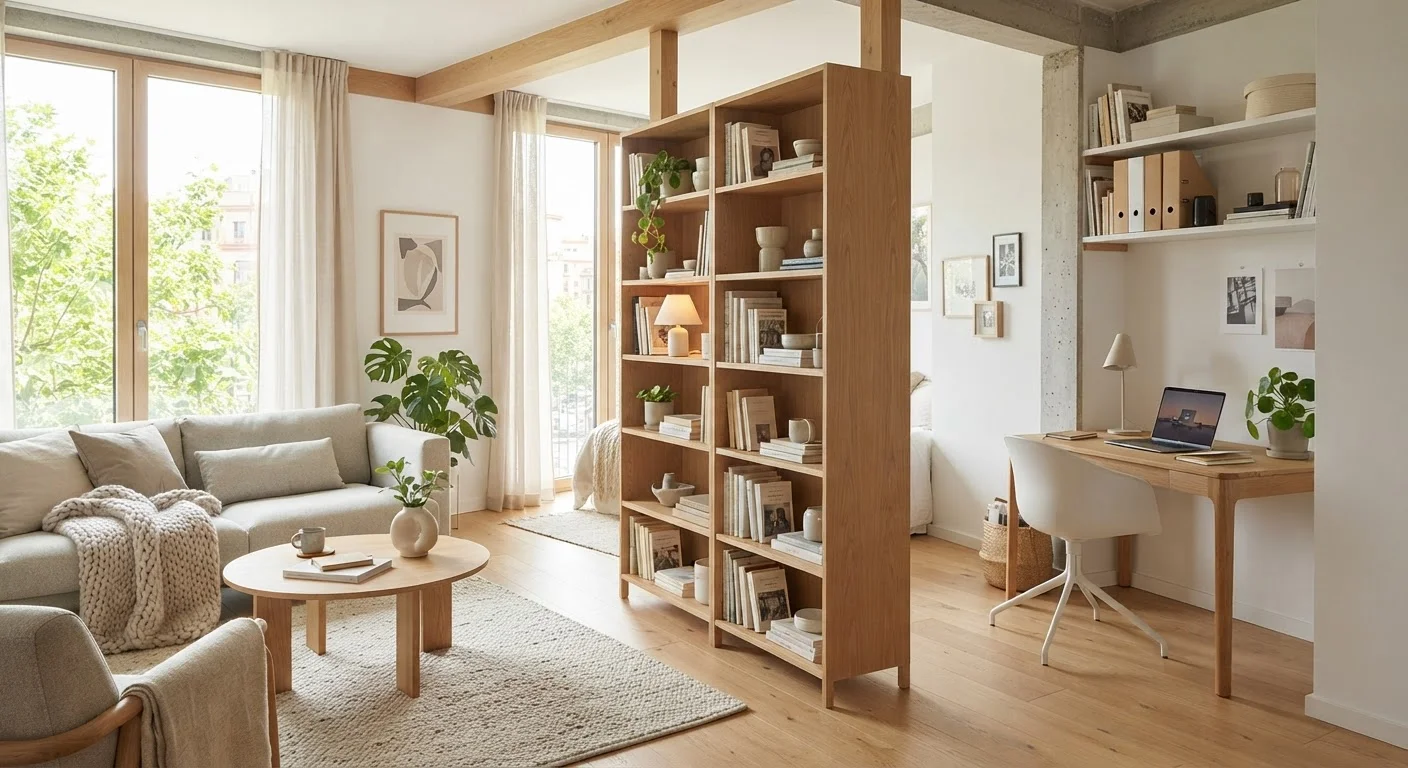
Why Room Dividers So Often Backfire
The instinct to carve up a studio or open-plan living area into separate zones is completely understandable — you want a bedroom that feels like a bedroom, a workspace that helps you focus, and a living room that doesn't also double as your kitchen overflow. The problem is that most quick fixes create the opposite of what you're after: a chopped-up, cave-like space that feels smaller and dimmer than before.
The core mistake is treating division as subtraction — adding something that blocks space rather than defining it. Before you rearrange anything, it helps to understand what a zone actually is. A zone doesn't require four walls. It requires enough visual and functional cues that both you and your brain register it as distinct. That shift in thinking opens up a much wider toolkit.
For a grounding overview of zoning concepts and terminology, see the small-space living reference guide — it's a useful foundation before committing to any layout change.
Best Practices for Dividing Zones That Still Feel Spacious
The following practices apply whether you're working with a studio apartment, a combined living-dining room, or a bedroom that needs a functioning work corner. Each one prioritizes visual openness while still delivering real functional separation.
Use open shelving as a permeable partition rather than a solid wall
Solid panels block light and sightlines, immediately shrinking both zones they separate. Open shelves let light pass through while still providing a clear visual boundary. They also pull double duty as storage, making them one of the most space-efficient dividers available.
Anchor each zone with a distinct area rug
Rugs define territory on the floor plane — the most intuitive spatial reference point we have. Two rugs in an open room signal two spaces without raising a single barrier. This works especially well in open-plan layouts where furniture alone isn't enough to communicate separation.
Position the back of a sofa as a room boundary
Furniture placement is the most overlooked zoning tool. A sofa floating in the center of a room — with its back facing the 'other' zone — acts as a soft partition that defines two areas without blocking light or reducing floor space.
Use lighting to give each zone its own atmosphere
Light temperature and direction do more psychological zoning work than most people realize. A warmer, lower lamp in a reading corner versus cooler overhead light in a workspace tells your brain it's in a different environment — no physical division required.
Choose dividers that maintain sightlines at or below eye level
Any divider that rises above seated eye level — roughly 4 feet when you're on a sofa — starts to feel like a wall. Keeping dividers lower preserves the sense of openness that makes small spaces livable, while still marking out territory.
Apply a subtle color or texture shift at zone boundaries
Paint, wallpaper, or even a different finish on one wall can tell a room's story in zones without any furniture at all. Color is processed immediately and intuitively — a tonal shift behind a bed makes it read as a bedroom even in a studio.
Quick Actions You Can Take Today
You don't need to overhaul your layout to start creating better zones. Several of the most effective moves cost nothing and take under an hour. Use these as entry points before committing to larger changes.
Once you've got your zoning strategy in place, revisit your full layout — measure and plan before moving a single piece of furniture to avoid the most common rearrangement traps. And don't neglect the vertical dimension: using wall height strategically can dramatically expand what's possible in a divided room.
The content provided on our blog site traverses numerous categories, offering readers valuable and practical information. Readers can use the editorial team’s research and data to gain more insights into their topics of interest. However, they are requested not to treat the articles as conclusive. The website team cannot be held responsible for differences in data or inaccuracies found across other platforms. Please also note that the site might also miss out on various schemes and offers available that the readers may find more beneficial than the ones we cover.