

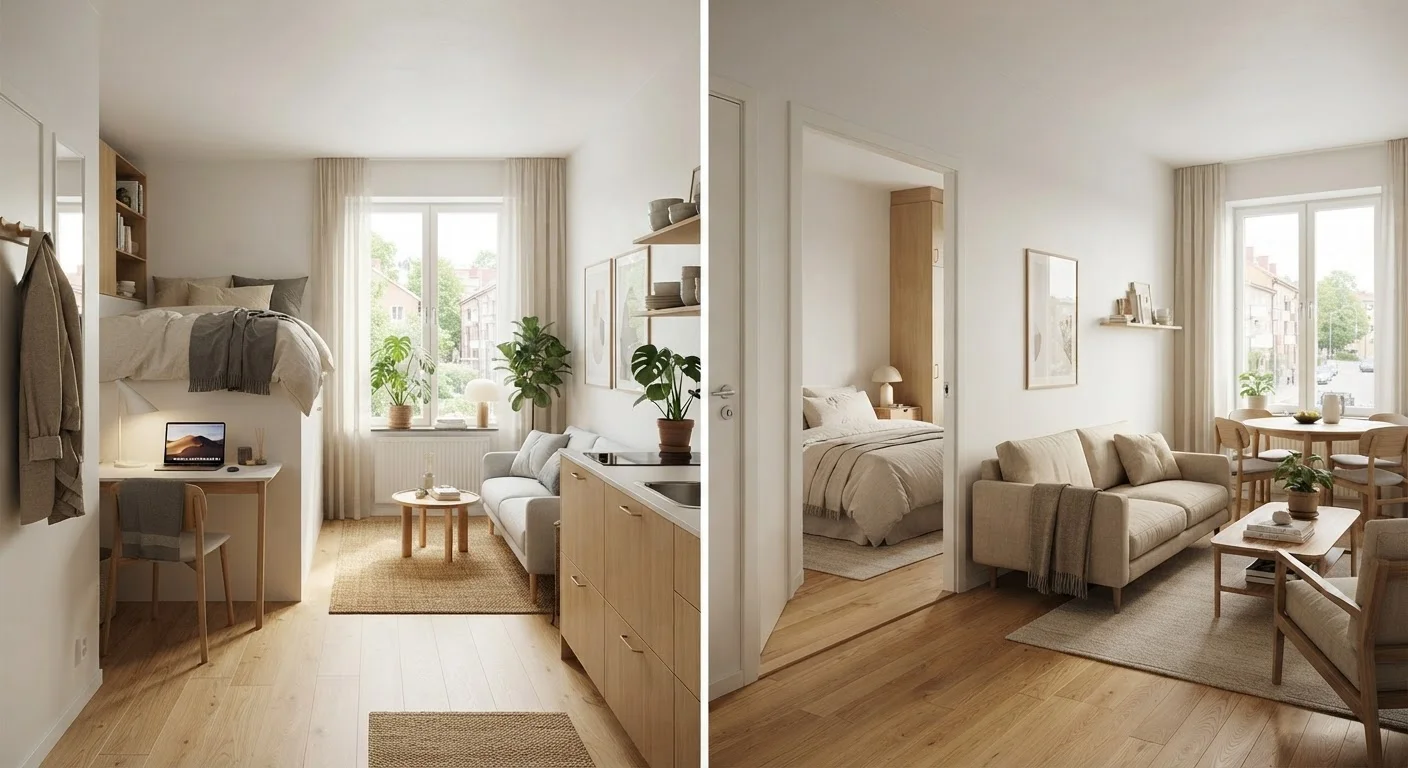
Option A
Studio Apartment
The compact, cost-efficient single-room option.
Best for: Solo renters who prioritize lower monthly costs and minimal upkeep over dedicated sleeping separation.
Option B
One-Bedroom Apartment
The structured layout with defined living and sleeping zones.
Best for: Renters who work from home, value sleep-wake separation, or want a more conventional household setup.
The Real Cost Gap Between a Studio and a One-Bedroom
Rent is the obvious starting point, but the total cost difference runs deeper than the monthly lease figure. Studios typically rent for 20–35% less than one-bedrooms in the same neighborhood, but that gap narrows or widens significantly depending on your city. In dense urban markets, that difference can mean $300–$600 or more each month — real money when you're managing a tight budget.
Beyond rent, consider utilities. A larger apartment costs more to heat, cool, and light. One-bedrooms also tend to require more furniture to feel functional — an empty bedroom isn't useful until it has at least a bed frame, mattress, and storage. Studios demand less floor coverage to feel complete, though the pieces you choose matter enormously. See our guide to multi-function furniture for practical help selecting items that genuinely earn their floor space.
Security deposits, renter's insurance premiums (loosely tied to square footage and contents value), and moving costs can also differ. None of these are dealbreakers, but they add up and deserve a place in your decision-making math.
| Criterion | Studio Apartment | One-Bedroom Apartment |
|---|---|---|
| Typical monthly rent | Lower (often 20–35% less) | Higher baseline cost |
| Utility costs | Generally lower | Higher (more space to heat/cool) |
| Sleeping separation | None — open-plan only | Dedicated, closable bedroom |
| Work-from-home suitability | Challenging without zoning | Better — bedroom separates focus zones |
| Built-in storage | Limited — must be created | More closets by default |
| Furniture investment needed | Lower — fewer rooms to furnish | Higher — bedroom requires its own setup |
| Guest hosting | Disruptive to daily routine | Easier — bedroom stays private |
| Cleaning and maintenance | Faster — single open space | More surface area to maintain |
What You Gain — and Give Up — in Each Layout
A studio's defining constraint is also its defining advantage: everything shares one room. Your kitchen, living area, and sleeping space exist in an open, unified floor plan. This makes the apartment faster to clean, easier to heat evenly, and surprisingly flexible if you're deliberate about zoning. Area rugs, bookshelves used as partial dividers, and strategic furniture placement can create a sense of distinct spaces without walls.
What a studio genuinely cannot replicate is acoustic and visual separation. If you take video calls for work, have a partner on a different sleep schedule, or simply want a room where you shut the door and decompress, a studio's openness becomes a liability. That separation is what a one-bedroom delivers — and it's not trivial. Sleep researchers consistently note that associating your bed with sleep (rather than also with work and TV) improves sleep quality over time.
One-bedrooms also offer more storage by default: a closet in the bedroom, often another in a hallway, sometimes a linen cupboard. In a studio, storage is a design problem you solve yourself. Fortunately, it's a solvable one. Using vertical wall space strategically can dramatically expand effective storage without claiming any additional floor area.
Making Either Layout Work Harder for You
Whichever you rent, the same principle applies: the layout you have is a starting point, not a ceiling. Studios reward ruthless editing — fewer, more intentional pieces outperform a room crowded with cheap furniture. A lofted bed, a fold-down wall desk, or a storage ottoman can reclaim square footage that a conventional setup wastes.
In a one-bedroom, the temptation is to fill every room fully without questioning whether the space earns its cost. If a bedroom mostly stores laundry and serves as a late-night phone-scrolling zone, it may not be providing the sleep and focus benefits that justify the rent premium.
Both layouts benefit from the same habits: limiting duplicate items, using under-bed and over-door storage, and being honest about how you actually move through your home on a typical day. Renting on a budget is ultimately about understanding your own routines clearly enough to match a layout to them — rather than adapting your life to a floor plan that was never designed for how you live.
This article provides general housing information for educational purposes and does not constitute financial, legal, or real estate advice. Rental costs, availability, and lease terms vary widely by location and market conditions. Consult a qualified professional for advice specific to your circumstances.
The content provided on our blog site traverses numerous categories, offering readers valuable and practical information. Readers can use the editorial team’s research and data to gain more insights into their topics of interest. However, they are requested not to treat the articles as conclusive. The website team cannot be held responsible for differences in data or inaccuracies found across other platforms. Please also note that the site might also miss out on various schemes and offers available that the readers may find more beneficial than the ones we cover.