

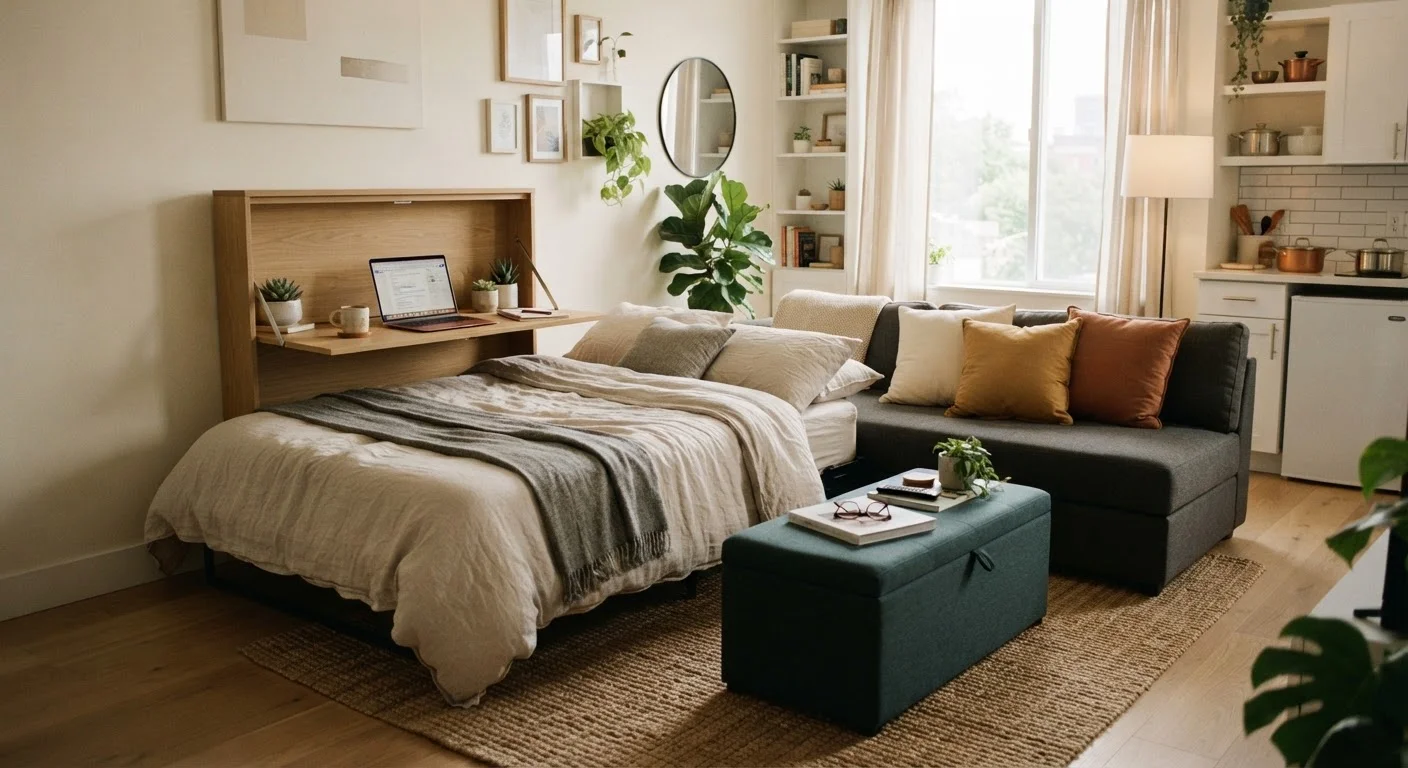
Our Verdict
Multi-function furniture earns its place when it solves a specific, recurring space problem and both functions hold up under regular use. When a piece requires awkward workarounds every time you switch modes — or when one function is so compromised it goes unused — it becomes clutter rather than a solution.
Renters and small-space dwellers who have identified a precise gap in their layout and are willing to spend a few minutes evaluating conversion ease and build quality before purchasing.
The Promise — and the Catch — of Doing Double Duty
Walk into any furniture showroom targeting urban renters and you'll find sofa beds folded neatly, ottomans with lids, and wall-mounted desks that fold flush. They look elegant in a staged space. Back in your actual apartment, results vary considerably.
The appeal is straightforward: one piece of furniture occupying the footprint of one piece while delivering the function of two. For anyone living in a studio or a cramped one-bedroom — a scenario explored honestly in our studio vs. one-bedroom comparison — that arithmetic is genuinely compelling. But the compromise is equally real, and it's worth understanding both sides before committing floor space and budget to a hybrid piece.
The core question isn't whether multi-function furniture works in theory. It's whether a specific piece will work in your specific room, used by you, every day.
The Real Advantages of Well-Chosen Hybrid Pieces
When the selection is deliberate, multi-function furniture can meaningfully change how a small home feels and operates.
Frees up measurable floor space in small rooms
A sofa bed eliminates the need for a separate guest bed that would otherwise occupy the room permanently. In a studio under 500 sq ft, that difference is significant.
Reduces total furniture count and visual clutter
Fewer distinct pieces in a room generally makes it feel larger and easier to navigate, a key principle in compact living design.
Cost can be lower than buying two separate pieces
A storage ottoman typically costs less than a coffee table plus a storage chest combined, making it a practical budget consideration when furnishing from scratch.
Flexible function adapts to shifting household needs
A fold-down desk serves a home office need without permanently designating floor space to it — useful for renters whose work-from-home frequency changes.
Storage ottomans are a good example of a piece where both functions are nearly equal in quality to their single-purpose counterparts. The surface works as a footrest, overflow seating, or a coffee table with a tray; the interior handles blankets, board games, or seasonal items. Compare that to our guide on under-bed storage strategies, and you'll see that the most effective small-space solutions consistently target dead zones — and the interior of an ottoman is otherwise dead space.
Fold-down wall desks are similarly efficient when they're positioned correctly. Mounted at the right height with adequate clearance, they create a full working surface on demand and disappear when you need the floor back. The key qualifier: "positioned correctly" does real work in that sentence.
Where Multi-Function Furniture Falls Short
The disadvantages aren't hypothetical — they show up predictably in certain categories of hybrid furniture.
Secondary function often underperforms its dedicated equivalent
Sofa-bed mattresses are constrained by the folding mechanism, and most sleep noticeably worse than a standalone bed at the same price point.
Conversion adds friction to daily routines
Any piece that requires regular reconfiguration introduces a step that many users skip — leading to a function that never actually gets used.
Mechanisms wear out faster under regular use
Hinges, slats, and folding joints are points of structural stress. Over years of daily or weekly conversion, these components degrade faster than fixed furniture equivalents.
Transition footprint is often underestimated
A fold-out sofa or expanding table may require significantly more clearance than the resting dimensions suggest, making room planning errors common.
Harder to resell or repurpose than single-function pieces
Hybrid furniture appeals to a narrower buyer pool on secondary markets, and a worn mechanism reduces resale value more sharply than cosmetic wear on a standard piece.
Sofa beds are the most commonly cited disappointment. The mattress thickness and support are structurally constrained by the folding mechanism, which means regular overnight guests often sleep poorly. Meanwhile, the sofa cushions and frame are frequently stiffer than a dedicated sofa because they need to accommodate the bed platform.
Convertible dining tables — those that expand with leaves or fold from a console — can work well for occasional entertaining, but the conversion process often requires two people, cleared surfaces nearby, and a tolerance for minor frustration. If you're expanding the table more than once a week, the time cost adds up.
Understanding the vocabulary of small-space design helps here. Our small-space living reference guide breaks down concepts like zoning and negative space that clarify why some hybrid pieces disrupt a room's flow rather than improving it.
How to Evaluate a Piece Before You Commit
One Problem, One Solution
The most reliable way to evaluate any multi-function piece is to name the specific problem it solves before you shop. "I need somewhere for guests to sleep two to three times a year" is a solvable problem. "I want more flexibility in general" is too vague to guide a good purchase. Naming the problem also tells you whether a hybrid piece is even necessary — sometimes a dedicated single-function item does the job more reliably for less money.
A reliable evaluation comes down to four practical checks:
- Test the conversion mechanism yourself. How many steps does it take? How much effort? If it's awkward in a showroom with nothing in the way, it will be worse at home with a rug and side table nearby.
- Measure the transition footprint. A sofa bed, when open, may extend three to four feet further than the closed sofa. A fold-down desk needs clear wall space and clearance above and below. Before you rearrange, use our furniture rearrangement checklist to map this accurately.
- Assess primary function first. Sit on the sofa — does it work as a sofa? Open the ottoman — is the storage depth actually useful? A hybrid piece that fails its primary job isn't saved by its secondary one.
- Factor in durability over price. Mechanisms wear out. Hinges, slats, and folding joints take stress that fixed furniture doesn't. A lower price tag may mean a shorter useful life, which changes the value calculation significantly.
Vertical storage — shelving, wall-mounted units — often provides more reliable returns than furniture hybrids for pure storage needs. Our guide to vertical space covers this approach in depth for renters who don't want to commit to a complex piece.
The content provided on our blog site traverses numerous categories, offering readers valuable and practical information. Readers can use the editorial team’s research and data to gain more insights into their topics of interest. However, they are requested not to treat the articles as conclusive. The website team cannot be held responsible for differences in data or inaccuracies found across other platforms. Please also note that the site might also miss out on various schemes and offers available that the readers may find more beneficial than the ones we cover.