

Our Verdict
For the majority of routine cleaning tasks, store-brand and generic products deliver results that are difficult to distinguish from their pricier counterparts. The gap between a $1.50 store-brand spray and a $5.00 name-brand version typically comes down to branding and scent, not cleaning chemistry. That said, it pays to read ingredient labels in specialized categories rather than assuming all generics are equivalent to all name-brands.
| Best for | Recommended |
|---|---|
| Everyday surface cleaning and general disinfecting | Generic / store-brand cleaners |
| Tough stain removal or enzyme-based cleaning needs | Compare active ingredients before choosing either |
| Those prioritizing scent experience or brand-specific formulas | Name-brand cleaners |
Why Cleaning Products Have Such a Wide Price Range
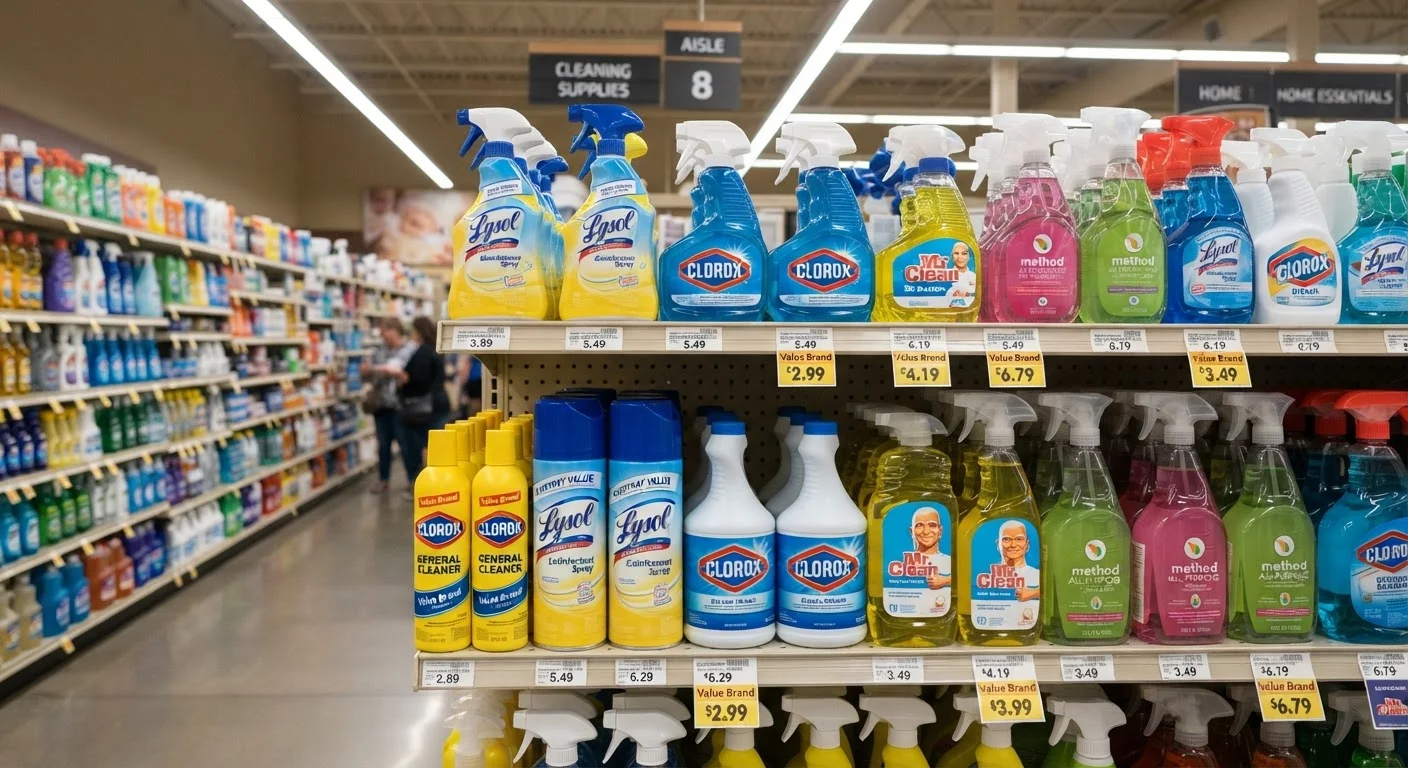
Walk down any cleaning aisle and you'll find the same basic job — cutting grease, killing germs, scrubbing soap scum — priced anywhere from under $2 to well over $7. That spread isn't mostly about chemistry. It's about marketing spend, packaging design, fragrance development, and years of brand-building.
Cleaning product formulas are built around a relatively small set of active ingredients: surfactants that lift grease, disinfecting agents like quaternary ammonium compounds or sodium hypochlorite (bleach), acids that dissolve mineral deposits, and bases that cut through organic grime. Manufacturers — both name-brand and store-brand — source these from the same industrial chemical suppliers. The formulas that end up on shelves under different labels are often functionally near-identical.
This is similar to what happens with grocery items. store-brand vs. name-brand groceries follows the same pattern: where the underlying product is a commodity, private-label versions tend to close the gap quickly.
What the Ingredient Label Actually Tells You
The most useful thing you can do before swapping a name-brand cleaner for a generic is flip the bottle over. In the US, cleaning product labels are required to disclose active disinfecting ingredients and their concentrations. For a disinfectant spray, you're looking at whether both products list the same quaternary ammonium compound (often called "quat") at a similar percentage, or the same percentage of sodium hypochlorite in a bleach-based cleaner.
Inactive ingredients — the stuff that makes a product smell like lavender or leave a streak-free shine — vary more between brands. These differences are real but mostly cosmetic. They affect your experience of using the product, not how well it actually cleans or disinfects.
| Generic / Store-Brand | Name-Brand | |
|---|---|---|
| Active ingredients | Often identical to name-brand equivalents | Industry-standard; well-documented |
| Price per ounce | Typically 40–60% lower | Premium-priced; includes brand markup |
| Fragrance and scent | Basic or minimal scent options | Wide range of scent profiles |
| Packaging and design | Functional; minimal design investment | Distinctive; often ergonomic or styled |
| Cleaning performance (routine tasks) | Comparable for most surfaces | Comparable; not meaningfully superior |
| Specialized formulas | Verify enzyme/concentration on label | Broader range of specialized products |
When you're comparing per-ounce cost alongside ingredient lists, the value case for generics becomes straightforward. The unit price — not the shelf price — is the number that tells you what you're actually paying for each ounce of product. A 32 oz. store-brand spray at $2.49 versus a 22 oz. name-brand at $4.99 looks close on the shelf but is very different per ounce.
Where Generics Hold Up — and Where to Pay Closer Attention
For most of what people buy in the cleaning aisle, generics perform on par with name-brands:
- All-purpose sprays: Surfactant-based, heavily commoditized. Generic versions typically clean just as well.
- Bleach-based disinfectants: Sodium hypochlorite concentration is the key variable. If concentrations match, performance matches.
- Glass cleaners: Ammonia or alcohol-based formulas are simple; differences are mainly fragrance and streak tendency.
- Dish soap: Surfactant concentration matters; store brands have improved substantially here.
A few categories reward more scrutiny:
- Enzyme-based cleaners (for pet stains or organic odors): Enzyme quality and concentration vary more across manufacturers. It's worth checking that the generic lists the same enzyme types.
- Specialty mold and mildew removers: Active ingredient concentration differences matter more here; read both labels carefully.
- Heavy-duty degreasers: Professional-grade formulas may have legitimately different concentrations than budget alternatives.
Compare the Active Ingredient, Not the Brand
Before defaulting to a name-brand cleaner, check what percentage of the active disinfecting ingredient is listed on each label. If both products list the same compound at the same concentration, you're paying extra only for the label. For products without a listed disinfecting agent — like general-purpose sprays — surfactant content and water quality do most of the work, and generics source from the same supply chain.
If you buy larger sizes when switching to a generic, the savings compound further — though it only makes sense if you'll actually use the product before it expires or degrades. See our look at when bulk buying genuinely saves money for the full picture.
Making the Switch Without Guesswork
You don't need to overhaul your whole cleaning routine at once. A practical approach is to start with one or two products where the active ingredients are easy to compare — an all-purpose spray or a bathroom disinfectant — and swap those first. Use up the name-brand product you have, then try the store-brand equivalent on the same surfaces. Most people find the cleaning results indistinguishable.
The savings are real. If a household spends $25–$35 per month on cleaning supplies and switches the majority of those purchases to generics, typical savings can run $10–$15 a month without any reduction in cleanliness. Over a year, that's a meaningful chunk of spending redirected elsewhere.
The same habit of comparing what's actually in the product applies beyond the cleaning aisle — generic vs. branded gadgets involves similar trade-offs between what you're paying for branding versus real functional differences.
The bottom line: the price gap between generic and name-brand cleaners rarely reflects a meaningful quality gap for routine use. Reading the active ingredient label takes about 30 seconds and gives you far more information than the front of the bottle ever will.
The content provided on our blog site traverses numerous categories, offering readers valuable and practical information. Readers can use the editorial team’s research and data to gain more insights into their topics of interest. However, they are requested not to treat the articles as conclusive. The website team cannot be held responsible for differences in data or inaccuracies found across other platforms. Please also note that the site might also miss out on various schemes and offers available that the readers may find more beneficial than the ones we cover.