

Start here
Why Basic Maintenance Knowledge Matters
Next
The Checks You Can Do Without Any Tools
Then
Understanding Your Owner's Manual
When you're ready
When to Call a Mechanic
Finish with
Building a Simple Maintenance Habit
Why Basic Maintenance Knowledge Matters
Most new car owners focus entirely on the purchase price and monthly payment. The ongoing cost of keeping the car running — oil, tires, brakes, filters — often comes as a genuine shock. As our editorial team covers in why maintenance costs catch so many car owners off guard, routine maintenance adds up faster than most people expect.
The good news: you don't need to become a mechanic to get ahead of these costs. Understanding the basics — what needs checking, how often, and why — puts you in control. It helps you recognize when something is genuinely urgent versus when a shop is recommending work you don't yet need.
Engine oil
A lubricating fluid that reduces friction between metal components inside the engine. It degrades over time and must be replaced at regular intervals.
Coolant
A liquid (also called antifreeze) that circulates through the engine to regulate temperature. It prevents both overheating and freezing.
Tire pressure
The amount of air inside a tire, measured in PSI (pounds per square inch). Under- or over-inflated tires wear unevenly and can affect fuel economy and handling.
Service interval
The mileage or time span between required maintenance tasks, as specified by the vehicle manufacturer in the owner's manual.
Dipstick
A long, thin metal rod that you pull out to measure the engine oil level. Markings on the tip indicate whether the oil is at the correct level.
Tire tread depth
The depth of the grooves on a tire's surface. Adequate tread is essential for gripping wet roads safely; worn tread significantly increases stopping distance.
The Checks You Can Do Without Any Tools
A handful of simple checks cover the majority of what keeps a car running reliably. None of these require special equipment.
- Engine oil: Pull the dipstick, wipe it clean, reinsert it, then pull again. Oil should be between the two marks and appear amber to dark brown — not milky or gritty.
- Coolant (antifreeze): Check the translucent reservoir under the hood. It should sit between the MIN and MAX lines. Never open the radiator cap when the engine is hot.
- Tire pressure: The correct pressure (in PSI) is on a sticker inside your driver's door. Use a pressure gauge monthly — especially when temperatures change, since pressure drops in cold weather.
- Tire tread: Place a penny into the tread groove with Lincoln's head facing down. If you can see the top of his head, the tread is worn and the tire likely needs replacing.
- Windshield washer fluid: The only fluid you can top up with anything other than a manufacturer-specified product — but keep it full, especially in winter.
These five checks, done monthly, address the most common causes of breakdowns and preventable repair bills.
Understanding Your Owner's Manual
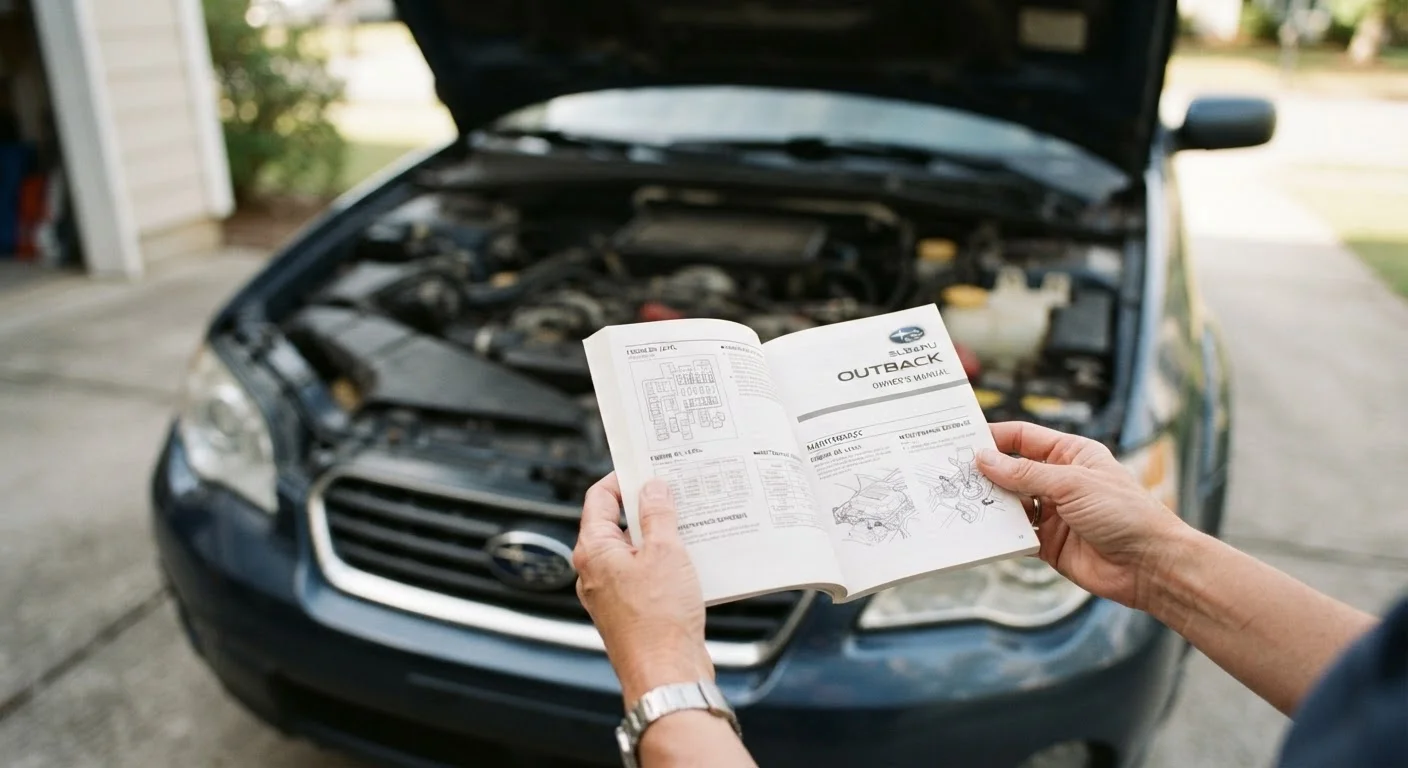
Your owner's manual is the single most authoritative source for your specific vehicle's maintenance needs. It tells you the correct oil grade, filter specifications, tire pressure, and the manufacturer's recommended service intervals — all calibrated for your exact engine.
Generic advice online may not match your car. A maintenance interval that's accurate for one engine can be wrong for another. When in doubt, the manual wins.
The maintenance schedule section is typically near the back. It outlines services by mileage or time (whichever comes first). Common milestones include oil changes, air filter replacement, spark plugs, and transmission fluid. If you bought your car used and don't have the manual, many manufacturers provide digital versions on their websites — search for your year, make, and model.
Photograph Your Mileage at Each Service
Take a quick photo of your odometer every time you have any service done and store it in a dedicated phone album. This gives you an instant, date-stamped record of when each job was last completed — useful for tracking intervals and for proving service history if you sell the car.
When to Call a Mechanic
Some tasks are straightforward enough for most beginners. Others involve safety systems — brakes, suspension, airbags — where a mistake can be dangerous. Our detailed breakdown in DIY vs. mechanic: which jobs are worth doing yourself walks through exactly where that line falls.
A few clear signals that you should see a qualified mechanic right away:
- A red warning light on your dashboard
- Grinding, squealing, or pulsing when you brake
- The car pulling strongly to one side while driving
- Smoke or steam from under the hood
- Any unusual smell, especially burning or fuel
For anything beyond the no-tool checks described above, getting a second opinion from a trusted mechanic is worth the cost. And knowing what the job involves — even if you're not doing it yourself — means you can ask informed questions and avoid being charged for work that wasn't done.
Building a Simple Maintenance Habit
The biggest obstacle for most beginners isn't knowledge — it's inertia. The simplest system is one you'll actually stick to: set a recurring calendar reminder once a month for your fluid and tire checks, and note your mileage every time you fill up. When you're approaching a service milestone from your owner's manual, schedule it before you hit it rather than after.
For a full picture of what these costs look like over time, everything first-time car owners need to know about ongoing costs is a practical next read. And if money is tight and you're wondering which maintenance tasks are truly non-negotiable, car maintenance on a budget: what actually matters explains exactly that.
Maintenance isn't glamorous, but it's one of the most controllable expenses in car ownership. A small amount of attention each month is almost always cheaper than the bill that arrives when something gets ignored.
This article is for general informational purposes only and is not a substitute for advice from a qualified mechanic or financial professional. Maintenance needs vary by vehicle, driving conditions, and individual circumstances.
Frequently Asked Questions
A quick check of engine oil, coolant, and windshield washer fluid once a month is a reasonable habit for most drivers. Brake fluid and power steering fluid are slower to change and can be checked every few months. Always consult your owner's manual for intervals specific to your vehicle.
Engine oil lubricates moving metal parts and removes heat. When it degrades or runs low, friction increases and engine wear accelerates. Skipping changes for long enough can lead to expensive engine damage — sometimes beyond the cost of replacing the car.
No. A tire pressure gauge costs a few dollars and is easy to use — you just press it onto the valve stem on each tire. Correct pressure is listed on a sticker inside your driver's door, not on the tire sidewall.
Red warning lights generally indicate stop-immediately situations (oil pressure, engine temperature, brakes). Yellow or amber lights usually mean investigate soon but not right now. Your owner's manual explains each symbol for your specific vehicle.
Yes, adding oil is one of the safest DIY tasks. Use the exact grade listed in your owner's manual, add small amounts at a time, and recheck the dipstick. Overfilling can also cause problems, so go slowly.
The most common mistake is assuming nothing is wrong because the car seems to drive fine. Many problems — low tire pressure, degraded brake pads, low coolant — don't cause obvious symptoms until they become expensive or dangerous. Regular checks catch these early.
The content provided on our blog site traverses numerous categories, offering readers valuable and practical information. Readers can use the editorial team’s research and data to gain more insights into their topics of interest. However, they are requested not to treat the articles as conclusive. The website team cannot be held responsible for differences in data or inaccuracies found across other platforms. Please also note that the site might also miss out on various schemes and offers available that the readers may find more beneficial than the ones we cover.