

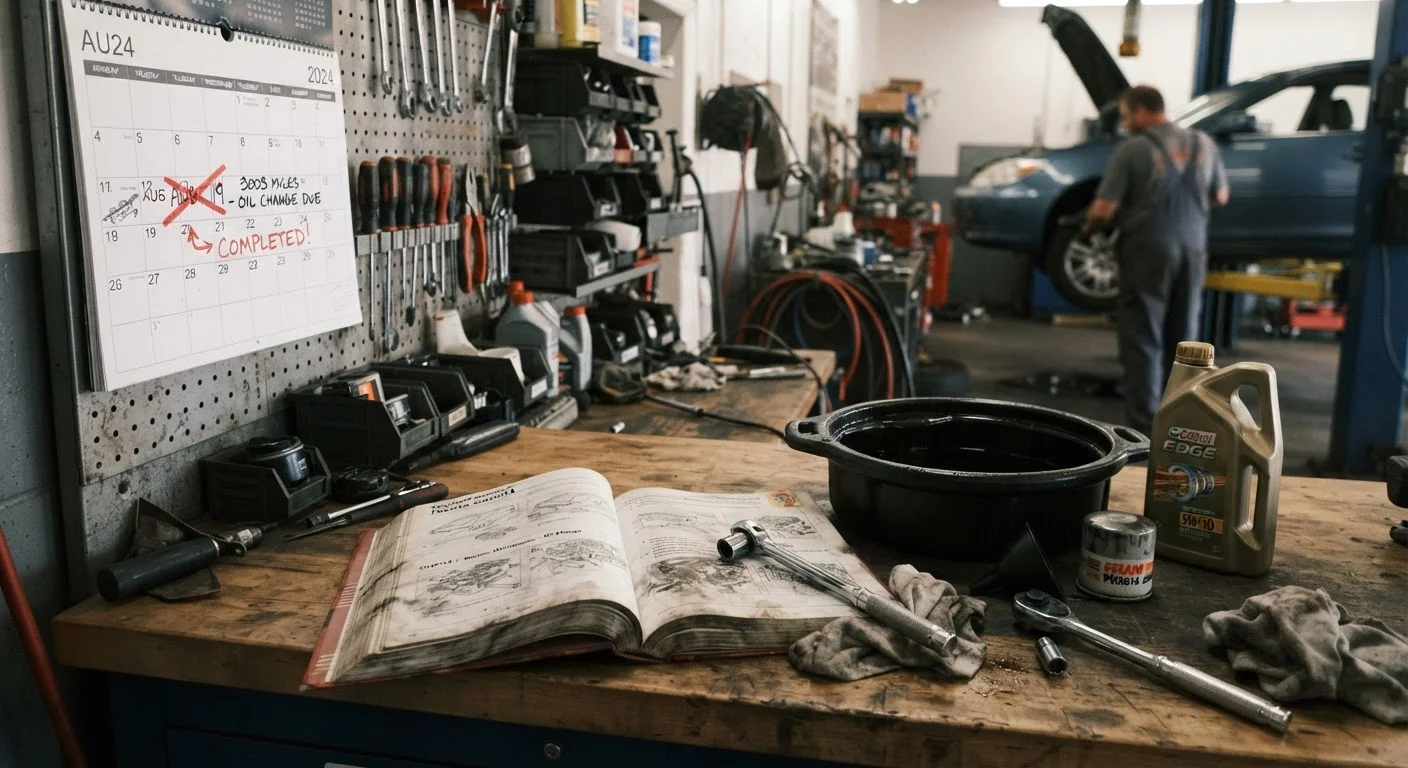
Why Maintenance Myths Cost Real Money
Most car maintenance myths started somewhere reasonable — a grain of outdated truth, an old mechanic's rule of thumb, or a clever marketing push. The problem is that they've stuck around long after the facts changed, and following them uncritically can drain your wallet in two ways: you either overspend on services you don't need, or you skip ones that actually matter.
This isn't about cutting corners on safety. It's about understanding what your car genuinely needs so you can stop paying for what it doesn't. For a broader look at where maintenance costs tend to catch drivers off guard, see why maintenance costs catch so many car owners off guard.
Myth
You need to change your oil every 3,000 miles to protect your engine.
Fact
Most modern vehicles with conventional oil can go 5,000–7,500 miles between changes; those using full synthetic oil often go 10,000–15,000 miles, per manufacturer guidance.
The 3,000-mile rule dates back to an era of older engine designs and lower-quality motor oil. Today's engines are built to tighter tolerances, and modern synthetic and synthetic-blend oils are significantly more stable over time. The AAA has noted that many drivers change their oil more frequently than necessary, wasting money on a service their engine didn't yet need.
Your owner's manual contains the interval your manufacturer actually recommends for your engine and your driving conditions. That's the number worth following — not a figure from a quick-lube marketing campaign. For more on what happens when oil changes are skipped entirely, why skipping oil changes costs more than the oil change itself explains the engine consequences in plain terms.
Myth
You must take your car to the dealership for service, or your warranty will be voided.
Fact
Under the U.S. Magnuson-Moss Warranty Act, manufacturers generally cannot void your warranty simply because you used an independent mechanic or aftermarket parts, as long as the service meets their specifications.
This is one of the most costly myths for budget-conscious drivers. Dealership service departments often charge meaningfully more than independent mechanics for identical work. The belief that you're legally required to use them — or risk losing warranty coverage — keeps many drivers overpaying for years.
The key condition is documentation. Keep records of every service, including the date, mileage, work performed, and parts used. If a warranty dispute arises, you'll need to show that maintenance was completed to the manufacturer's standards. A manufacturer can only deny a warranty claim if they demonstrate that improper maintenance caused the specific failure — not simply because you went to an independent shop.
Myth
Premium fuel gives your car better performance and fuel economy, so it's worth the extra cost.
Fact
Premium fuel only benefits engines specifically engineered to require it. Using it in a standard engine produces no measurable gain in performance or efficiency.
Premium fuel has a higher octane rating, which matters for high-compression or turbocharged engines that are designed around it. For the vast majority of engines rated for regular unleaded fuel, putting premium in the tank does nothing useful — you're simply paying more per gallon for no return.
Your fuel cap or owner's manual will say 'premium required' or 'premium recommended' if it applies. 'Required' means the engine may knock or underperform on regular fuel. 'Recommended' typically means the engine was tuned for premium but will run safely on regular, possibly with minor performance differences. For more on fuel-related myths, fuel economy misconceptions that drivers keep getting wrong covers several related misbeliefs worth reading.
Myth
If a car is running fine, you don't need to bother with routine maintenance.
Fact
Many critical maintenance items — coolant, brake fluid, transmission fluid, timing belts — show no symptoms until they fail, and failure often results in expensive repairs or safety risks.
This is perhaps the most dangerous myth on the list. A car that 'feels fine' isn't necessarily healthy under the hood. Brake fluid absorbs moisture over time and can compromise braking performance; coolant degrades and loses its ability to prevent corrosion; transmission fluid breaks down and can cause costly damage if left too long. None of these produce obvious warning signs in early stages.
The smarter framing is preventive: small, scheduled costs now versus large, unplanned costs later. Fluid checks that prevent the most expensive engine damage covers what to look for and how often — practical guidance for staying ahead of expensive surprises. You might also find lesser-known ways drivers quietly run up their maintenance bills useful for spotting the overlooked items that tend to snowball.
What This Means for Your Maintenance Budget
Correcting these myths isn't just about being right — it's about keeping money in your pocket. A driver who switches from 3,000-mile oil changes to their manufacturer's actual recommended interval (often 7,500 to 10,000 miles) could cut oil change costs roughly in half annually. A driver who stops paying for premium fuel their engine doesn't require saves a noticeable amount every fill-up. These savings compound quietly over years of ownership.
Don't Confuse Cutting Costs With Cutting Corners
Skipping genuinely necessary maintenance — like brake inspections, timing belt replacements, or coolant flushes — to save money in the short term can result in repair bills that dwarf the original cost of the service. The goal is eliminating unnecessary spending, not postponing work that protects your safety and your engine. When in doubt about whether a service is truly due, ask a qualified, independent mechanic for a second opinion.
The single most useful tool here is your owner's manual. It contains manufacturer-tested intervals based on your specific engine, not generalized industry averages. If you don't have one, most automakers publish them online. Pair that with a simple service log — keeping track of your car's service history helps you spot overdue items and avoid duplicating work you've already paid for.
It also helps to separate high-stakes maintenance from low-stakes. Not every item on a service menu carries equal risk if delayed. Car maintenance on a budget: what actually matters breaks down which tasks protect your car's reliability and which can reasonably wait when money is tight — without guesswork.
This article is for general informational purposes only and does not constitute personalised financial or mechanical advice. For decisions specific to your vehicle or financial situation, consult a qualified mechanic or financial adviser.
The content provided on our blog site traverses numerous categories, offering readers valuable and practical information. Readers can use the editorial team’s research and data to gain more insights into their topics of interest. However, they are requested not to treat the articles as conclusive. The website team cannot be held responsible for differences in data or inaccuracies found across other platforms. Please also note that the site might also miss out on various schemes and offers available that the readers may find more beneficial than the ones we cover.