

Summary
18 items · 20–40 minutes per month
Why Maintenance and Fuel Economy Are Directly Linked
Fuel is one of the two biggest recurring costs of car ownership — the other being insurance. Unlike insurance premiums, though, fuel consumption is something you can meaningfully influence through how well you maintain your vehicle. The connection is straightforward: when components like tyres, filters, and fluids aren't in good shape, the engine has to work harder to do the same job. More effort means more fuel burned.
This isn't about keeping your car showroom-clean. It's about a small number of targeted checks done consistently. Research published by the U.S. Department of Energy indicates that addressing a combination of neglected maintenance items — low tyre pressure, dirty air filters, worn spark plugs, and incorrect motor oil — can improve fuel economy by a meaningful margin. None of these fixes are expensive. What makes them costly is skipping them.
For a deeper look at how maintenance expenses accumulate, see why maintenance costs catch so many car owners off guard. And if you want to pair good maintenance habits with smarter driving technique, driving habits that stretch every litre of fuel further covers that ground well.
Tyre Checks
Engine Oil
Air and Fuel Filters
Spark Plugs and Ignition
Fluids and Cooling System
What You'll Need Before You Start
Most of these checks require only basic, inexpensive tools you can keep in your glovebox or trunk. A few — like spark plug inspection — are better handled at a service interval, but the rest you can run through yourself in a parking lot or driveway. Check your owner's manual for the manufacturer's recommended specs before you begin; those numbers override any general guidelines.
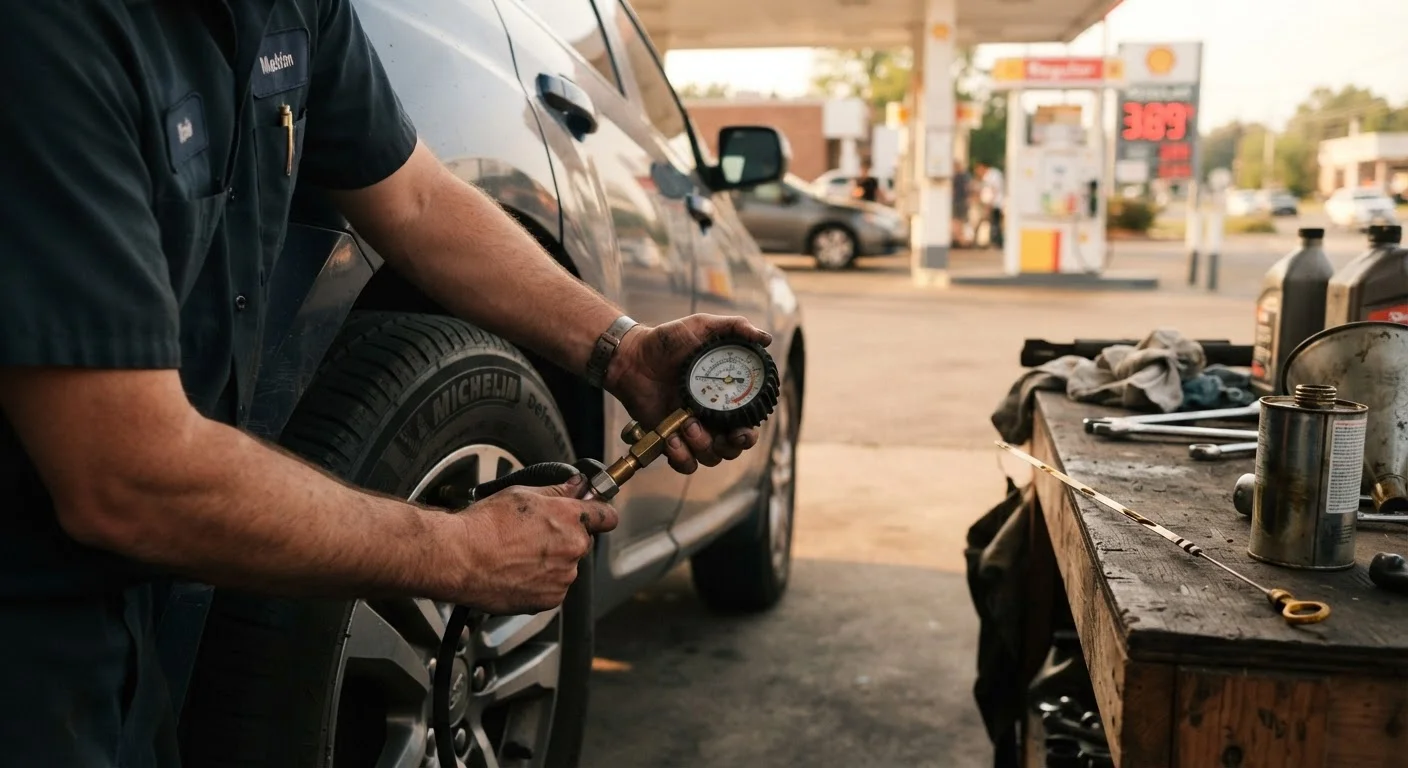
Tyre Pressure Gauge
Accurately measures PSI so you can inflate to the manufacturer's specification rather than guessing.
Owner's Manual
Contains the authoritative specifications for oil viscosity, filter intervals, tyre pressure, and spark plug type for your specific vehicle.
Dipstick and Clean Rag
Used to check engine oil level and assess oil condition between changes.
Portable Air Compressor
Allows you to top up tyre pressure at home without needing a petrol station pump.
OBD-II Code Reader
Reads check engine light codes so you can identify issues like a faulty oxygen sensor before they significantly worsen fuel economy.
Don't Rely on Your Dashboard Tyre Pressure Warning
The TPMS (Tyre Pressure Monitoring System) light typically only illuminates when a tyre is already 25% below the recommended pressure — by which point fuel economy and handling have already been affected. Use a physical gauge monthly rather than waiting for a warning light to appear. The TPMS is a safety minimum, not a maintenance standard.
After the Checklist: Keeping the Gains
Running through this list once is a good start. Doing it on a regular schedule — monthly for the quick items, every service interval for the others — is what actually moves the needle on your fuel bill. Set a recurring reminder on your phone tied to the first of each month or your oil change schedule.
For a broader look at overlooked items that quietly inflate your bills, lesser-known ways drivers quietly run up their maintenance bills is worth reading alongside this checklist. You can also find more cost-cutting strategies at the Car Maintenance Savings hub.
For a detailed guide on fluids specifically, see fluid checks that prevent the most expensive engine damage. And if tyre care deserves its own focus in your routine, tyre care habits that quietly save you money every month goes deeper on pressure, rotation, and alignment.
This article is for general informational purposes only and does not constitute personalised mechanical, financial, or legal advice. Always consult your vehicle's owner's manual and a qualified mechanic for guidance specific to your car and situation.
The content provided on our blog site traverses numerous categories, offering readers valuable and practical information. Readers can use the editorial team’s research and data to gain more insights into their topics of interest. However, they are requested not to treat the articles as conclusive. The website team cannot be held responsible for differences in data or inaccuracies found across other platforms. Please also note that the site might also miss out on various schemes and offers available that the readers may find more beneficial than the ones we cover.