

Why Store-Bought Fertiliser Isn't the Only Answer
Walk into any garden centre and you'll find shelves of fertilisers promising remarkable results. But most of what your soil actually needs — organic matter, microbial life, improved drainage, and slow-release nutrients — can be supplied by materials you already generate at home or can source for free in your neighbourhood.
This matters especially if you're gardening on a tight budget. Bagged fertilisers and soil conditioners add up fast, and for a new gardener trying to grow food or greenery without overspending, those costs can be discouraging. The good news: the natural alternatives below are not consolation prizes. Many professional growers and permaculture practitioners consider them superior to synthetic options because they feed the soil ecosystem rather than just the plant.
Whether you're tending raised beds, in-ground vegetable patches, or containers — check out our guide on container gardening in rental spaces for more ideas — these methods scale to your situation.
Compost your kitchen and yard waste
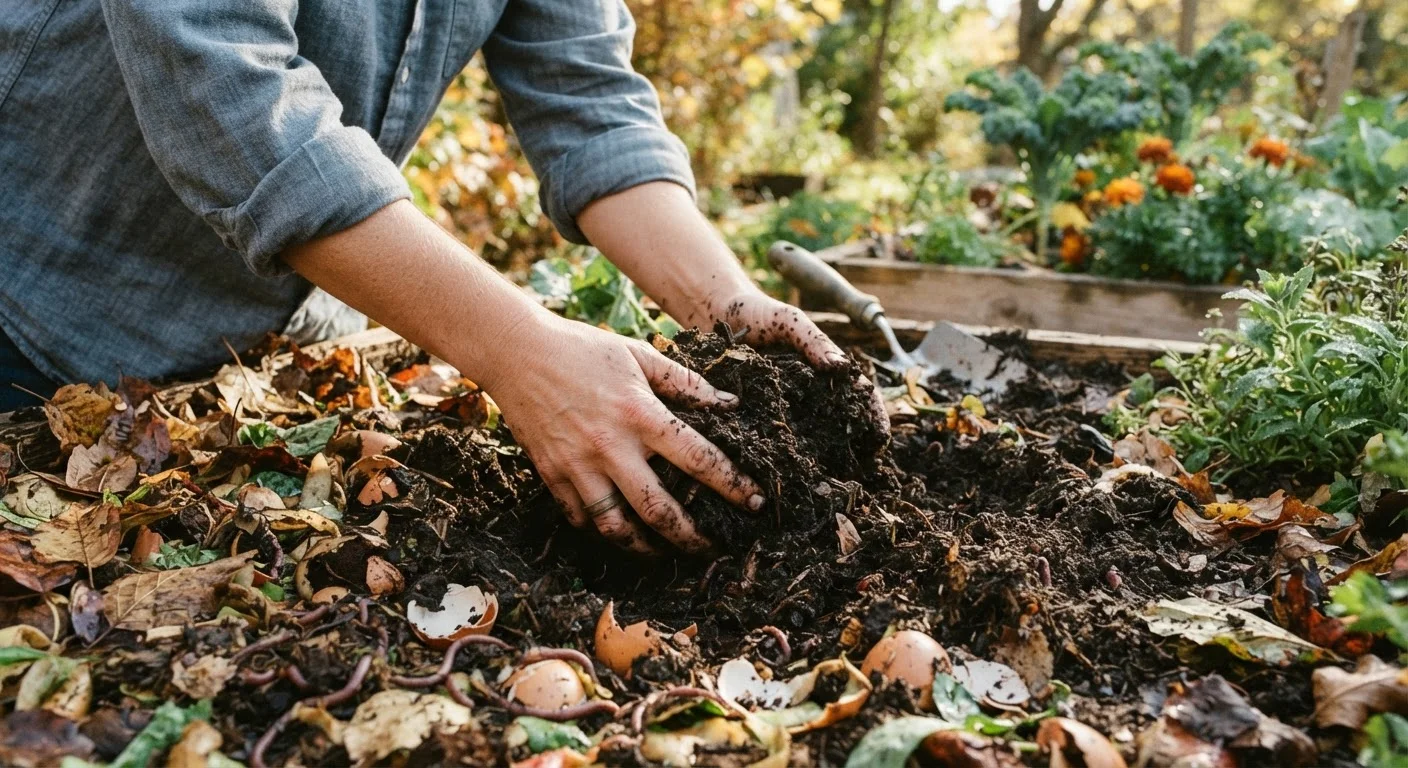
Home composting turns food scraps and garden trimmings into a nutrient-dense soil amendment — often called "black gold" by gardeners — at no cost beyond a little time. Fruit and vegetable peels, coffee grounds, eggshells, tea bags (paper ones), cardboard, and fallen leaves are all compostable. The key is balancing "greens" (nitrogen-rich, wet materials) with "browns" (carbon-rich, dry materials) in roughly a 1:2 ratio by volume.
A simple pile in a corner of your yard works fine, though a basic bin made from recycled pallets or a repurposed trash can with holes drilled in the sides speeds up the process. Turning the pile every week or two introduces oxygen and accelerates decomposition. In warm weather, finished compost can be ready in as little as two to three months.
For a thorough walkthrough of the process, our guide on composting at home covers the science and the realistic time investment.
Compost feeds the soil ecosystem, not just the plant — making it more effective than most synthetic alternatives.
Collect and store leaf mould
Leaf mould is one of the simplest soil amendments to make and one of the most overlooked. It's produced by gathering fallen autumn leaves, piling them in a wire cage or black bin bags with a few holes poked in, dampening them, and leaving them to decompose for 12 to 18 months. The result is a crumbly, dark material that dramatically improves soil structure — particularly useful in both sandy soils (which it helps retain moisture) and heavy clay soils (which it helps to aerate).
Leaf mould is lower in nutrients than compost but exceptional as a soil conditioner and mulch. It also supports beneficial fungal networks in the soil. If you don't generate enough leaves yourself, neighbours, parks, or local municipalities often have surplus bags in autumn that would otherwise go to landfill.
Leaf mould costs nothing and can transform the structure of both sandy and clay-heavy soils within two seasons.
Use coffee grounds as a nitrogen boost
Used coffee grounds contain roughly 2% nitrogen by weight, along with trace amounts of phosphorus and potassium, making them a useful slow-release soil amendment. Sprinkle them lightly on the soil surface around plants or work them shallowly into the top inch of soil — avoid applying them in thick layers, as they can compact and repel water.
Coffee grounds are slightly acidic, making them particularly well-suited to acid-loving plants such as blueberries, azaleas, and tomatoes. If you don't drink coffee at home, many coffee shops are willing to give away used grounds for free — it saves them a disposal step. Grounds can also be added directly to your compost pile to boost nitrogen content.
A light dressing of coffee grounds provides slow-release nitrogen and is often free from local coffee shops.
Apply grass clippings as a nitrogen-rich mulch
Fresh grass clippings are high in nitrogen and decompose quickly when applied as a thin mulch layer around vegetables and garden beds. Spread them no more than one inch deep to prevent matting, which can block water and airflow. As they break down, they release nutrients directly into the topsoil and contribute organic matter that feeds soil microbes.
Avoid using clippings from lawns that have been treated with herbicides or pesticides, as residues can persist and affect plant growth. Clippings from neighbours or community spaces can be a useful supplement if your own lawn is small. They can also be mixed into compost piles as a green layer to speed up decomposition.
Grass clippings applied as a thin mulch release nitrogen steadily as they decompose — with zero cost involved.
Plant cover crops as green manure
Cover crops — also called green manures — are plants grown specifically to improve the soil rather than for harvest. Common options include clover, winter rye, buckwheat, and vetch. When dug into the soil before they set seed, they add significant organic matter and nutrients. Leguminous varieties like clover and vetch fix atmospheric nitrogen through root nodules, enriching soil that has been depleted by heavy vegetable growing.
Seed packets for cover crops are inexpensive and a small pack typically covers a surprisingly large area. They're particularly valuable for beds left fallow over winter: rather than leaving soil exposed and prone to erosion or nutrient leaching, a cover crop holds it together and actively improves it for spring planting. This approach pairs well with the strategies outlined in our guide on building a low-maintenance garden.
Leguminous cover crops fix atmospheric nitrogen into the soil — naturally rebuilding fertility before your next growing season.
Save and crush eggshells for calcium
Eggshells are composed primarily of calcium carbonate, the same compound found in garden lime. Calcium is an essential plant nutrient that supports cell wall development and helps prevent disorders like blossom end rot in tomatoes and peppers. Crushed eggshells can be worked into planting holes or sprinkled around plants as a slow-release calcium source.
Dry shells thoroughly before crushing to avoid odour, then grind them in a blender or bag and roll with a rolling pin to increase surface area and speed up breakdown. While eggshells decompose slowly in cool conditions, they're a genuinely free supplement that accumulates quickly in most households. They can also be added to compost.
Crushed eggshells deliver slow-release calcium that can prevent common nutrient deficiencies in vegetable crops.
Building Soil Health as an Ongoing Practice
Soil enrichment isn't a one-time fix — it's a habit. The most productive kitchen gardens tend to belong to people who consistently return organic matter to the ground: composting kitchen scraps, mulching with whatever's available, rotating crops, and occasionally resting a bed with a cover crop. Over time, these small inputs accumulate into genuinely fertile, living soil that requires less intervention each season.
Combine methods for the best results
No single amendment does everything. Compost improves overall fertility; leaf mould improves structure; cover crops rebuild nitrogen. Using two or three of these approaches together — tailored to what's practical in your situation — produces noticeably better soil than any one method alone. Start with what you already have on hand and build from there.
If you want to go deeper on soil composition and what plants actually need from their growing medium, our article on why expensive potting mix is often overkill breaks it down clearly. And for those just getting started with zero budget, starting a food garden when you have almost nothing to spend covers the full picture from scratch.
The methods here are a starting point, not a ceiling. Experiment, observe how your plants respond, and adjust — that iterative approach is exactly how experienced gardeners develop intuition that no bag of fertiliser can replicate.
The content provided on our blog site traverses numerous categories, offering readers valuable and practical information. Readers can use the editorial team’s research and data to gain more insights into their topics of interest. However, they are requested not to treat the articles as conclusive. The website team cannot be held responsible for differences in data or inaccuracies found across other platforms. Please also note that the site might also miss out on various schemes and offers available that the readers may find more beneficial than the ones we cover.