

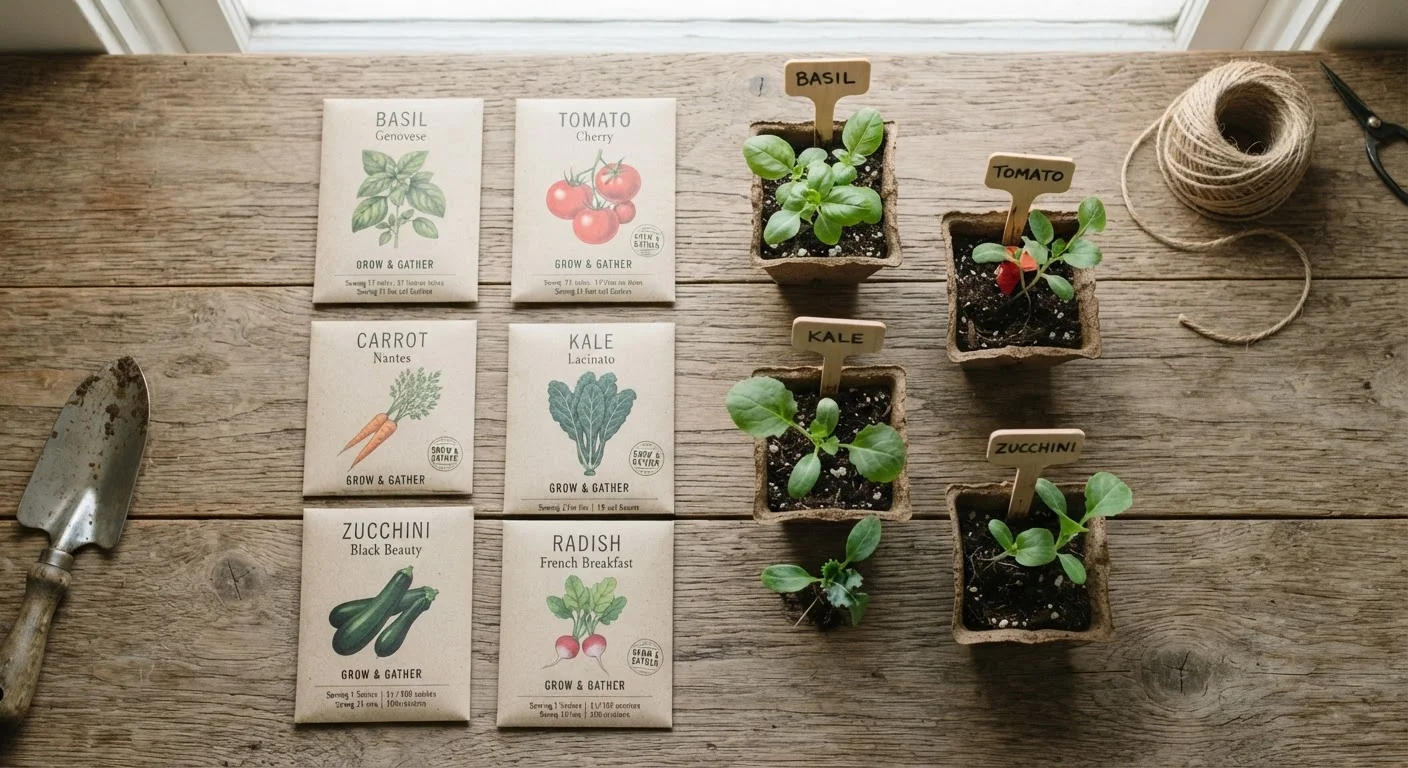
Option A
Seed Packets
The low upfront, high-patience option.
Best for: Budget growers willing to invest time and basic equipment for greater long-term savings and variety.
Option B
Seedling Transplants
The faster, simpler path to harvest.
Best for: First-time gardeners or those with short growing seasons who need a reliable head start.
Breaking Down the Real Costs
The sticker price tells only part of the story. A seed packet may cost $2–$4 and contain 50 or more seeds, putting your per-plant cost well under $0.10. A single nursery transplant, by contrast, typically runs $3–$6. On paper, seeds win easily — but that gap narrows once you factor in what it actually takes to get those seeds to a plantable size.
Indoor seed starting requires a few key inputs: a seed-starting mix (different from regular potting soil), small containers or trays, consistent moisture, and in most US climates, supplemental lighting. Without adequate light — usually 14–16 hours daily — seedlings stretch thin and weak, a condition called etiolation, which makes them poor transplant candidates. A basic grow-light setup can cost $30–$80 upfront. If you're only growing a flat or two of tomatoes, that cost doesn't amortize quickly.
Transplants absorb all of that overhead on the nursery's end. You pay more per plant, but you're also paying for weeks of professional growing conditions. For someone without the time or space to manage seedlings indoors, that premium can be entirely justified. See our guide to starting a food garden on almost nothing for strategies that keep total startup costs as low as possible regardless of which path you choose.
| Criterion | Seed Packets | Seedling Transplants |
|---|---|---|
| Average cost per plant | $0.05–$0.15 | $3–$6 |
| Upfront equipment needed | Trays, grow light, seed-starting mix | None required |
| Time to planting outdoors | 6–10 weeks indoors first | Immediate |
| Variety selection | Hundreds of varieties available | Limited to nursery stock |
| Seed saving potential | Yes (open-pollinated types) | Rarely practical |
| Risk of failure | Higher (germination not guaranteed) | Lower (established root system) |
| Best for direct-sow crops | Yes (beans, carrots, radishes) | Not recommended |
| Long-term cost over 3 seasons | Decreases with seed saving | Remains fixed per season |
Crop Type Changes Everything
Not every vegetable responds equally to both approaches. Fast-maturing crops like radishes, carrots, beets, and beans strongly prefer direct sowing — their taproots don't tolerate transplant disturbance. For these, seed packets aren't just cheaper; they're the correct method. Buying transplants of these crops, even if available, is usually money spent against the plant's best interests.
Long-season crops — tomatoes, peppers, eggplant, and celery — are a different story. In most of the continental US, these need 6–10 weeks of indoor growing before the last frost date. If you can provide that environment, seeds deliver exceptional value. If you can't, transplants bridge the gap between your climate's frost calendar and these crops' maturity requirements.
Herbs occupy a middle ground. Basil, parsley, and cilantro start easily from seed with minimal equipment, while slow-growers like rosemary and lavender are often more practical as transplants. Understanding the difference between annuals and perennials also matters here — perennial herbs bought as transplants represent a one-time cost spread across many growing seasons, shifting the value calculation considerably.
The Seed-Saving Multiplier
One advantage seeds hold that transplants structurally cannot match: the ability to save your own. Open-pollinated and heirloom seed varieties — labeled as such on most packets — produce offspring that grow true to the parent plant. That means at the end of the season, you can harvest, dry, and store seed from your best performers at no additional cost.
Over two or three seasons, a gardener who saves seed from tomatoes, squash, beans, and peppers can effectively reduce their annual seed budget to near zero for those crops. Transplants, by contrast, must be repurchased every season. Many commercially sold transplants are also grown from hybrid (F1) varieties, whose seeds don't reliably reproduce the parent — making seed saving from them impractical.
Soil quality compounds these economics. Whether you start from seed or transplant, the medium your plants grow in shapes their development. Our guide on affordable soil alternatives explains how to build productive growing mixes without paying premium prices for bagged products.
50+
Seeds in a typical vegetable packet
Most standard seed packets contain 50–200 seeds depending on crop type, making per-plant cost a fraction of transplant prices.
6–10 weeks
Indoor lead time for warm-season crops
Crops like tomatoes and peppers need this much indoor growing time before the last frost date in most US regions.
~$0
Cost of saved open-pollinated seed
Gardeners who save and dry seed from open-pollinated varieties can effectively eliminate seed costs for those crops in future seasons.
Making the Decision for Your Setup
The honest answer is that most budget-conscious gardeners benefit from combining both approaches. Use transplants for long-season crops in your first year while you build confidence and infrastructure. Use seeds for easy direct-sow crops from the start — they require no special equipment and deliver immediate savings. As your setup matures, shift more crops to seed starting.
Space is a practical constraint worth naming. Indoor seedling trays need a dedicated spot near light for weeks, which isn't always available in an apartment or small home. If you're working with a balcony or compact plot, consider how your growing area affects what's manageable. Our space-efficient planting guide covers how to maximize yield from limited footprints — a strategy that matters whether you start from seed or transplant.
Finally, consider your time budget alongside your financial one. Seeds demand more attention across a longer window. If a missed watering kills a tray of seedlings in March, you've lost both money and the growing window. For gardeners with unpredictable schedules, a few well-chosen transplants may preserve more value than a full seed-starting operation that falls through. Neither choice is wrong — the right one is whichever you'll actually follow through on.
The content provided on our blog site traverses numerous categories, offering readers valuable and practical information. Readers can use the editorial team’s research and data to gain more insights into their topics of interest. However, they are requested not to treat the articles as conclusive. The website team cannot be held responsible for differences in data or inaccuracies found across other platforms. Please also note that the site might also miss out on various schemes and offers available that the readers may find more beneficial than the ones we cover.