

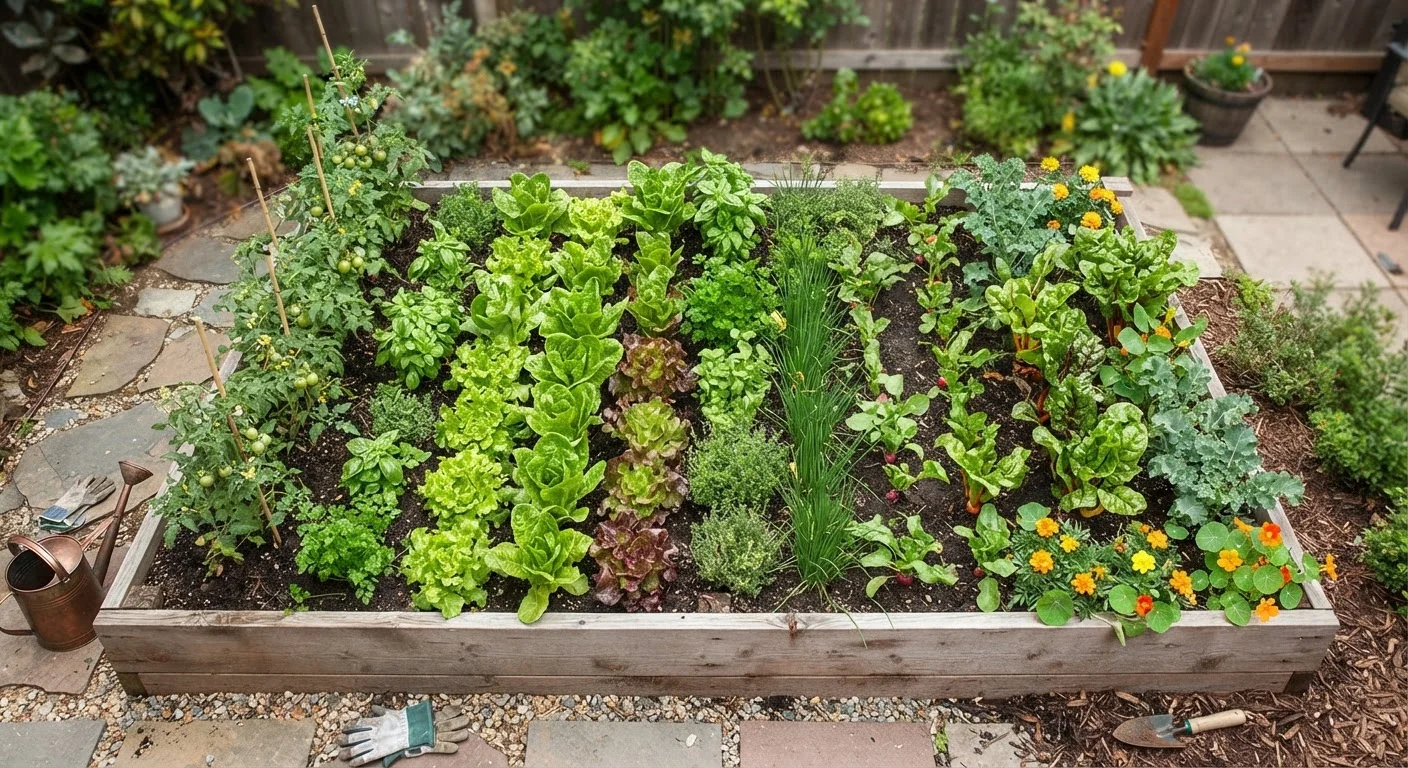
Why Space Efficiency Is the Real Game Changer
Most gardening advice assumes you have room to spare. When you're working with a balcony, a patio corner, or a single 4×4 raised bed, that advice falls flat. The good news: limited space doesn't mean limited harvest. Productive small gardens aren't about working harder — they're about planning smarter.
The core principle is simple: every square foot should be earning its keep. That means overlapping planting windows, growing upward instead of outward, and choosing crops that give back more than they take. If you're just getting started on a shoestring, our guide to starting a food garden with almost nothing to spend covers the fundamentals of sourcing materials cheaply before you lay out your first bed.
Core Practices for Maximum Yield per Square Foot
These strategies work whether you're growing in the ground, in raised beds, or in containers. Apply them together for compounding results.
Use square foot gardening grids to determine spacing, not row-based formulas
Traditional row spacing was designed for machinery, not hand gardening. Square foot gardening — dividing beds into one-foot sections and planting the maximum number of plants each section supports — eliminates wasted aisle space and consistently increases yield per bed. It also simplifies planning for beginners.
Prioritize cut-and-come-again crops for continuous harvest from a single plant
Plants like leaf lettuce, kale, Swiss chard, arugula, and herbs such as basil and parsley regenerate after cutting. One plant occupies a single square foot for an entire season rather than being pulled after one harvest, dramatically improving the return on that space.
Interplant fast-maturing crops between slow-growing ones
Slow crops like tomatoes and peppers take weeks to fill their allotted space. Planting quick crops — radishes, lettuce, green onions — between them exploits otherwise empty soil during that gap. By the time the main crop expands, the quick crop is already harvested.
Train vining plants upward using trellises or stakes rather than letting them sprawl
A sprawling cucumber plant can consume 6–8 square feet of bed space. The same plant grown vertically on a trellis occupies 1–2 square feet at soil level, freeing the rest for low-growing crops and improving air circulation, which reduces disease pressure.
Choose compact or dwarf cultivars specifically bred for small-space performance
Standard varieties of many vegetables are sized for field production. Dwarf or patio varieties of tomatoes, peppers, cucumbers, and squash produce comparable yields at a fraction of the plant footprint, making them significantly more efficient in small beds and containers.
Going Vertical: The Overlooked Dimension
Most gardeners think in two dimensions. Adding a vertical dimension — using walls, fences, trellises, or stacked containers — can effectively double or triple your growing area without occupying extra floor space. Cucumbers, pole beans, peas, and small squash varieties all climb readily when given support. Even tomatoes trained to a single stake rather than allowed to sprawl free up significant ground-level space for lower-growing herbs and greens.
If you're renting, temporary trellis systems can be freestanding rather than wall-mounted. See how to set up a productive container-based system without touching your walls or lease in our guide to container gardening in rental spaces.
Use Wall Space, Not Just Floor Space
If you have a sunny fence or exterior wall, a row of pocket planters or a simple DIY pallet planter can add 10–20 square feet of growing surface without touching your floor area at all. Herbs and strawberries are especially well-suited to vertical wall systems. Just confirm any wall-mounted system is approved under your lease if you're renting.
Succession Planting and Companion Combinations
A square foot left bare after a spring lettuce harvest is wasted potential. Succession planting — seeding or transplanting a new crop immediately after removing the previous one — keeps soil working from the last frost to the first. A bed that grows lettuce in spring can follow with bush beans in summer and a fast radish crop in early fall.
Companion planting adds another layer. When crops are strategically paired — tall plants shading heat-sensitive greens, nitrogen-fixers feeding heavy feeders — you get more out of each combination than either plant would produce alone. Our explainer on companion planting separates the evidence-backed pairings from the folklore so you can make informed choices.
For timing your succession cycles correctly, use a seasonal planting calendar to track planting windows across the full growing year.
Up to 4x
More yield vs. traditional row gardening
Square foot gardening proponents, including horticulture educators, commonly cite yield-per-area gains of 2–4x compared to conventional row layouts in small home garden trials.
30–50%
Of garden space wasted in row layouts
Cooperative Extension specialists have noted that aisle and pathway space in traditional row gardens can consume roughly 30–50% of total garden area that produces no food.
Quick Wins You Can Implement This Weekend
You don't need to redesign your whole garden to start seeing results. These immediate actions will put more of your existing space to work right away.
The Soil Factor: Why Foundation Beats Layout
No spacing technique compensates for poor soil. Dense planting increases competition for nutrients and moisture, which means the soil needs to be rich enough to support multiple plants in close proximity. Compost — whether homemade from kitchen scraps or sourced free from a municipal program — is the most cost-effective amendment available. Incorporating a 2–3 inch layer before planting, and top-dressing mid-season, keeps dense plantings productive without expensive fertilizers.
If you're weighing whether to build up or dig in, our raised beds vs. in-ground plots comparison breaks down the real cost difference. And for a genuinely zero-cost soil booster, our piece on turning kitchen scraps into garden inputs shows what you can regenerate from what you'd otherwise throw away.
The content provided on our blog site traverses numerous categories, offering readers valuable and practical information. Readers can use the editorial team’s research and data to gain more insights into their topics of interest. However, they are requested not to treat the articles as conclusive. The website team cannot be held responsible for differences in data or inaccuracies found across other platforms. Please also note that the site might also miss out on various schemes and offers available that the readers may find more beneficial than the ones we cover.