

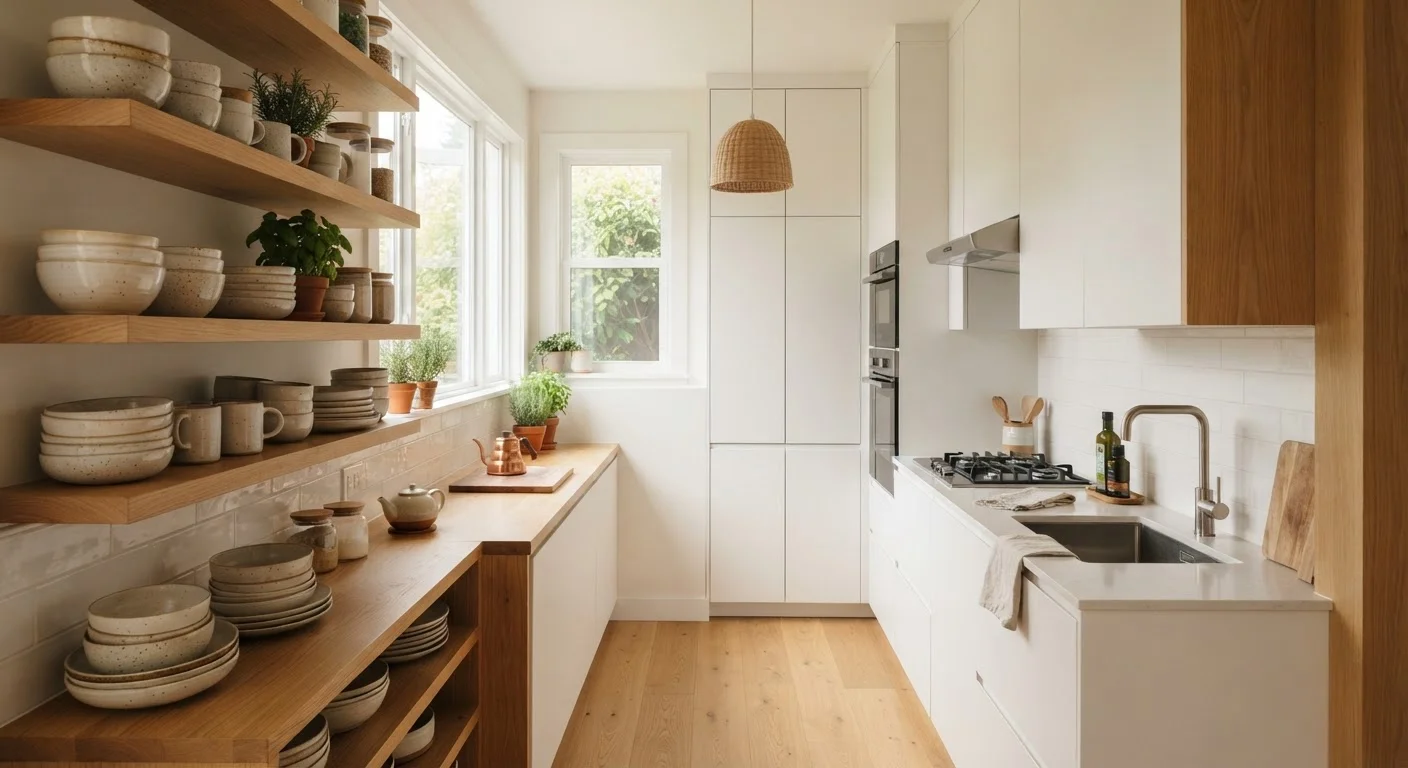
Option A
Open Shelving
The airy, design-forward option that demands organisation.
Best for: Renters or homeowners who keep a curated, tidy kitchen and want to make the space feel larger without major renovation.
Option B
Closed Cabinets
The practical, clutter-hiding workhorse of traditional kitchens.
Best for: Households that accumulate a mix of mismatched items and prefer the peace of mind that comes with concealed storage.
What Each Option Actually Does to a Small Kitchen
Storage choice in a small kitchen is fundamentally a visual and spatial decision, not just an organisational one. Open shelving removes the solid plane of cabinet doors, letting your eye travel further into the wall and creating an illusion of depth. Closed cabinets, by contrast, present a uniform surface — tidy in one sense, but potentially heavy in a narrow galley or studio kitchen.
That said, neither option operates in isolation. Open shelves do the heavy lifting aesthetically only when the items on them are considered. A shelf full of mismatched cereal boxes and random appliances achieves the opposite of the airy look you're after. Closed cabinets, meanwhile, don't automatically make a kitchen feel smaller — light-coloured doors, glass-panelled inserts, or handleless designs can preserve an open feel while still concealing contents.
For context on why visual weight matters so much in small rooms, see our piece on why small rooms feel stuffy — many of the same principles around visual congestion apply directly to kitchen planning.
Head-to-Head: Key Differences at a Glance
Before diving into the nuances, it helps to compare both options across the dimensions that matter most for small-space, budget-focused households.
| Criterion | Open Shelving | Closed Cabinets |
|---|---|---|
| Visual impact | Opens up space, feels lighter | Can feel heavier; depends on door style |
| Clutter tolerance | Low — everything is visible | High — contents stay hidden |
| Upfront cost (DIY) | Generally lower | Moderate to high depending on units |
| Maintenance | Frequent dusting and wiping | Less frequent; doors protect contents |
| Renter-friendliness | High with removable hardware | Lower; harder to reverse |
| Storage density | Lower — display limits packing | Higher — full depth usable |
| Customisation ease | High — swap items freely | Fixed once installed |
These differences aren't dealbreakers in isolation — they're trade-offs. Your living situation, household size, and how you actually use your kitchen should determine which column wins for you.
The Real Cost of Each Option
Budget matters. Open shelving is typically the more accessible starting point: a simple floating shelf bracket system can cost a fraction of a full cabinet run, and installation is often within DIY reach for renters comfortable with a drill. The materials — raw wood, plywood, or laminate boards — are widely available and can be finished to match existing trim without specialist skills.
Closed cabinetry represents a wider cost range. Flat-pack (ready-to-assemble) options bring the price down considerably compared to custom or semi-custom units, but even flat-pack installation requires more time, more hardware, and often more wall preparation. If you're renting, adding permanent cabinetry may require landlord approval and complicates move-out restoration.
One underappreciated cost with open shelving is ongoing curation effort. Grease and dust settle visibly on open shelves near cooking zones, meaning items need regular wiping down. Factor that maintenance into your real-world decision — it's a time cost, not just a money cost.
~60%
Of US renters make no structural changes
According to the Harvard Joint Center for Housing Studies, the majority of renters avoid permanent modifications, making reversible storage solutions especially relevant.
3–5×
Cost difference: open shelf vs. full cabinet run
Industry estimates suggest a basic floating shelf installation can cost a fraction of an equivalent linear foot of installed cabinetry, though material choices significantly affect both figures.
For renters specifically, open shelving often wins on flexibility. A well-placed shelf run taps into vertical wall space without permanent modification — a concept explored in more depth in our guide to vertical space strategies renters often overlook.
Making a Hybrid Layout Work in a Tiny Kitchen
Most design professionals working in compact spaces land on the same advice: don't choose just one. A hybrid approach — open shelving above the counter line, closed storage below — captures the visual lightness of open display where your eyes naturally travel, while keeping lower storage practical and concealed.
In practice, this means your upper zone holds the items you're comfortable putting on display: uniform jars, everyday ceramics, a few cookbooks. The lower zone — drawers, doors, or a mix — handles the rest: cleaning supplies, pots, plastic containers, pantry staples in original packaging. This partition also aligns with ergonomics; upper-zone items should be things you reach for regularly but don't need to grab in a hurry.
For anyone building out a broader small-space system, this kitchen decision connects naturally to whole-home organisation. Our complete guide to making a small home work long-term covers how storage decisions in each room compound into a coherent, liveable layout over time.
This article provides general home improvement information for educational purposes. Costs, installation requirements, and landlord permissions vary widely by location and property. Always verify lease terms before making modifications to a rental property.
The content provided on our blog site traverses numerous categories, offering readers valuable and practical information. Readers can use the editorial team’s research and data to gain more insights into their topics of interest. However, they are requested not to treat the articles as conclusive. The website team cannot be held responsible for differences in data or inaccuracies found across other platforms. Please also note that the site might also miss out on various schemes and offers available that the readers may find more beneficial than the ones we cover.