

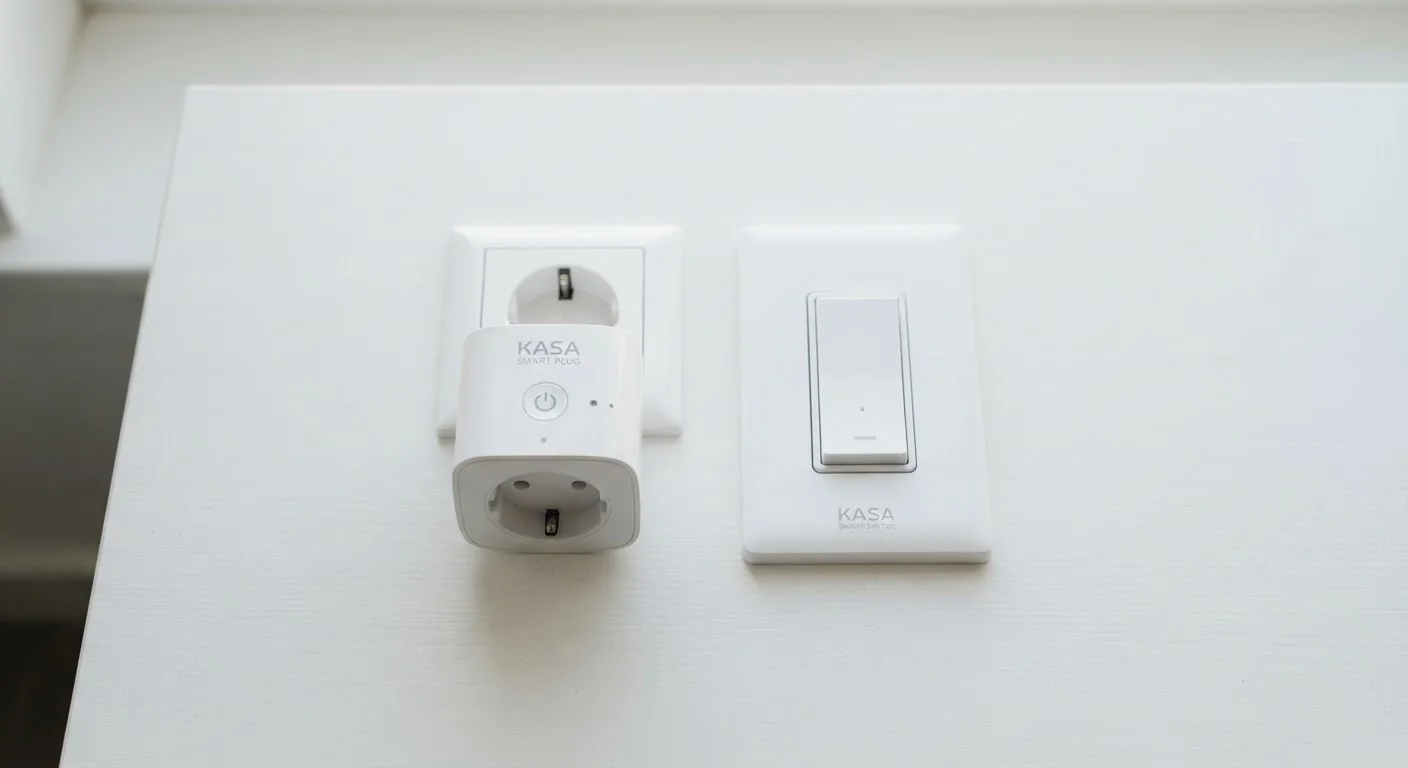
Option A
Smart Plug
The plug-in, no-commitment starting point.
Best for: Renters or first-timers who want instant smart home control without touching any wiring.
Option B
Smart Switch
The permanent, whole-room upgrade.
Best for: Homeowners ready to replace wall switches and control ceiling lights or hardwired fixtures natively.
What Each Device Actually Does
A smart plug sits between your wall outlet and whatever device you plug into it — a lamp, a fan, a coffee maker. It adds a layer of remote control, scheduling, and sometimes energy monitoring to that one device. You can turn it on or off from your phone, set a timer, or trigger it through a voice assistant. No wiring involved.
A smart switch physically replaces the wall switch already in your home. Instead of flipping a traditional toggle, the switch connects to your Wi-Fi (or a hub) and lets you control whatever is hardwired to that circuit — usually ceiling lights, bathroom fans, or other fixtures. Installation means turning off the circuit breaker, removing the old switch, and wiring in the new one. It's a job many homeowners do themselves, but it does involve electrical work. If you're not comfortable with that, a licensed electrician should handle it.
The core difference: smart plugs extend control to plug-in devices; smart switches extend control to hardwired ones. They don't compete so much as they serve different parts of your home. See our beginner's smart home setup guide for a fuller picture of where each fits in a starter setup.
Side-by-Side: Key Differences at a Glance
Before going deeper, it helps to see the two options compared directly across the factors that matter most when you're on a budget and just getting started.
| Criterion | Smart Plug | Smart Switch |
|---|---|---|
| Installation | Plug into outlet — done | Replaces wall switch; basic wiring required |
| Works for renters | Yes — no permanent changes | Generally no — alters wiring |
| Controls ceiling/hardwired lights | No | Yes |
| Controls plug-in appliances | Yes | No |
| Typical upfront cost | Lower | Moderate to higher |
| Physical switch still usable | N/A — no physical switch | Yes — works manually too |
| Portability | High — move it anywhere | Fixed in wall |
| Energy monitoring (common) | Many models include it | Less common at entry level |
One point worth clarifying: smart switches do not make existing smart bulbs redundant — they serve a different function. If you already have smart bulbs in a lamp, a smart plug on that lamp's power cord isn't ideal either, since cutting power to a smart bulb resets its connection. For that scenario, the bulb itself handles the smarts. Our smart lighting breakdown explains how bulbs, plugs, and switches can coexist without conflict.
The Renter vs. Owner Question
Your housing situation is probably the most practical filter here. Renters generally can't alter wiring or remove wall switches without landlord permission. Smart plugs are genuinely the only viable path in most rental agreements — you plug them in, use them, and take them with you when you leave. No trace, no negotiation required.
Homeowners have the option of both, but smart switches offer something plugs never can: control over ceiling fixtures and lights that are hardwired into the wall. If your living room's main lighting comes from an overhead fixture, a smart plug does nothing for it. A smart switch does.
A Note on Electrical Work and Renters
Even if a landlord is open to modifications, replacing a wall switch is considered an electrical alteration in most leases and local codes. Some jurisdictions require a licensed electrician to perform or inspect switch replacements. If you're renting, always check your lease and local rules before attempting any wiring change — and get any landlord agreement in writing.
For those just building their first setup and unsure where smart devices fit into a broader home automation plan, this overview of entry-level smart home devices is worth reading alongside this comparison.
Cost, Setup, and What You Actually Get
Smart plugs typically carry a lower upfront cost and zero installation time. You're paying for convenience and portability. The trade-off is that your control is limited to plug-in devices, and if you move them around, you may need to reconfigure them in your app.
Smart switches cost more per unit and require installation time — plus the confidence (or cost of a professional) to handle basic electrical work safely. But the payoff is more seamless: the physical switch still works normally for anyone in the household, and you get smart control of lights that couldn't otherwise be automated. Over time, that usability tends to make smart switches the more durable investment for owners.
On the automation side, both options support scheduling and voice assistant integration. If you're thinking about what kinds of routines are actually worth building, these early smart home automations are a practical starting point. And if you're weighing whether you need a hub to tie everything together, this hub vs. hub-free comparison covers how Wi-Fi-based devices simplify that decision for beginners.
This article is for general informational purposes only. Always turn off power at the breaker before working with electrical components, and consult a licensed electrician if you are unsure about any wiring task.
The content provided on our blog site traverses numerous categories, offering readers valuable and practical information. Readers can use the editorial team’s research and data to gain more insights into their topics of interest. However, they are requested not to treat the articles as conclusive. The website team cannot be held responsible for differences in data or inaccuracies found across other platforms. Please also note that the site might also miss out on various schemes and offers available that the readers may find more beneficial than the ones we cover.