

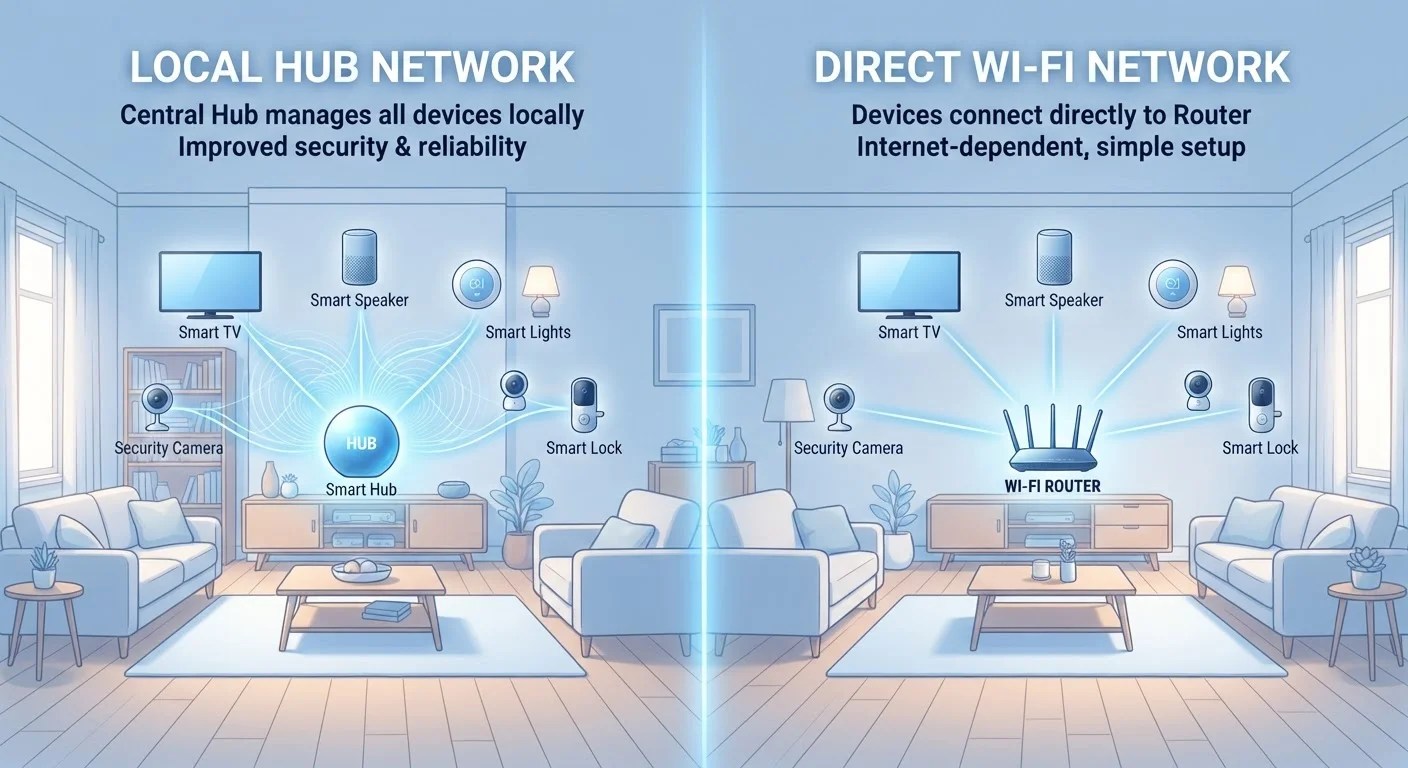
Option A
Hub-Based Smart Home
The centralized, protocol-flexible approach.
Best for: People building a larger, mixed-device setup who want local control and broad device compatibility.
Option B
Hub-Free Smart Home
The app-first, plug-and-play alternative.
Best for: First-timers or renters who want a simple, low-upfront-cost setup without extra hardware.
What a Hub Actually Does
A smart home hub is a dedicated piece of hardware that acts as a translator and command center for your devices. Its main job is to bridge different wireless protocols — for example, converting signals from Zigbee or Z-Wave devices into something your router and smartphone can understand. Without a hub, those non-Wi-Fi devices simply can't talk to your network at all.
If terms like Zigbee and Z-Wave are new to you, our guide on Wi-Fi, Zigbee, and Z-Wave protocols explains what each one means in plain language. The short version: Zigbee and Z-Wave are lower-power radio frequencies used by many sensors, locks, and bulbs — but they need a hub to connect to the internet.
In a hub-based setup, the hub also runs automations locally. That means if your internet goes down, your programmed routines — like lights turning on at sunset — can still execute. That's a meaningful reliability advantage that hub-free setups generally can't match.
| Criterion | Hub-Based | Hub-Free |
|---|---|---|
| Upfront hardware cost | Higher (hub purchase required) | Lower (no extra hardware) |
| Device protocol support | Wi-Fi, Zigbee, Z-Wave, Matter | Wi-Fi and Matter only |
| Works without internet | Often yes (local processing) | Rarely (cloud-dependent) |
| Setup complexity | Moderate — hub config needed | Low — app-based setup |
| Scalability | High — many devices supported | Limited by Wi-Fi congestion |
| Router load | Low (non-Wi-Fi devices bypass router) | High (every device on Wi-Fi) |
| Long-term reliability risk | Lower (local control option) | Higher (cloud service dependency) |
How Hub-Free Setups Work Instead
Hub-free smart homes skip the dedicated hardware entirely. Every device connects directly to your home's Wi-Fi network, and control happens through a manufacturer's app or a voice assistant platform. There's no extra box to configure, and setup is typically as simple as plugging in a device and following an app walkthrough.
The trade-off is dependency. Each device relies on the manufacturer's cloud servers to function — if the company shuts down an app or service, the device may stop working as advertised. This is a real pattern in the smart home industry, not a hypothetical. Our article on hidden ongoing smart home costs covers how cloud dependency can affect long-term value.
Wi-Fi congestion is another practical concern. A standard home router can handle dozens of connections, but each smart device occupies a slot. A large hub-free setup — say, 20 or more devices — can begin to strain an average router, leading to dropped connections and slow response times. The most common reasons smart home setups fail often trace back to exactly this issue.
Comparing the Two Approaches Side by Side
The differences between hub-based and hub-free setups are clearest when you look at specific factors: upfront cost, device compatibility, reliability, and long-term flexibility. Neither approach is universally better — the right fit depends on how many devices you plan to use, how much technical setup you're comfortable with, and whether you rent or own.
For a broader grounding in how these systems fit together, our plain-language smart home explainer is a useful starting point before committing to either path.
~25+
Devices before Wi-Fi congestion becomes a concern
Network engineers generally recommend keeping smart device counts below 25–30 on consumer-grade routers to maintain stable performance.
2–3×
More device types supported with a hub
Hub platforms that support Zigbee, Z-Wave, and Wi-Fi can access a significantly wider range of compatible devices than Wi-Fi-only ecosystems.
$50–$150
Typical upfront cost range for a dedicated smart home hub
Entry-level hub hardware varies widely; some open-source hub options run on low-cost single-board computers for less.
Which Setup Fits Your Situation
If you're starting with one or two devices — a smart bulb, a plug, a doorbell — a hub-free setup is the more practical entry point. The lower upfront cost and simpler configuration make sense when you're still figuring out what smart home tech actually does for you day-to-day. Renters especially benefit here: Wi-Fi devices require no wiring and move with you. See our guide on smart home devices for renters for realistic options without risking your deposit.
If you're planning a larger setup — or you want to use devices that don't run on Wi-Fi — investing in a hub early is worth considering. It gives you a more stable foundation and reduces long-term fragmentation across multiple apps. Budget-minded shoppers should also look at entry-level smart home devices to understand which affordable options integrate well across both hub and hub-free environments before making any purchases.
This article provides general educational information about smart home technology and does not constitute purchasing, financial, or technical advice tailored to your specific situation. Compatibility and functionality vary by device and platform — always verify before buying.
The content provided on our blog site traverses numerous categories, offering readers valuable and practical information. Readers can use the editorial team’s research and data to gain more insights into their topics of interest. However, they are requested not to treat the articles as conclusive. The website team cannot be held responsible for differences in data or inaccuracies found across other platforms. Please also note that the site might also miss out on various schemes and offers available that the readers may find more beneficial than the ones we cover.