

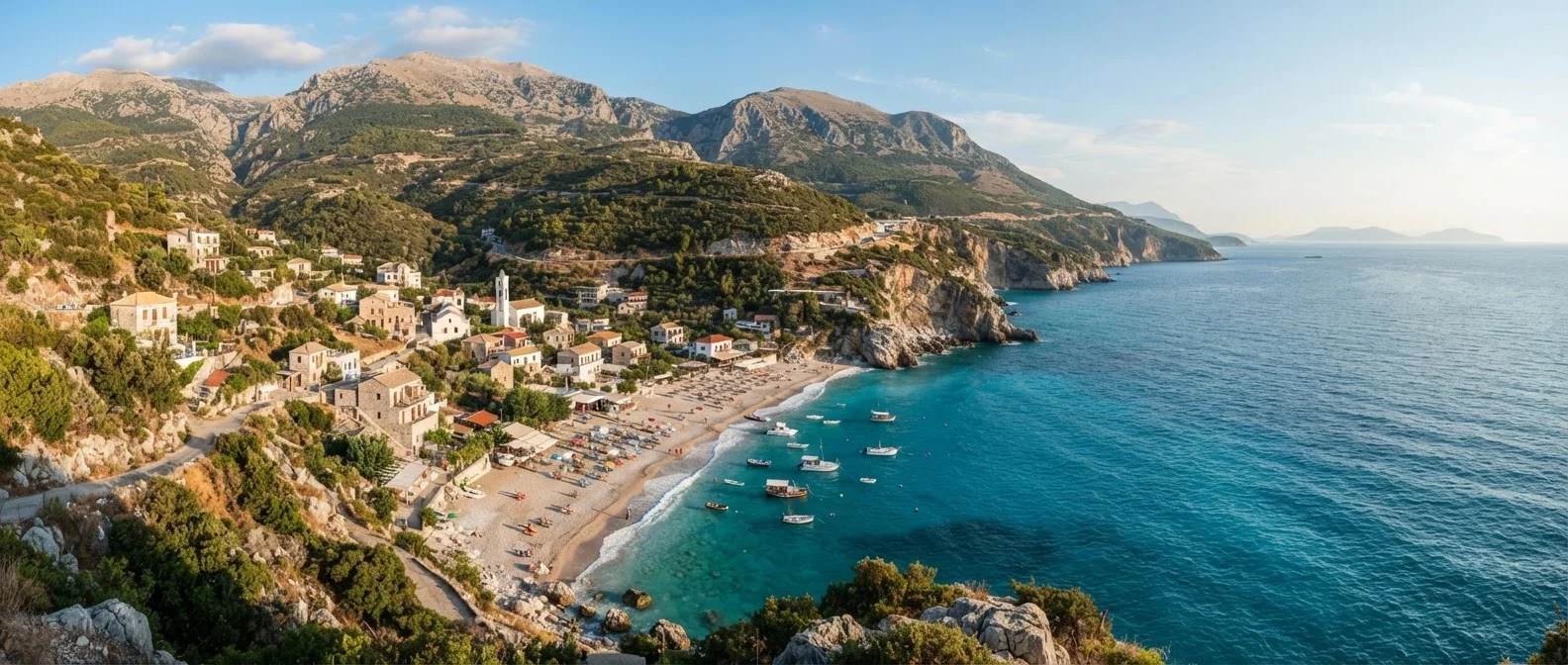
Why Albania Makes Sense on a Tight Budget
Albania sits on the Adriatic and Ionian coasts, sandwiched between Montenegro, North Macedonia, Greece, and Kosovo. It has the geography of a Mediterranean dream — mountain ranges, ancient ruins, Ottoman-era bazaars, and stretches of coastline — yet it remains one of Europe's least-visited countries. That combination of low tourist volume and a lower cost base means your dollars genuinely go further here than almost anywhere else on the continent.
For context: Albania's average income level remains significantly below the EU average, which keeps everyday prices — food, transport, accommodation — proportionally accessible for visitors. That's not a reason to undervalue the country or its people; it's a factual starting point for planning. If you've been comparing European itineraries and find how Eastern Europe stacks up against Southeast Asia useful, Albania sits at the very affordable end of the European spectrum.
~$35/day
Typical budget traveller daily spend
Based on commonly reported traveller estimates covering accommodation, food, and local transport in Albania.
2
UNESCO World Heritage Sites
Gjirokastër and Berat are both UNESCO-listed historic centres, accessible at very low entry cost.
362 km
Total Albanian coastline
Albania's Adriatic and Ionian coastline spans 362 km, much of it still underdeveloped by mass tourism standards.
What Things Actually Cost in Albania
Based on generally reported traveller experiences, a careful budget traveller can get by on roughly $30–$45 USD per day, covering a hostel dorm or guesthouse room, local meals, and public transport. Mid-range solo travellers spending on private rooms and occasional sit-down restaurants typically land in the $50–$70 range. These are general estimates — prices vary by season, location, and individual choices, and are subject to change.
- Accommodation: Hostel dorms in Tirana run roughly $12–$18/night; guesthouses in smaller towns can be even less.
- Food: A full meal at a local restaurant (byrek pastry, grilled meat, salad, beer) often costs $5–$10.
- Transport: Intercity furgons (shared minibuses) connect most towns for $2–$5 per leg.
- Entry fees: Most archaeological sites charge $2–$5 USD equivalent.
The Albanian lek (ALL) is the official currency. While some tourist businesses accept euros, using lek gives better value. ATMs are available in cities; carry cash when venturing into rural areas.
Where to Go: Key Destinations Without the Crowds
Tirana — The capital is a practical, lively base. The National History Museum, Bunk'Art bunker museums, and the Blloku neighbourhood give you a sharp orientation into Albanian history and contemporary culture. It's compact and walkable.
Gjirokastër — A UNESCO-listed Ottoman city built on a hillside, with a castle, cobblestone streets, and traditional tower houses. Accommodation here is characterful and affordable. It rewards slow exploration.
The Albanian Riviera — From Sarandë south to Himara, the Ionian coastline has clear water, relatively undeveloped coves, and beach towns that haven't yet priced out independent travellers. Reach them by furgon from Sarandë or rent a scooter and go at your own pace.
Valbona and the Accursed Mountains — The Valbona–Theth hiking trail through the Albanian Alps is one of the most dramatic day hikes in Europe. It requires basic fitness and proper footwear. Guesthouses in both villages are simple, filling, and very affordable.
Berat — Another UNESCO town, known for its hillside castle and Ottoman-era houses with large windows that give it the nickname "city of a thousand windows." A logical stop between Tirana and Gjirokastër.
Getting There and Getting Around
Tirana Nënë Tereza International Airport (TIA) is the main entry point. It receives flights from numerous European hubs; connections from the US typically involve a European stopover. Fares vary considerably by season — shoulder season (May–June, September–October) generally offers better availability and conditions without peak summer heat or prices.
Overland entry from North Macedonia, Montenegro, Kosovo, or Greece is also common and can be cheaper. Ferries from Bari or Ancona (Italy) arrive at the port of Durrës.
Inside Albania, furgons (shared minibuses) are the practical network. They're informal — no fixed online booking — but locals at bus stations will point you in the right direction. Taxis in cities should be negotiated in advance or use a metered ride-hailing app where available. Renting a car unlocks rural areas but requires comfort with mountain roads and variable road conditions.
Always confirm the departure point and rough departure time for furgons the evening before — they don't run on strict schedules and often leave when full, typically in the morning.
Missing a furgon in a small town can mean waiting hours for the next one, disrupting an entire day's plan with no good fallback.
Book the Valbona–Theth ferry across Lake Koman as early in the morning as possible, especially in July and August — capacity is limited and the scenery on that fjord-like lake is a highlight in itself.
The Lake Koman ferry is the standard access route to Valbona and operates on limited vessels; late arrivals can miss the single daily departure.
Practical Considerations Before You Go
Entry requirements: US citizens have historically been able to enter Albania visa-free for extended stays, but entry rules can change. Always verify current requirements with the official Albanian government and the US State Department before booking.
Safety: Albania is generally considered safe for travellers; petty crime exists as in any tourist area. The US State Department's travel advisory page is the authoritative source for current conditions.
Language: Albanian (Shqip) is the official language. English is spoken in tourist areas and by younger Albanians in cities, less so in rural villages. Learning a few basic phrases earns real goodwill.
Connectivity: SIM cards are cheap and widely available at the airport and phone shops. Coverage is good in cities and along the coast; more patchy in mountain areas.
Health and travel insurance: Travel insurance that covers medical evacuation is strongly recommended for any mountain hiking. Verify coverage details directly with your insurer before travelling — general information here is not a substitute for reading your actual policy.
Albania vs. Other Budget Destinations
Albania isn't the only overlooked country worth your attention. If you're weighing options, Georgia in the Caucasus offers similarly dramatic landscapes and deep history at comparable price points, though it requires a longer flight from most US departure cities. Our roundup of underrated countries where a $40-a-day budget goes far puts Albania in broader perspective.
The honest comparison: Albania's main advantages over better-known budget destinations are its coastal geography, fast-improving infrastructure, and the fact that mass tourism hasn't yet homogenised the experience. The trade-off is that some logistics — especially outside major routes — require more flexibility and tolerance for improvisation than, say, a well-trodden Southeast Asian backpacker trail.
One thing worth being deliberate about: when a destination's affordability is partly structural (lower local incomes), how you spend matters. Eating at local restaurants, staying in locally owned guesthouses, and buying from small vendors keeps value in the community. See how to travel cheaply without exploiting affordable destinations for a practical take on this.
This article is for general informational and educational purposes only. Prices, entry requirements, safety conditions, and travel advisories change frequently. Always verify visa, border, health, and safety information with official government sources and your travel insurance provider before making any travel decisions.
The content provided on our blog site traverses numerous categories, offering readers valuable and practical information. Readers can use the editorial team’s research and data to gain more insights into their topics of interest. However, they are requested not to treat the articles as conclusive. The website team cannot be held responsible for differences in data or inaccuracies found across other platforms. Please also note that the site might also miss out on various schemes and offers available that the readers may find more beneficial than the ones we cover.